AQA · GCSE · Chemistry
Course version: 8462 · Version from Sept 2018
Equal amounts in moles of gases occupy the same volume under the same…
Full specification wording
Use of amount of substance in relation to volumes of gases: Equal amounts in moles of gases occupy the same volume under the same conditions of temperature and pressure.
This statement is the molar volume principle.
Checked against the AQA 8462 specification (opens in a new tab) on .
- Point 1 of 3
Study notes
From the checked teaching notes for this specification point.
The idea
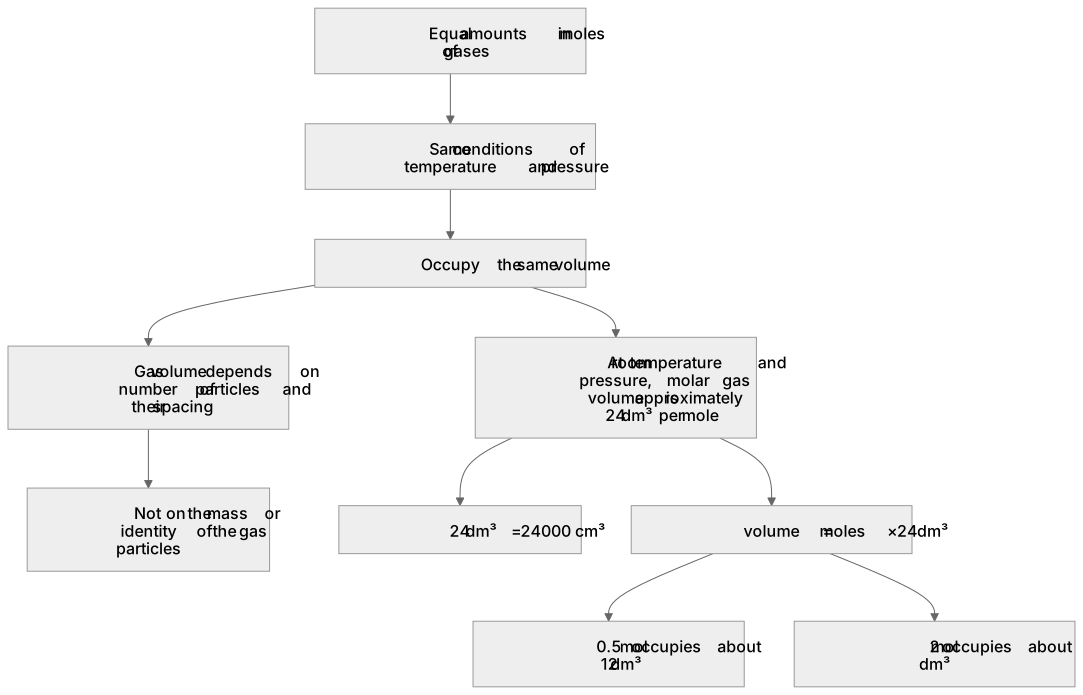
This statement is the molar volume principle. Under identical temperature and pressure, one mole of any gas fills the same volume, because gas volume depends on the number of particles and their spacing, not on particle mass or identity. At room temperature and pressure (about 20 °C and 1 atmosphere), that volume is approximately 24 dm³, so 24 dm³ equals 24 000 cm³. Consequently, equal moles give equal volumes: 0.5 mol of any gas occupies about 12 dm³, and 2 mol occupies about 48 dm³. The relationship is volume = moles × 24 dm³ when volume is in dm³ at r.t.p. This lets you compare reacting gas volumes directly from a balanced equation, because coefficients give mole ratios and therefore volume ratios for gases measured under the same conditions.
What earns the marks
- States that equal numbers of moles of any gas occupy equal volumes when temperature and pressure are the same.
- Recalls the molar gas volume at room temperature and pressure as approximately 24 dm³ per mole.
- Uses volume = moles × 24 dm³ to convert between amount in moles and gas volume at r.t.p.
- Explains that gas volume depends on number of particles and their spacing, not on the mass or identity of the gas particles.
- Applies the principle to compare volumes of different gases: equal moles give equal volumes under the same conditions.
Common mistakes and how to put them right
Thinking that equal masses of different gases occupy equal volumes.
Put it right by comparing moles, not grams, because equal moles occupy equal volumes.
Using 24 dm³ without checking that the gas is measured at room temperature and pressure.
Put it right by stating the condition and converting if a different temperature or pressure is given.
Mixing up dm³ and cm³.
Put it right by remembering 1 dm³ = 1000 cm³, so 24 dm³ = 24 000 cm³.
Exam tips
- Write the condition 'at room temperature and pressure' whenever you use the value 24 dm³, because the molar volume changes with temperature and pressure.
- Convert mass to moles first using moles = mass ÷ relative formula mass, then multiply by 24 dm³ to find the gas volume at r.t.p.
- For comparison questions, compare the number of moles of each gas rather than their masses, then state that equal moles occupy equal volumes under the same conditions.
Try the lesson
The start of the Use of amount of substance in relation to volumes of gases: Equal amounts in moles of gases occupy the same volume under the same conditions of temperature and pressure. lesson, made from checked teaching notes for this specification point.
Have a go first
Under the same conditions of temperature and pressure, which statement about gases is correct?
Listen
This statement is the molar volume principle. Under identical temperature and pressure, one mole of any gas fills the same volume, because gas volume depends on the number of particles and their spacing, not on particle mass or identity. At room temperature and pressure (about 20 °C and 1 atmosphere), that volume is approximately 24 dm³, so 24 dm³ equals 24 000 cm³. Consequently, equal moles give equal volumes: 0.5 mol of any gas occupies about 12 dm³, and 2 mol occupies about 48 dm³. The relationship is volume = moles × 24 dm³ when volume is in dm³ at r.t.p. This lets you compare reacting gas volumes directly from a balanced equation, because coefficients give mole ratios and therefore volume ratios for gases measured under the same conditions. A strong answer earns marks for these points. States that equal numbers of moles of any gas occupy equal volumes when temperature and pressure are the same. Recalls the molar gas volume at room temperature and pressure as approximately 24 dm³ per mole. Uses volume = moles × 24 dm³ to convert between amount in moles and gas volume at r.t.p. Explains that gas volume depends on number of particles and their spacing, not on the mass or identity of the gas particles. A common slip: Thinking that equal masses of different gases occupy equal volumes. Instead, comparing moles, not grams, because equal moles occupy equal volumes. Exam tip: Write the condition 'at room temperature and pressure' whenever you use the value 24 dm³, because the molar volume changes with temperature and pressure.
See it
Label the diagram
Some boxes have lost their names. Pick the right name for each number.
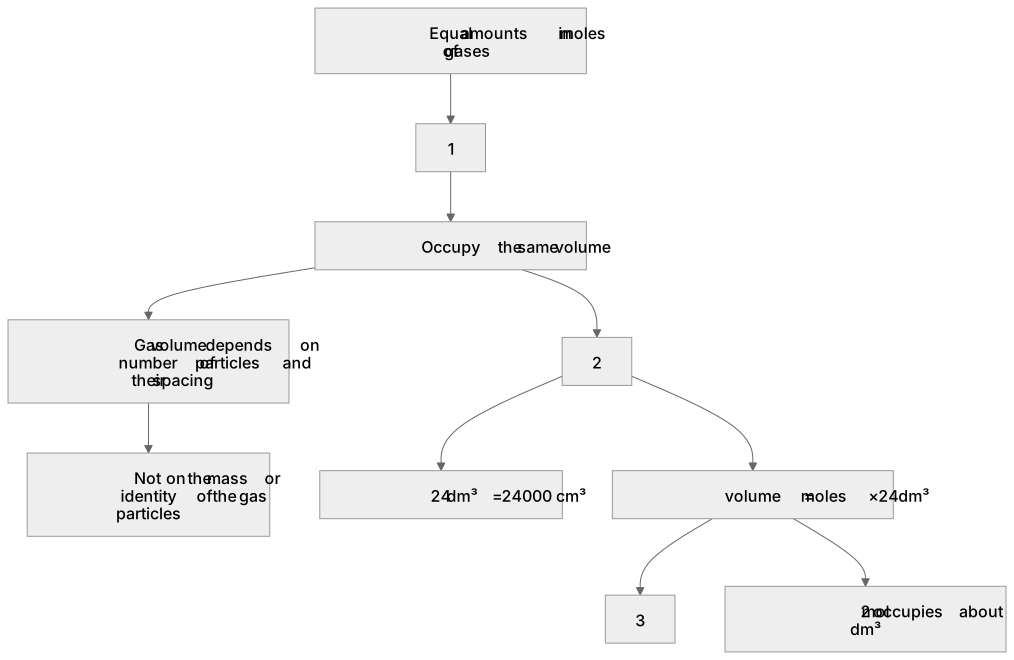
1Box 1
2Box 2
3Box 3
There is more to this lesson
The full lesson goes on to check your understanding and help you earn the marks. Create a free account to carry on, with your progress saved.
A week of Premium from your first lesson · Then the free plan continues · No card, no charge
Test your understanding of Use of amount of substance in relation to volumes of gases: Equal amounts in moles of gases occupy the same volume under the same conditions of temperature and pressure.
Active recall beats re-reading. Take an instant quiz now to test what you’ve learned and lock it into long-term memory.
A week of Premium from your first lesson · Then the free plan continues · No card, no charge