AQA · GCSE · Chemistry
Course version: 8462 · Version from Sept 2018
The balancing numbers in a symbol equation can be calculated from the…
Full specification wording
Using moles to balance equations (HT only): The balancing numbers in a symbol equation can be calculated from the masses of reactants and products by converting the masses in grams to amounts in moles and converting the numbers of moles to simple whole number ratios.
When masses of reactants and products are known but the equation is not balanced, the balancing numbers can be found from mole ratios.
Checked against the AQA 8462 specification (opens in a new tab) on .
- Point 1 of 3
- 4 key terms
Study notes
From the checked teaching notes for this specification point.
The idea
When masses of reactants and products are known but the equation is not balanced, the balancing numbers can be found from mole ratios. Convert each mass to moles using n = m ÷ Mr. Then divide every mole value by the smallest value to obtain the simplest ratio, and multiply if needed to remove fractions so all numbers are whole. For example, if 4.8 g Mg reacts with 3.2 g O₂ to form 8.0 g MgO: n(Mg) = 4.8 ÷ 24 = 0.2 mol, n(O₂) = 3.2 ÷ 32 = 0.1 mol, n(MgO) = 8.0 ÷ 40 = 0.2 mol. Dividing by 0.1 gives 2 : 1 : 2, so the equation is 2Mg + O₂ → 2MgO. The ratio must be simplified to the smallest whole numbers.
What earns the marks
- Convert each given mass to moles using the correct Mr for each substance.
- Divide all mole values by the smallest mole value to start simplifying the ratio.
- Multiply through if necessary to obtain the smallest whole-number ratio.
- Write the balanced symbol equation using those whole numbers as balancing numbers.
- Check that the final equation conserves atoms of each element and is consistent with the given masses.
Common mistakes and how to put them right
Using masses directly as balancing numbers.
Put it right by converting every mass to moles first.
Leaving the ratio as decimals or fractions.
Put it right by dividing by the smallest value and multiplying to reach whole numbers.
Using the wrong Mr for one substance.
Put it right by calculating each Mr from the formula before dividing.
Exam tips
- Lay out the calculation in a table of substance, mass, Mr and moles to avoid mixing values.
- After finding the ratio, substitute it back into the equation and count atoms to confirm balance.
- If a ratio gives 1.5, double all values rather than rounding, because rounding changes the chemistry.
Try the lesson
The start of the Using moles to balance equations (HT only): The balancing numbers in a symbol equation can be calculated from the masses of reactants and products by converting the masses in grams to amounts in moles and converting the numbers of moles to simple whole number ratios. lesson, made from checked teaching notes for this specification point.
Have a go first
In a reaction, 24 g of magnesium reacts completely with 16 g of oxygen to form magnesium oxide. Calculate the balancing numbers for the symbol equation by finding the simplest whole number molar ratio of Mg : O₂ : MgO. (Mr: Mg = 24, O₂ = 32, MgO = 40)
Listen
When masses of reactants and products are known but the equation is not balanced, the balancing numbers can be found from mole ratios. Convert each mass to moles using n = m ÷ Mr. Then divide every mole value by the smallest value to obtain the simplest ratio, and multiply if needed to remove fractions so all numbers are whole. For example, if 4.8 g Mg reacts with 3.2 g O₂ to form 8.0 g MgO: n(Mg) = 4.8 ÷ 24 = 0.2 mol, n(O₂) = 3.2 ÷ 32 = 0.1 mol, n(MgO) = 8.0 ÷ 40 = 0.2 mol. Dividing by 0.1 gives 2 : 1 : 2, so the equation is 2Mg + O₂ → 2MgO. The ratio must be simplified to the smallest whole numbers. A strong answer earns marks for these points. Convert each given mass to moles using the correct Mr for each substance. Divide all mole values by the smallest mole value to start simplifying the ratio. Multiply through if necessary to obtain the smallest whole-number ratio. Write the balanced symbol equation using those whole numbers as balancing numbers. A common slip: Using masses directly as balancing numbers. Instead, converting every mass to moles first. Exam tip: Lay out the calculation in a table of substance, mass, Mr and moles to avoid mixing values.
See it
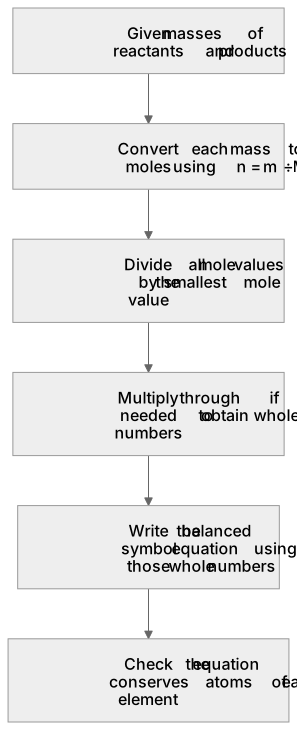
Put it in order
Put these steps in the order they happen.
- 1. Divide all mole values by the smallest mole value
- 2. Convert each mass to moles using n = m ÷ Mr
- 3. Given masses of reactants and products
- 4. Check the equation conserves atoms of each element
- 5. Write the balanced symbol equation using those whole numbers
- 6. Multiply through if needed to obtain whole numbers
Key words
Say what each word means before you turn the card.
Mole calculations from masses
Try answering aloud or in your head before turning the card.
Empirical ratios from moles
Try answering aloud or in your head before turning the card.
Whole-number ratios
Try answering aloud or in your head before turning the card.
Balancing symbol equations
Try answering aloud or in your head before turning the card.
See every definition
- Mole calculations from masses
- Converting the masses in grams to amounts in moles, using the correct Mr for each substance.
- Empirical ratios from moles
- Dividing all mole values by the smallest mole value to start simplifying the ratio.
- Whole-number ratios
- Multiplying through if necessary to obtain the smallest whole-number ratio, rather than leaving decimals or fractions.
- Balancing symbol equations
- Writing the balanced symbol equation using those whole numbers as balancing numbers.
Label the diagram
Some boxes have lost their names. Pick the right name for each number.
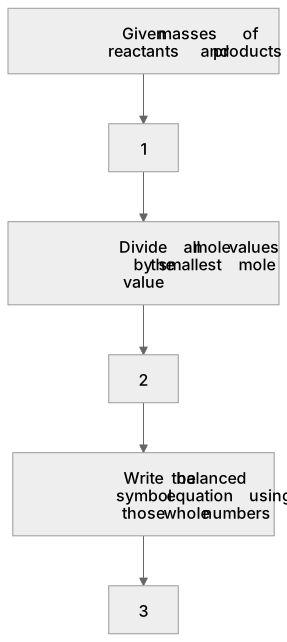
1Box 1
2Box 2
3Box 3
There is more to this lesson
The full lesson goes on to check your understanding and help you earn the marks. Create a free account to carry on, with your progress saved.
A week of Premium from your first lesson · Then the free plan continues · No card, no charge
Test your understanding of Using moles to balance equations (HT only): The balancing numbers in a symbol equation can be calculated from the masses of reactants and products by converting the masses in grams to amounts in moles and converting the numbers of moles to simple whole number ratios.
Active recall beats re-reading. Take an instant quiz now to test what you’ve learned and lock it into long-term memory.
A week of Premium from your first lesson · Then the free plan continues · No card, no charge