AQA · GCSE · Chemistry
Course version: 8462 · Version from Sept 2018
Sewage and agricultural waste water require removal of organic matter and…
Full specification wording
Waste water treatment: Sewage and agricultural waste water require removal of organic matter and harmful microbes.
Sewage from homes and agricultural waste water from farms contain organic matter and harmful microbes.
Checked against the AQA 8462 specification (opens in a new tab) on .
- Point 2 of 5
- 2 key terms
Study notes
From the checked teaching notes for this specification point.
The idea
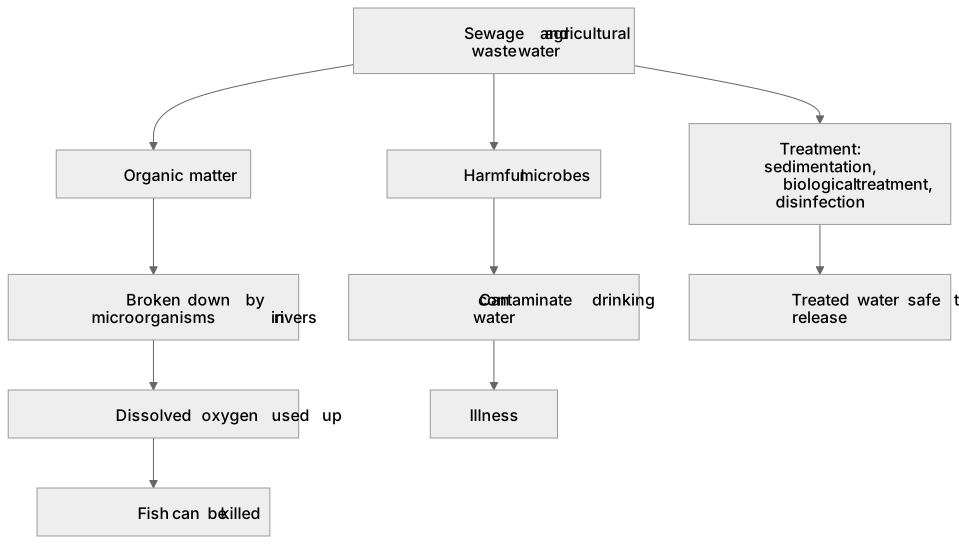
Sewage from homes and agricultural waste water from farms contain organic matter and harmful microbes. Organic matter includes food waste, faeces and plant material; harmful microbes include bacteria and viruses that can cause disease. If released untreated, organic matter is broken down by microorganisms in rivers, which uses up dissolved oxygen and can kill fish. Harmful microbes can contaminate drinking water and cause illness. Treatment therefore focuses on removing or breaking down organic matter and reducing harmful microbes. This can involve sedimentation, biological treatment using bacteria, and disinfection. The treated water is then safe to release, and the removed solids may be processed further.
What earns the marks
- State that sewage and agricultural waste water contain organic matter and harmful microbes.
- Explain that organic matter is broken down by microorganisms, which reduces dissolved oxygen in water and harms aquatic life.
- Explain that harmful microbes can cause disease and must be reduced before water is released.
- Describe treatment methods such as sedimentation, biological treatment and disinfection that remove organic matter and harmful microbes.
- Recognise that agricultural waste water may also contain nutrients or animal waste, which adds to the organic load.
Common mistakes and how to put them right
Thinking organic matter is always harmless.
Put it right: Its decomposition removes oxygen from water and damages ecosystems.
Confusing harmful microbes with all bacteria.
Put it right: Some bacteria are useful in treatment, while harmful microbes are the disease-causing ones that must be reduced.
Believing boiling is used to treat large volumes of waste water.
Put it right: Large-scale treatment uses sedimentation, biological processes and disinfection rather than boiling.
Exam tips
- Use the terms 'organic matter' and 'harmful microbes' explicitly in your answers to match the specification.
- Explain the consequence of not removing organic matter, such as oxygen depletion, to show deeper understanding.
- When describing treatment, link each stage to what it removes, for example 'biological treatment uses bacteria to break down organic matter'.
Try the lesson
The start of the Waste water treatment: Sewage and agricultural waste water require removal of organic matter and harmful microbes. lesson, made from checked teaching notes for this specification point.
Have a go first
Which two things must be removed from sewage and agricultural waste water during treatment?
Listen
Sewage from homes and agricultural waste water from farms contain organic matter and harmful microbes. Organic matter includes food waste, faeces and plant material; harmful microbes include bacteria and viruses that can cause disease. If released untreated, organic matter is broken down by microorganisms in rivers, which uses up dissolved oxygen and can kill fish. Harmful microbes can contaminate drinking water and cause illness. Treatment therefore focuses on removing or breaking down organic matter and reducing harmful microbes. This can involve sedimentation, biological treatment using bacteria, and disinfection. The treated water is then safe to release, and the removed solids may be processed further. A strong answer earns marks for these points. State that sewage and agricultural waste water contain organic matter and harmful microbes. Explain that organic matter is broken down by microorganisms, which reduces dissolved oxygen in water and harms aquatic life. Explain that harmful microbes can cause disease and must be reduced before water is released. Describe treatment methods such as sedimentation, biological treatment and disinfection that remove organic matter and harmful microbes. A common slip: Thinking organic matter is always harmless. Instead, its decomposition removes oxygen from water and damages ecosystems. Exam tip: Use the terms 'organic matter' and 'harmful microbes' explicitly in your answers to match the specification.
See it
Key words
Say what each word means before you turn the card.
Organic matter
Try answering aloud or in your head before turning the card.
Harmful microbes
Try answering aloud or in your head before turning the card.
See every definition
- Organic matter
- Material in sewage and agricultural waste water that includes food waste, faeces and plant material, and is broken down by microorganisms in rivers, using up dissolved oxygen.
- Harmful microbes
- Bacteria and viruses that can cause disease, can contaminate drinking water and cause illness, and must be reduced before water is released.
Label the diagram
Some boxes have lost their names. Pick the right name for each number.
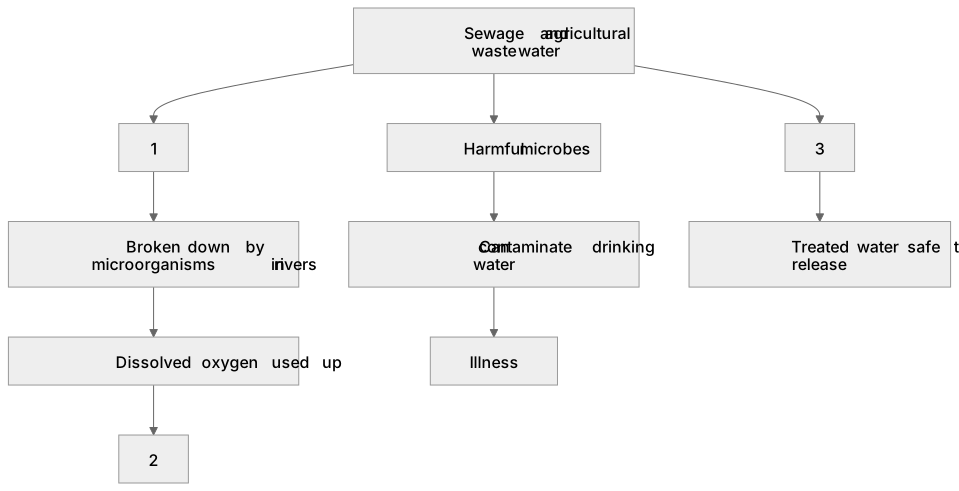
1Box 1
2Box 2
3Box 3
There is more to this lesson
The full lesson goes on to check your understanding and help you earn the marks. Create a free account to carry on, with your progress saved.
A week of Premium from your first lesson · Then the free plan continues · No card, no charge
Test your understanding of Waste water treatment: Sewage and agricultural waste water require removal of organic matter and harmful microbes.
Active recall beats re-reading. Take an instant quiz now to test what you’ve learned and lock it into long-term memory.
A week of Premium from your first lesson · Then the free plan continues · No card, no charge