AQA · GCSE · Chemistry
Course version: 8462 · Version from Sept 2018
Much of the energy for the processes comes from limited resources.
Full specification wording
Ways of reducing the use of resources: Much of the energy for the processes comes from limited resources.
Extracting raw materials and manufacturing products require large amounts of energy.
Checked against the AQA 8462 specification (opens in a new tab) on .
- Point 3 of 11
- 3 key terms
Study notes
From the checked teaching notes for this specification point.
The idea
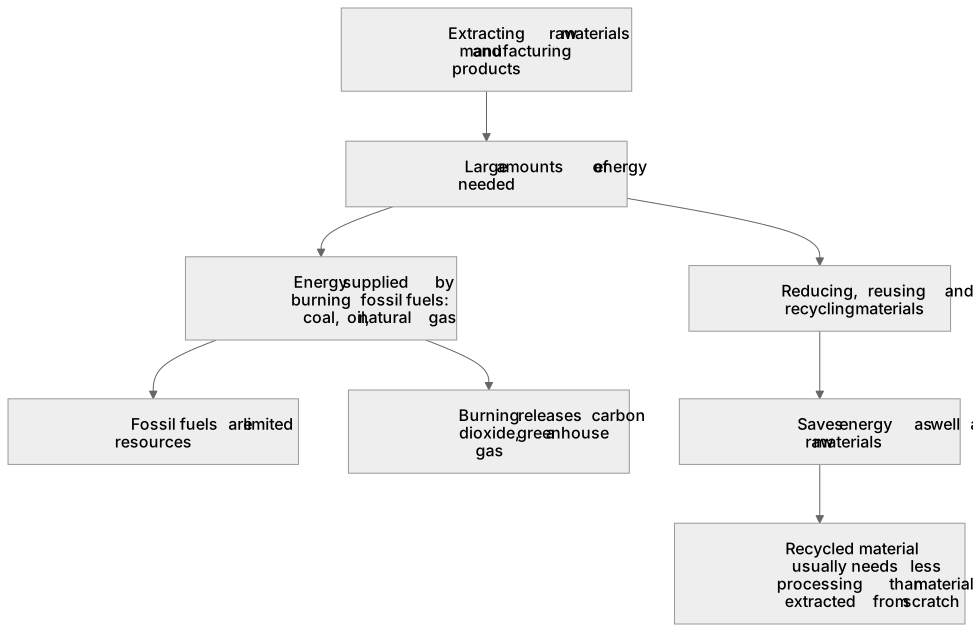
Extracting raw materials and manufacturing products require large amounts of energy. Mining and quarrying use fuel for machinery and transport, metal extraction by reduction with carbon or by electrolysis needs high temperatures or large electrical currents, glassmaking and firing clay ceramics need furnaces, and cracking and polymerising crude oil fractions need heat and pressure. Much of this energy is supplied by burning fossil fuels such as coal, oil and natural gas, which are limited resources that will eventually run out. Burning them also releases carbon dioxide, a greenhouse gas. Reducing, reusing and recycling materials therefore saves energy as well as raw materials, because recycled material usually needs less processing than material extracted from scratch.
What earns the marks
- Extraction and processing of raw materials require significant energy input.
- Much of that energy comes from burning fossil fuels such as coal, oil and natural gas.
- Fossil fuels are limited resources and are not replaced at a rate that matches consumption.
- Burning fossil fuels releases carbon dioxide, contributing to climate change.
- Recycling usually requires less energy than extracting and processing virgin raw materials.
- Reducing and reusing materials lower total energy demand across the product life cycle.
Common mistakes and how to put them right
Assuming all energy comes from renewable sources.
Put it right: Much industrial energy still comes from limited fossil fuels.
Thinking energy use is separate from resource use.
Put it right: The fuels supplying the energy are themselves limited resources.
Believing recycling uses no energy.
Put it right: Recycling still uses energy, but usually less than making the product from raw materials.
Exam tips
- Link energy use to a named process, such as electrolysis for aluminium extraction or firing for clay ceramics.
- Use the phrase limited resources when discussing fossil fuels, matching the specification wording.
- When comparing recycling with extraction, refer to the energy saved and the fossil fuel not burned.
Try the lesson
The start of the Ways of reducing the use of resources: Much of the energy for the processes comes from limited resources. lesson, made from checked teaching notes for this specification point.
Have a go first
Which of these energy sources used to power industrial processes is a limited resource?
Listen
Extracting raw materials and manufacturing products require large amounts of energy. Mining and quarrying use fuel for machinery and transport, metal extraction by reduction with carbon or by electrolysis needs high temperatures or large electrical currents, glassmaking and firing clay ceramics need furnaces, and cracking and polymerising crude oil fractions need heat and pressure. Much of this energy is supplied by burning fossil fuels such as coal, oil and natural gas, which are limited resources that will eventually run out. Burning them also releases carbon dioxide, a greenhouse gas. Reducing, reusing and recycling materials therefore saves energy as well as raw materials, because recycled material usually needs less processing than material extracted from scratch. A strong answer earns marks for these points. Extraction and processing of raw materials require significant energy input. Much of that energy comes from burning fossil fuels such as coal, oil and natural gas. Fossil fuels are limited resources and are not replaced at a rate that matches consumption. Burning fossil fuels releases carbon dioxide, contributing to climate change. A common slip: Assuming all energy comes from renewable sources. Instead, much industrial energy still comes from limited fossil fuels. Exam tip: Link energy use to a named process, such as electrolysis for aluminium extraction or firing for clay ceramics.
See it
Key words
Say what each word means before you turn the card.
Fossil fuels
Try answering aloud or in your head before turning the card.
Limited resources
Try answering aloud or in your head before turning the card.
Carbon dioxide
Try answering aloud or in your head before turning the card.
See every definition
- Fossil fuels
- Coal, oil and natural gas, which are limited resources that will eventually run out and whose burning releases carbon dioxide, a greenhouse gas.
- Limited resources
- Resources that will eventually run out, such as the fossil fuels supplying much of the energy for extracting raw materials and manufacturing products.
- Carbon dioxide
- A greenhouse gas released by burning fossil fuels such as coal, oil and natural gas.
Label the diagram
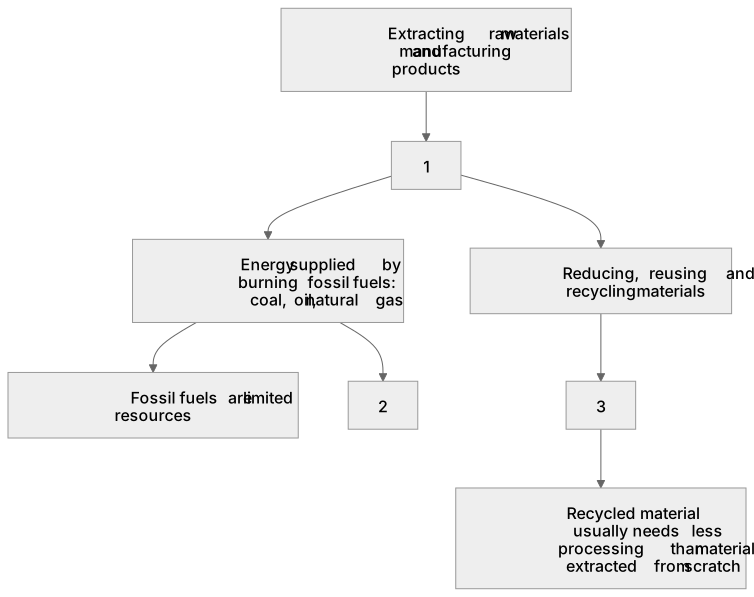
Some boxes have lost their names. Pick the right name for each number.
1Box 1
2Box 2
3Box 3
There is more to this lesson
The full lesson goes on to check your understanding and help you earn the marks. Create a free account to carry on, with your progress saved.
A week of Premium from your first lesson · Then the free plan continues · No card, no charge
Test your understanding of Ways of reducing the use of resources: Much of the energy for the processes comes from limited resources.
Active recall beats re-reading. Take an instant quiz now to test what you’ve learned and lock it into long-term memory.
A week of Premium from your first lesson · Then the free plan continues · No card, no charge