AQA · GCSE · Chemistry
Course version: 8462 · Version from Sept 2018
Metals, glass, building materials, clay ceramics and most plastics are…
Full specification wording
Ways of reducing the use of resources: Metals, glass, building materials, clay ceramics and most plastics are produced from limited raw materials.
Many everyday materials begin as raw materials extracted from the Earth's crust, and these reserves are finite.
Checked against the AQA 8462 specification (opens in a new tab) on .
- Point 2 of 11
- 4 key terms
Study notes
From the checked teaching notes for this specification point.
The idea
Many everyday materials begin as raw materials extracted from the Earth's crust, and these reserves are finite. Metals are extracted from ores, which are rocks containing enough of a metal compound to be worth mining; for example, iron is extracted from iron ore and aluminium from bauxite. Glass is made by melting sand, which is mostly silicon dioxide, with sodium carbonate and limestone. Building materials such as limestone, sandstone and slate are quarried directly, and clay ceramics such as bricks, tiles and pottery are made by shaping and firing clay. Most plastics are produced from crude oil, a fossil fuel, through fractional distillation and cracking to give monomers that are then polymerised. Because all of these raw materials are limited, continued production at current rates will eventually deplete them.
What earns the marks
- Metals are extracted from ores found in the Earth's crust, and high-grade ores are a limited resource.
- Glass is produced by melting sand, mainly silicon dioxide, together with sodium carbonate and limestone.
- Building materials such as limestone, sandstone and slate are obtained by quarrying rock.
- Clay ceramics, including bricks, tiles and pottery, are made by shaping and heating clay.
- Most plastics are made from crude oil, a fossil fuel, via fractional distillation, cracking and polymerisation.
- All of these raw materials are finite, so their continued use raises concerns about future supply.
Common mistakes and how to put them right
Saying metals are found as pure elements in the ground.
Put it right: Most metals occur as compounds in ores and must be extracted chemically.
Confusing glass with a plastic or a ceramic.
Put it right: Glass is made by melting sand with sodium carbonate and limestone, whereas clay ceramics are shaped and fired.
Stating that plastics come from plants.
Put it right: Most plastics are produced from crude oil, although some bioplastics exist.
Exam tips
- Name the raw material and the product for each material type, for example sand for glass or crude oil for most plastics.
- Use the term finite or limited when describing reserves, because the specification stresses that these raw materials are limited.
- If asked why a material is described as limited, refer to the rate of formation being far slower than the rate of use.
Try the lesson
The start of the Ways of reducing the use of resources: Metals, glass, building materials, clay ceramics and most plastics are produced from limited raw materials. lesson, made from checked teaching notes for this specification point.
Have a go first
Which raw material is used to produce glass?
Listen
Many everyday materials begin as raw materials extracted from the Earth's crust, and these reserves are finite. Metals are extracted from ores, which are rocks containing enough of a metal compound to be worth mining; for example, iron is extracted from iron ore and aluminium from bauxite. Glass is made by melting sand, which is mostly silicon dioxide, with sodium carbonate and limestone. Building materials such as limestone, sandstone and slate are quarried directly, and clay ceramics such as bricks, tiles and pottery are made by shaping and firing clay. Most plastics are produced from crude oil, a fossil fuel, through fractional distillation and cracking to give monomers that are then polymerised. Because all of these raw materials are limited, continued production at current rates will eventually deplete them. A strong answer earns marks for these points. Metals are extracted from ores found in the Earth's crust, and high-grade ores are a limited resource. Glass is produced by melting sand, mainly silicon dioxide, together with sodium carbonate and limestone. Building materials such as limestone, sandstone and slate are obtained by quarrying rock. Clay ceramics, including bricks, tiles and pottery, are made by shaping and heating clay. A common slip: Saying metals are found as pure elements in the ground. Instead, most metals occur as compounds in ores and must be extracted chemically. Exam tip: Name the raw material and the product for each material type, for example sand for glass or crude oil for most plastics.
See it

Key words
Say what each word means before you turn the card.
Earth's finite raw materials
Try answering aloud or in your head before turning the card.
Extraction of metals from ores
Try answering aloud or in your head before turning the card.
Manufacture of glass, building materials and clay ceramics
Try answering aloud or in your head before turning the card.
Crude oil as the feedstock for most plastics
Try answering aloud or in your head before turning the card.
See every definition
- Earth's finite raw materials
- Metals, glass, building materials, clay ceramics and most plastics are produced from limited raw materials, so continued production at current rates will eventually deplete them.
- Extraction of metals from ores
- Metals are extracted from ores, which are rocks containing enough of a metal compound to be worth mining.
- Manufacture of glass, building materials and clay ceramics
- Glass is made by melting sand with sodium carbonate and limestone, building materials are quarried directly, and clay ceramics are made by shaping and firing clay.
- Crude oil as the feedstock for most plastics
- Most plastics are produced from crude oil, a fossil fuel, through fractional distillation and cracking to give monomers that are then polymerised.
Label the diagram
Some boxes have lost their names. Pick the right name for each number.
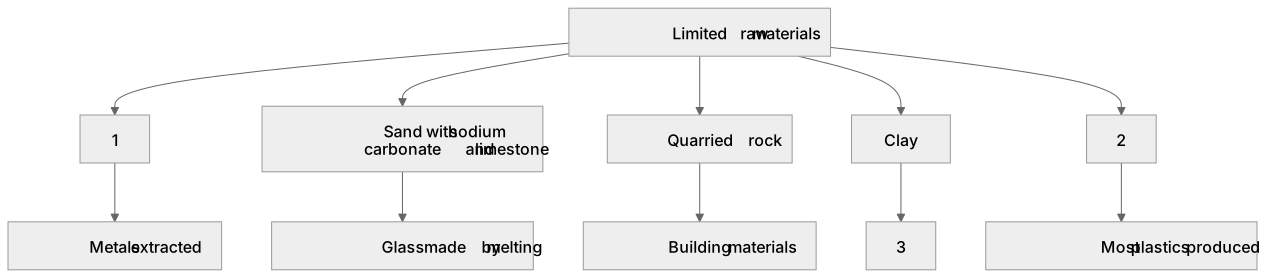
1Box 1
2Box 2
3Box 3
There is more to this lesson
The full lesson goes on to check your understanding and help you earn the marks. Create a free account to carry on, with your progress saved.
A week of Premium from your first lesson · Then the free plan continues · No card, no charge
Test your understanding of Ways of reducing the use of resources: Metals, glass, building materials, clay ceramics and most plastics are produced from limited raw materials.
Active recall beats re-reading. Take an instant quiz now to test what you’ve learned and lock it into long-term memory.
A week of Premium from your first lesson · Then the free plan continues · No card, no charge