AQA · GCSE · Chemistry
Course version: 8462 · Version from Sept 2018
Other products cannot be reused and so are recycled for a different use.
Full specification wording
Ways of reducing the use of resources: Other products cannot be reused and so are recycled for a different use.
Not every product can be used again in its original form.
Checked against the AQA 8462 specification (opens in a new tab) on .
- Point 7 of 11
- 4 key terms
Study notes
From the checked teaching notes for this specification point.
The idea
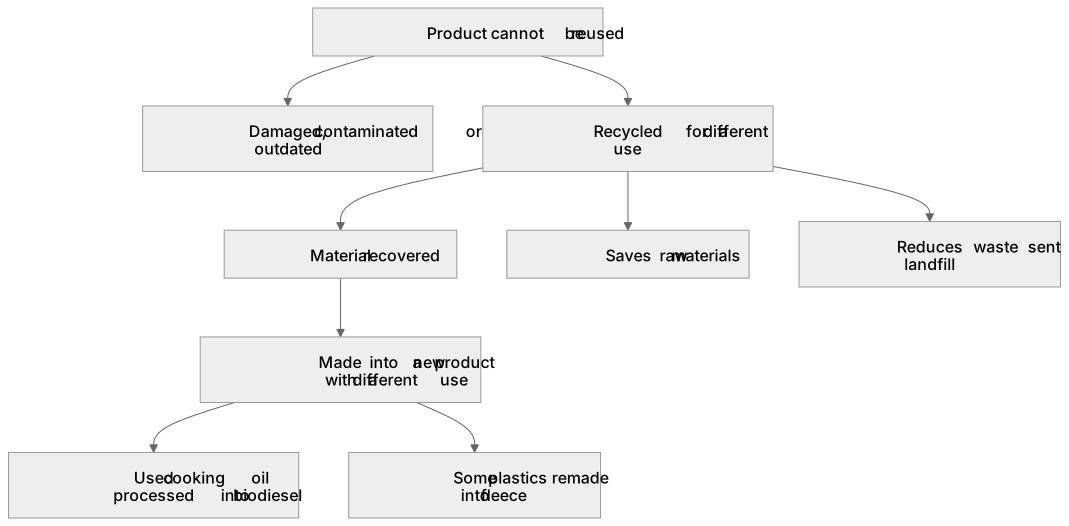
Not every product can be used again in its original form. Some items become damaged, contaminated or outdated, so reuse is not practical. These products are instead recycled, meaning the material is recovered and made into something different. For example, used cooking oil can be processed into biodiesel, and some plastics can be melted and remoulded into fleece fabric or garden furniture. Recycling for a different use still saves raw materials and reduces waste, even though the original product is not used again. The key idea is that the material is not discarded; it is reprocessed into a new product with a different purpose. This is sometimes called downcycling when the new product is of lower quality, but the general principle is the same: recover the material and use it again.
What earns the marks
- Some products cannot be reused because they are damaged, contaminated or no longer suitable for their original purpose.
- Recycling means recovering the material and making it into a new product.
- The new product may have a different use from the original product.
- Examples include used cooking oil being processed into biodiesel and some plastics being remade into fleece.
- Recycling for a different use still reduces the demand for raw materials.
- Recycling for a different use still reduces the amount of waste sent to landfill.
Common mistakes and how to put them right
Assuming all products can be reused.
Put it right: Some products are damaged or contaminated and must be recycled instead.
Thinking recycled material must become the same product.
Put it right: It can be made into a different product with a different use.
Believing recycling for a different use has no environmental benefit.
Put it right: It still saves raw materials and reduces waste.
Exam tips
- Use the phrase 'different use' to match the statement precisely.
- Give a named example, such as cooking oil to biodiesel, to support your answer.
- Explain why reuse is not possible before describing recycling.
- Link the answer to saving raw materials and reducing landfill.
Try the lesson
The start of the Ways of reducing the use of resources: Other products cannot be reused and so are recycled for a different use. lesson, made from checked teaching notes for this specification point.
Have a go first
Plastic bottles can be melted down and spun into fibres to make fleece clothing. Which statement best describes this process?
Listen
Not every product can be used again in its original form. Some items become damaged, contaminated or outdated, so reuse is not practical. These products are instead recycled, meaning the material is recovered and made into something different. For example, used cooking oil can be processed into biodiesel, and some plastics can be melted and remoulded into fleece fabric or garden furniture. Recycling for a different use still saves raw materials and reduces waste, even though the original product is not used again. The key idea is that the material is not discarded; it is reprocessed into a new product with a different purpose. This is sometimes called downcycling when the new product is of lower quality, but the general principle is the same: recover the material and use it again. A strong answer earns marks for these points. Some products cannot be reused because they are damaged, contaminated or no longer suitable for their original purpose. Recycling means recovering the material and making it into a new product. The new product may have a different use from the original product. Examples include used cooking oil being processed into biodiesel and some plastics being remade into fleece. A common slip: Assuming all products can be reused. Instead, some products are damaged or contaminated and must be recycled instead. Exam tip: Use the phrase 'different use' to match the statement precisely.
See it
Key words
Say what each word means before you turn the card.
Recycling
Try answering aloud or in your head before turning the card.
Reuse
Try answering aloud or in your head before turning the card.
Raw materials
Try answering aloud or in your head before turning the card.
Landfill
Try answering aloud or in your head before turning the card.
See every definition
- Recycling
- Recovering the material and making it into a new product, which may have a different use from the original product.
- Reuse
- Using a product again in its original form, which is not practical for items that become damaged, contaminated or outdated.
- Raw materials
- Resources whose demand is reduced when material is recovered and reprocessed into a new product rather than discarded.
- Landfill
- Where waste is sent, and whose amount is reduced when material is recovered and used again.
Label the diagram
Some boxes have lost their names. Pick the right name for each number.
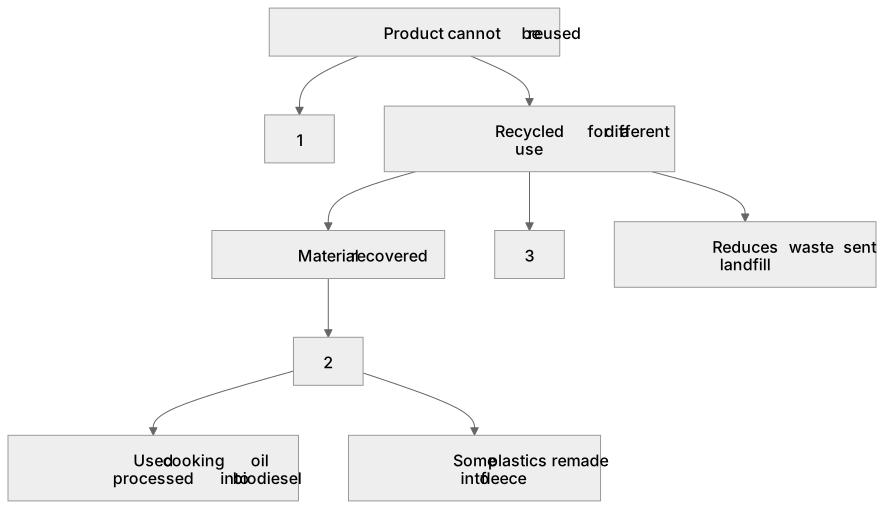
1Box 1
2Box 2
3Box 3
There is more to this lesson
The full lesson goes on to check your understanding and help you earn the marks. Create a free account to carry on, with your progress saved.
A week of Premium from your first lesson · Then the free plan continues · No card, no charge
Test your understanding of Ways of reducing the use of resources: Other products cannot be reused and so are recycled for a different use.
Active recall beats re-reading. Take an instant quiz now to test what you’ve learned and lock it into long-term memory.
A week of Premium from your first lesson · Then the free plan continues · No card, no charge