Pearson Edexcel · A-Level · Chemistry
Topic 1: Atomic Structure and the Periodic Table
Master the essential rules of oxidation numbers and unlock the secrets of redox reactions. This topic is a massive mark-winner in exams, giving you the algebraic tools to track electron transfer, balance complex half-equations, and spot tricky disproportionation reactions.
- 6 min read
- 3 worked examples
- 5 practice questions
- 6 key terms
Study Notes
Overview
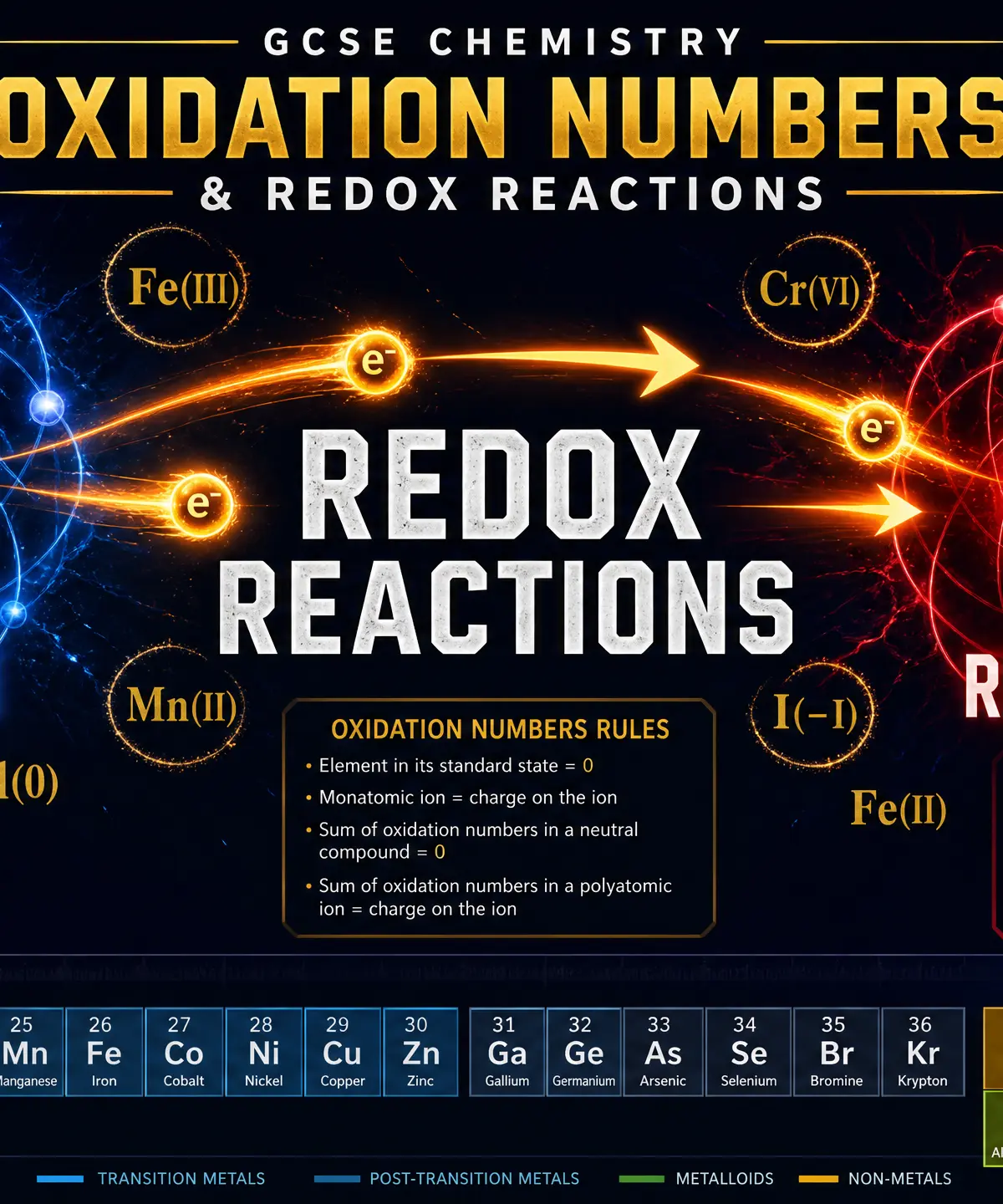
Welcome to one of the most powerful and satisfying topics in GCSE Chemistry: Oxidation Numbers and Redox Reactions. At its core, chemistry is all about the movement of electrons. Redox reactions are simply reactions where electrons are transferred from one species to another.
To keep track of these invisible moving electrons, chemists use a brilliant bookkeeping system called oxidation numbers (or oxidation states). Think of an oxidation number as a scoreboard for every atom in a compound, telling us exactly how many electrons it has effectively gained or lost compared to its neutral, uncombined state.
This topic is crucial because it forms the foundation for understanding electrolysis, transition metals, and chemical cells. In your exams, you will frequently be asked to calculate oxidation numbers, identify oxidising and reducing agents, and balance complex ionic half-equations. Mastering these rules will turn confusing redox questions into reliable, straightforward marks.
Listen to our 10-minute audio guide to master the core concepts:

Key Concepts
Concept 1: The Rules of Oxidation Numbers
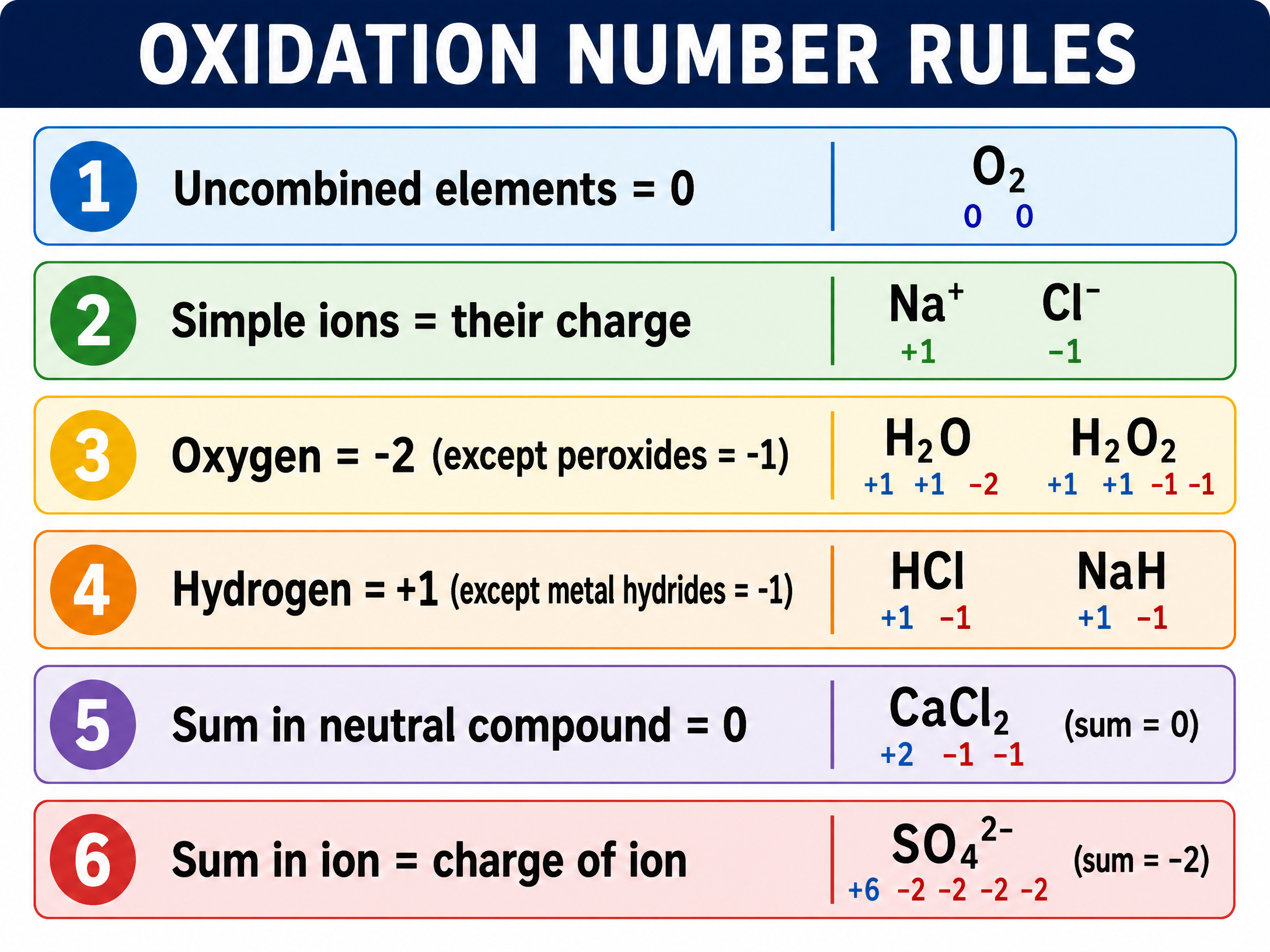
To use our electron scoreboard, we need to know the rules of the game. There are six essential rules for assigning oxidation numbers. You must memorise these, as they are the key to unlocking every calculation in this topic.
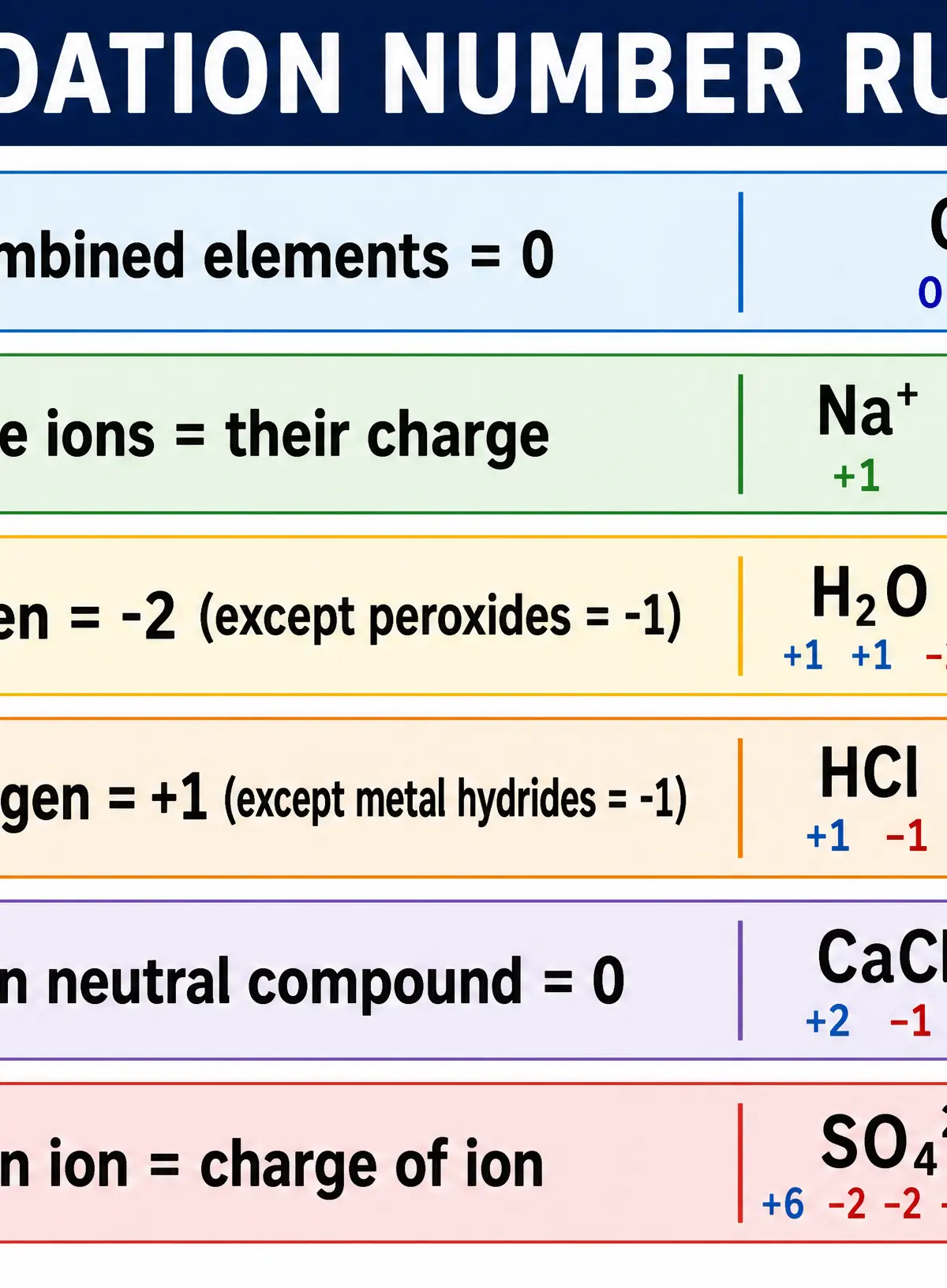
- Uncombined elements have an oxidation number of 0. Whether it is solid sodium (Na), oxygen gas (O₂), or sulfur (S₈), if an element is not combined with a different element, its oxidation number is zero. It hasn't gained or lost any electrons yet.
- Simple, monatomic ions have an oxidation number equal to their charge. For example, the sodium ion (Na⁺) has an oxidation number of +1, and the chloride ion (Cl⁻) has an oxidation number of -1.
- Oxygen is almost always -2. The major exception you need to know for exams is in peroxides (like hydrogen peroxide, H₂O₂), where oxygen is -1.
- Hydrogen is almost always +1. The exception here is in metal hydrides (like sodium hydride, NaH), where hydrogen is -1 because the metal is more electropositive.
- The sum of oxidation numbers in a neutral compound is 0. This is your checking rule. In H₂O, two hydrogens (+1 each) and one oxygen (-2) add up perfectly to zero: (2 × +1) + (-2) = 0.
- The sum of oxidation numbers in a polyatomic ion equals the charge of the ion. In the sulfate ion (SO₄²⁻), the sum of the oxidation number of sulfur and four oxygens must equal -2.
Example: Calculate the oxidation number of sulfur in sulfuric acid (H₂SO₄).
- Hydrogen = +1 (× 2 = +2)
- Oxygen = -2 (× 4 = -8)
- Sum must be 0 for a neutral compound.
- (+2) + S + (-8) = 0
- S - 6 = 0
- S = +6. We write this as S(VI) using Roman numerals.
Concept 2: Defining Oxidation and Reduction
Once we can calculate oxidation numbers, we can define oxidation and reduction in two distinct ways: by electron transfer, and by changes in oxidation number.
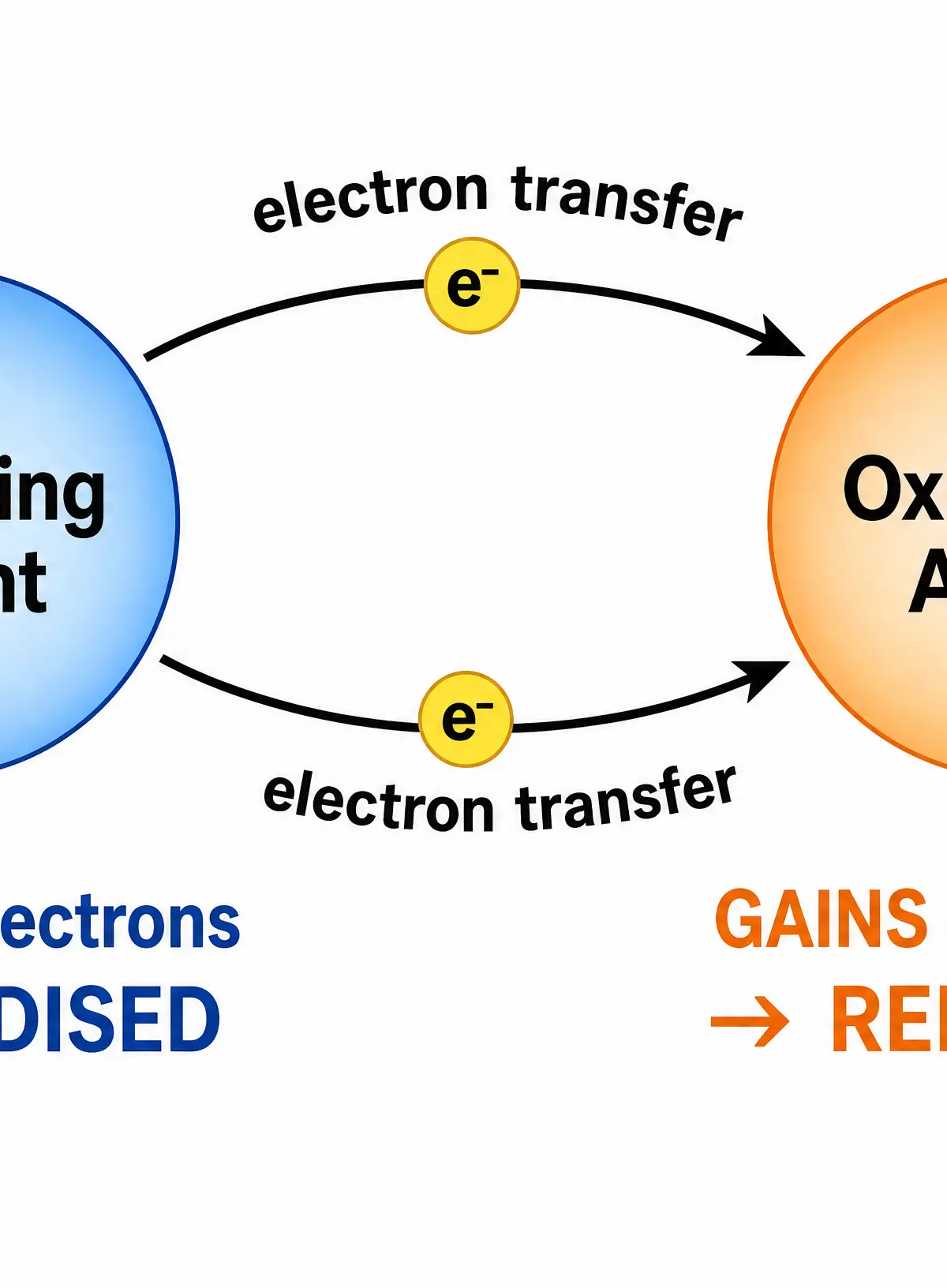
- Oxidation is the loss of electrons. Because electrons are negatively charged, losing them makes a species more positive. Therefore, oxidation is an increase in oxidation number.
- Reduction is the gain of electrons. Gaining negative electrons makes a species more negative. Therefore, reduction is a decrease in oxidation number.
Examiners will often ask you to justify why a species has been oxidised or reduced. You must state the specific change in oxidation number to get the mark (e.g., 'Iron is oxidised because its oxidation number increases from +2 to +3').
Concept 3: Oxidising and Reducing Agents
This concept frequently trips candidates up, but it makes perfect logical sense if you break it down.
- An oxidising agent is a substance that causes oxidation in another species. To do this, it must take electrons away from that species. By taking (gaining) electrons, the oxidising agent itself is reduced.
- A reducing agent is a substance that causes reduction in another species. To do this, it must give electrons to that species. By giving (losing) electrons, the reducing agent itself is oxidised.
Always remember: agents do the opposite to themselves of what they do to others.
Concept 4: Disproportionation
Disproportionation is a special type of redox reaction where the same element is simultaneously oxidised and reduced in the same reaction.
A classic example is the reaction of chlorine gas with cold, dilute sodium hydroxide:
Cl₂ + 2NaOH → NaCl + NaClO + H₂O
Let's track the chlorine:
- Reactant: Cl₂ is an uncombined element, so its oxidation number is 0.
- Product 1: In NaCl, the chloride ion is -1. The oxidation number has decreased from 0 to -1. This is reduction.
- Product 2: In NaClO (sodium chlorate(I)), oxygen is -2 and sodium is +1. For the compound to be neutral, chlorine must be +1. The oxidation number has increased from 0 to +1. This is oxidation.
Because chlorine has been both oxidised (0 to +1) and reduced (0 to -1), this is a disproportionation reaction.
Mathematical/Scientific Relationships
Balancing Ionic Half-EquationsHalf-equations show what happens to just one species in a redox reaction, including the electrons. Examiners expect you to construct and balance these from scratch, particularly in acidic conditions. Follow this strict sequence:
- Balance the main atoms (the species being oxidised/reduced).
- Balance oxygen by adding H₂O molecules to the opposite side.
- Balance hydrogen by adding H⁺ ions to the opposite side.
- Balance the total charge by adding electrons (e⁻) to the more positive side.
Practical Applications
Redox chemistry is the driving force behind the modern world. Every time you use a battery in your phone or laptop, a controlled redox reaction is occurring, forcing electrons to flow through a circuit to do useful work. The extraction of metals from their ores — such as reducing iron(III) oxide with carbon monoxide in a blast furnace — relies entirely on these principles.
Visual Resources
2 diagrams and illustrations
Interactive Diagrams
2 interactive diagrams to visualise key concepts
Conceptual Flow Outline
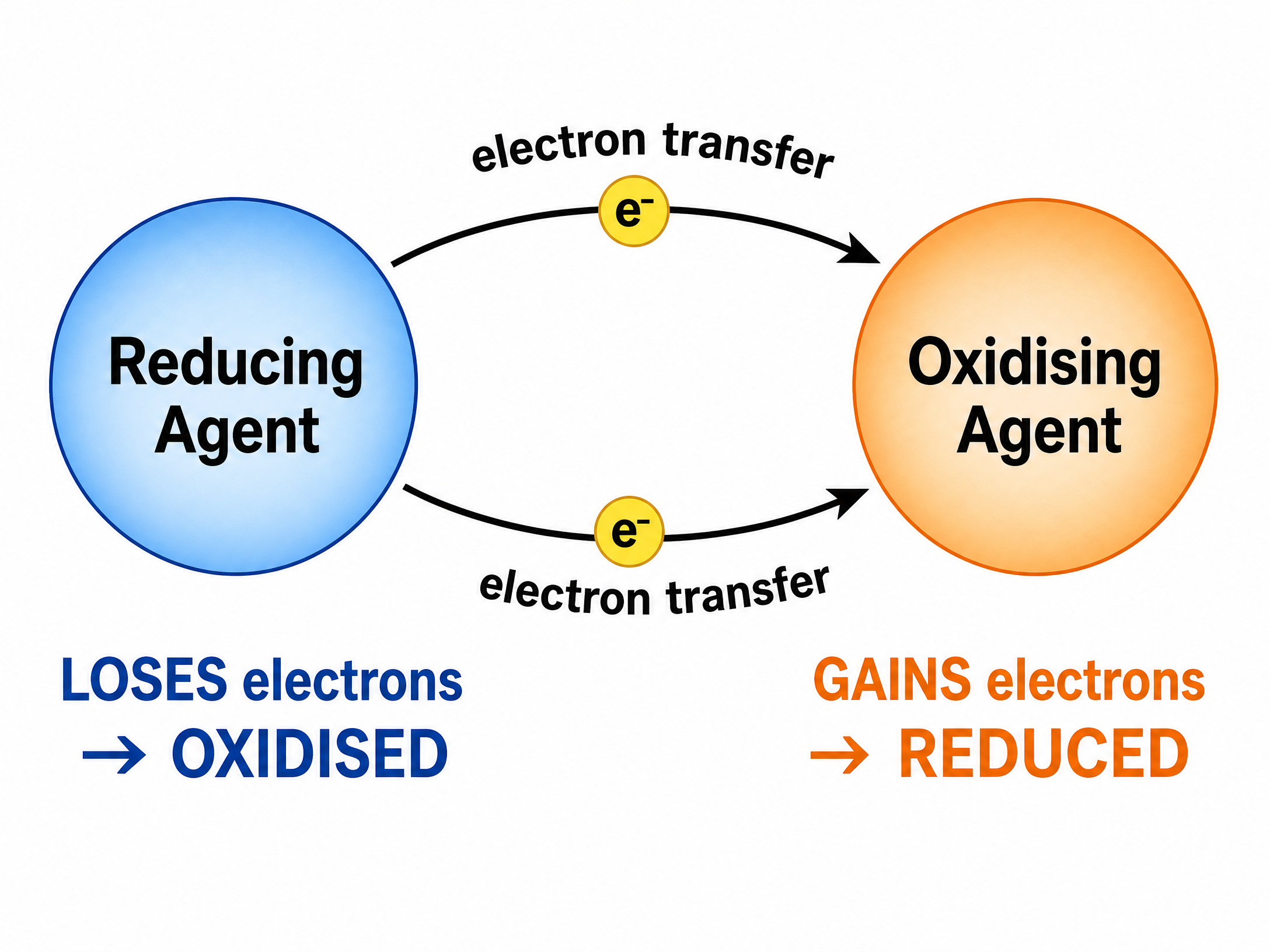
The relationship between oxidation, reduction, electron transfer, and agents.
Conceptual Flow Outline
Step-by-step process for balancing complex ionic half-equations in acidic conditions.
Worked Examples
3 worked examples — open one to explore the question and available guidance.
Practice Questions
Test your understanding — click to reveal model answers
What is the oxidation number of nitrogen in the nitrate(V) ion, NO₃⁻? (1 mark)
Hint: Remember the rule for oxygen, and the rule for polyatomic ions.
Identify the oxidising agent in the following reaction and explain your choice in terms of electron transfer: 2Fe³⁺ + 2I⁻ → 2Fe²⁺ + I₂ (2 marks)
Hint: Which species is gaining electrons and causing the other to lose them?
Hydrogen peroxide (H₂O₂) decomposes into water and oxygen gas. 2H₂O₂ → 2H₂O + O₂. Use oxidation numbers to prove this is a disproportionation reaction. (3 marks)
Hint: Calculate the oxidation number of oxygen in the reactant and in both products.
Write a balanced ionic half-equation for the oxidation of iodide ions (I⁻) to iodine (I₂). (1 mark)
Hint: Balance the iodine atoms first, then balance the charge.
A student states that in the compound sodium hydride (NaH), the oxidation number of hydrogen is +1. Evaluate this statement. (2 marks)
Hint: Think about the rules for hydrogen and its exceptions.