Pearson Edexcel · A-Level · Chemistry
Topic 2: Bonding and Structure
Master the core principles of oxidation numbers and redox reactions. This essential guide breaks down electron transfer, half-equation balancing, and disproportionation to help you secure top marks in your GCSE Chemistry exams.
- 5 min read
- 3 worked examples
- 5 practice questions
- 6 key terms
Study Notes
Overview
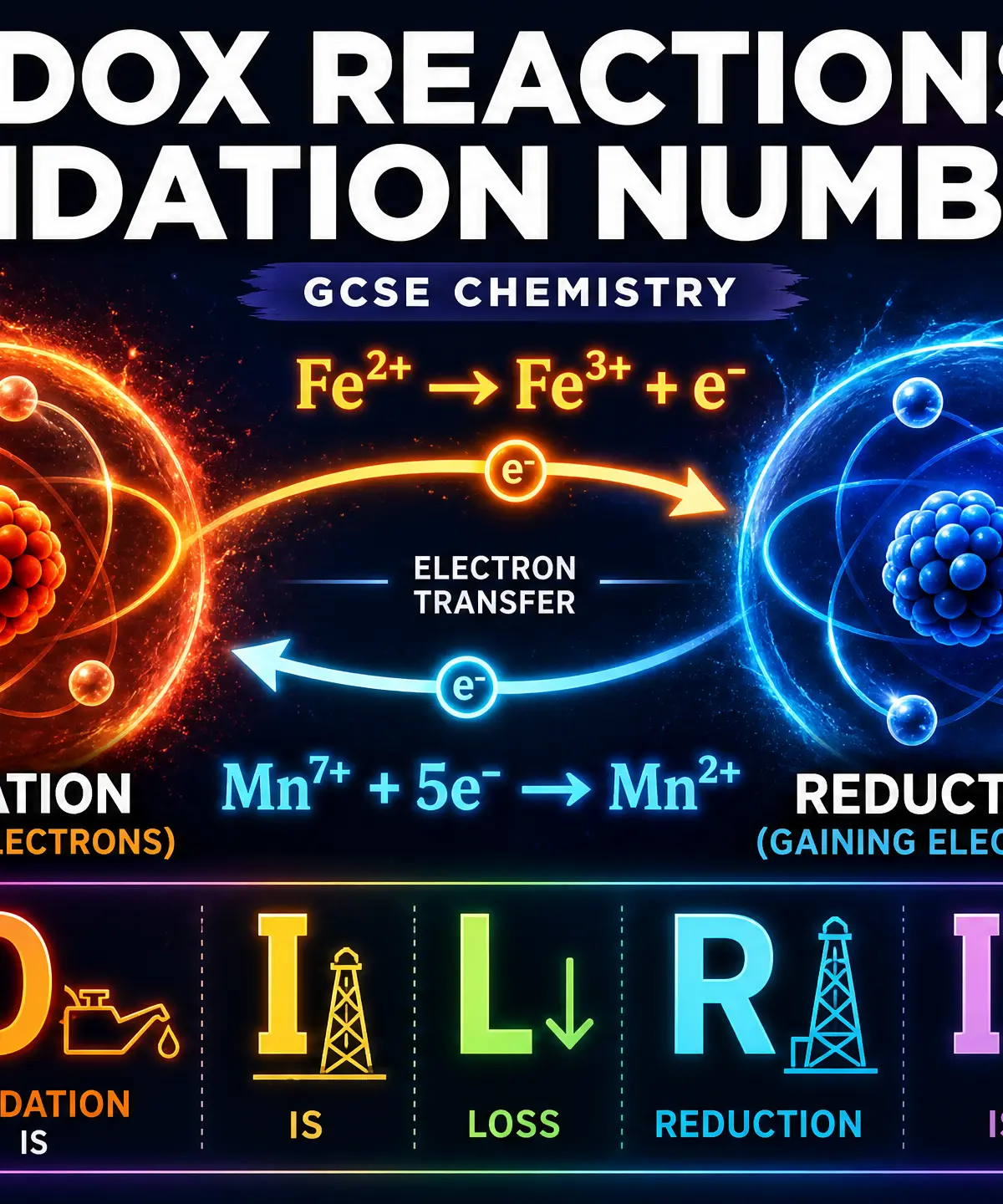
Welcome to one of the most fundamental topics in GCSE Chemistry: Oxidation Numbers and Redox Reactions. This topic is the gateway to understanding how electrons move during chemical changes, which is the driving force behind batteries, rusting, and industrial metal extraction.
Examiners consistently test this area because it bridges theoretical concepts with mathematical balancing. You will need to confidently assign oxidation states, identify oxidising and reducing agents, and balance complex ionic half-equations. This guide is structured to walk you through the precise examiner expectations, complete with the specific command words and marking points that differentiate a grade 7 from a grade 9 response.
Key Concepts
Concept 1: Defining Oxidation and Reduction
At the GCSE level, oxidation and reduction are defined entirely in terms of electron transfer.
- Oxidation is the loss of electrons.
- Reduction is the gain of electrons.
These two processes are inseparable; if one species loses electrons, another must gain them. This paired process is known as a redox reaction (REDuction-OXidation).
Examiner Tip: Candidates frequently confuse the direction of electron flow. Remember that the species being oxidised acts as a reducing agent (it forces another species to gain electrons), while the species being reduced acts as an oxidising agent (it forces another species to lose electrons).
Concept 2: Oxidation Numbers (Oxidation States)
Oxidation numbers are a bookkeeping system used by chemists to track electron distribution in compounds and ions. They tell us the hypothetical charge an atom would have if all bonds were purely ionic.
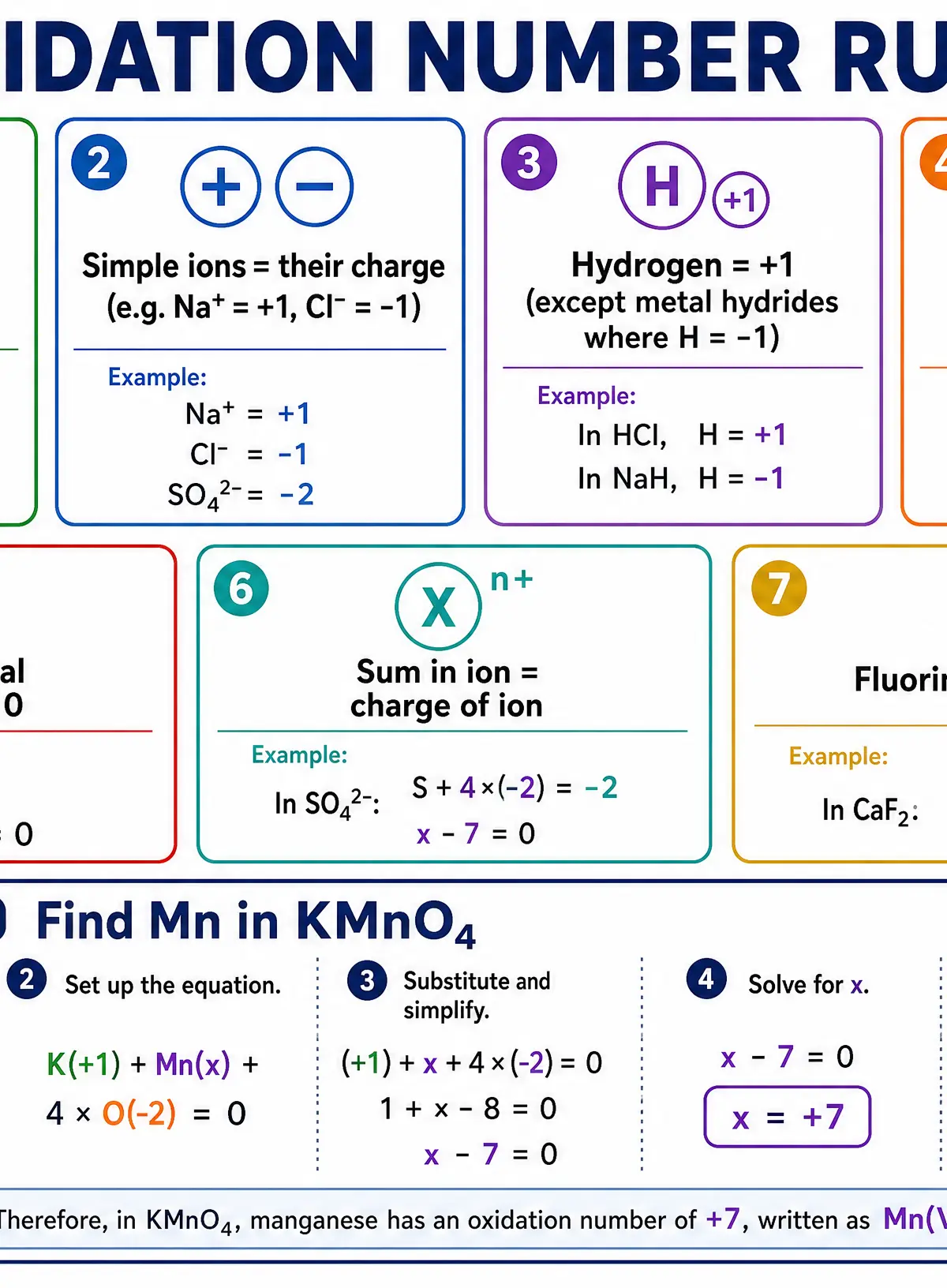
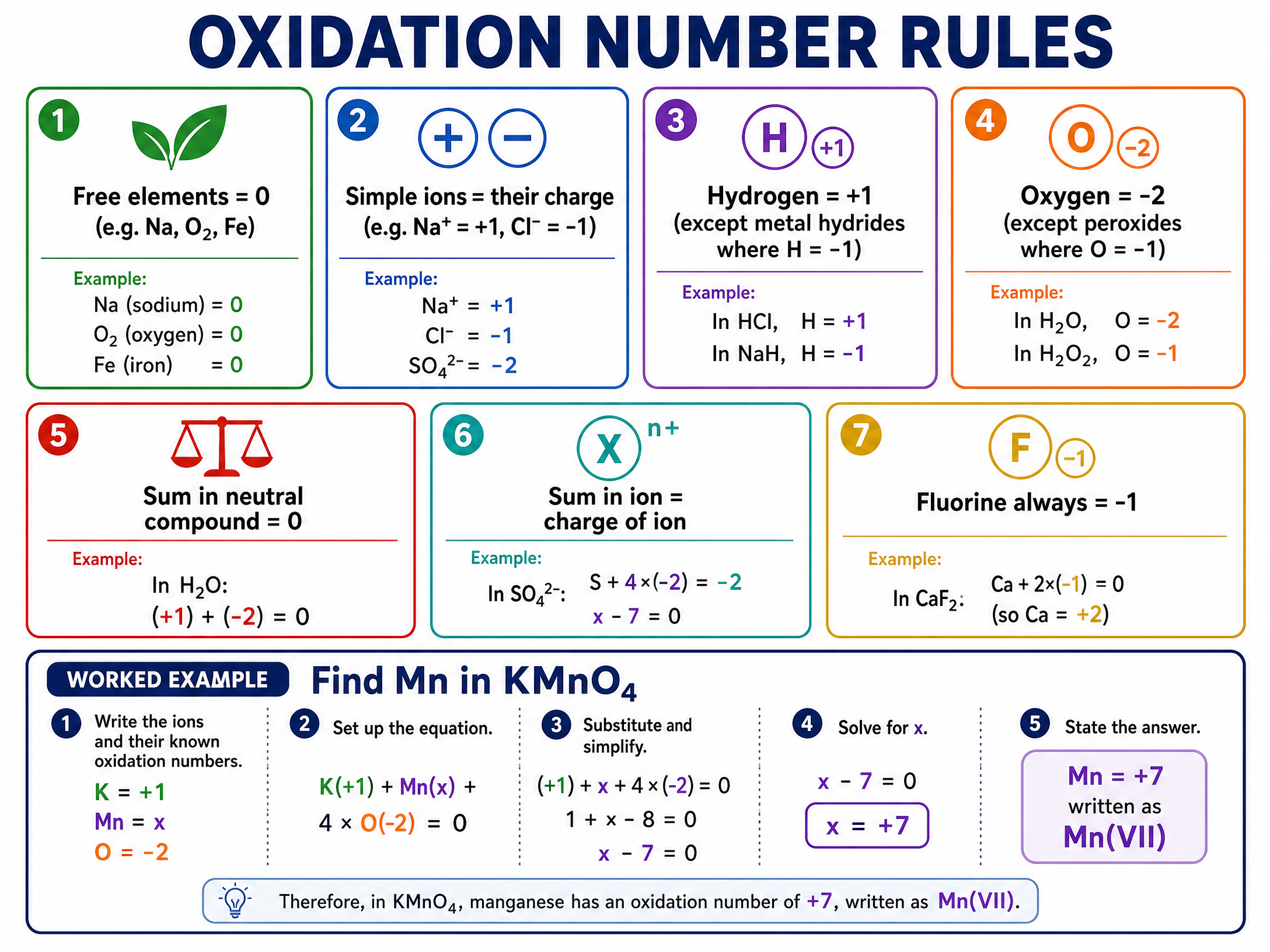
To assign oxidation numbers correctly, you must memorise the hierarchical rules. The most important rule to fall back on is that the sum of all oxidation numbers in a neutral compound is always zero, and in a polyatomic ion, the sum equals the charge on the ion.
Example: Calculate the oxidation number of sulfur in the sulfate ion, \text{SO}_4^{2-}.
Let the oxidation number of S be x.
Oxygen is -2 (Rule 4).
x + 4(-2) = -2
x - 8 = -2
x = +6
Therefore, sulfur is in the +6 oxidation state, written as S(VI).
Concept 3: Disproportionation Reactions
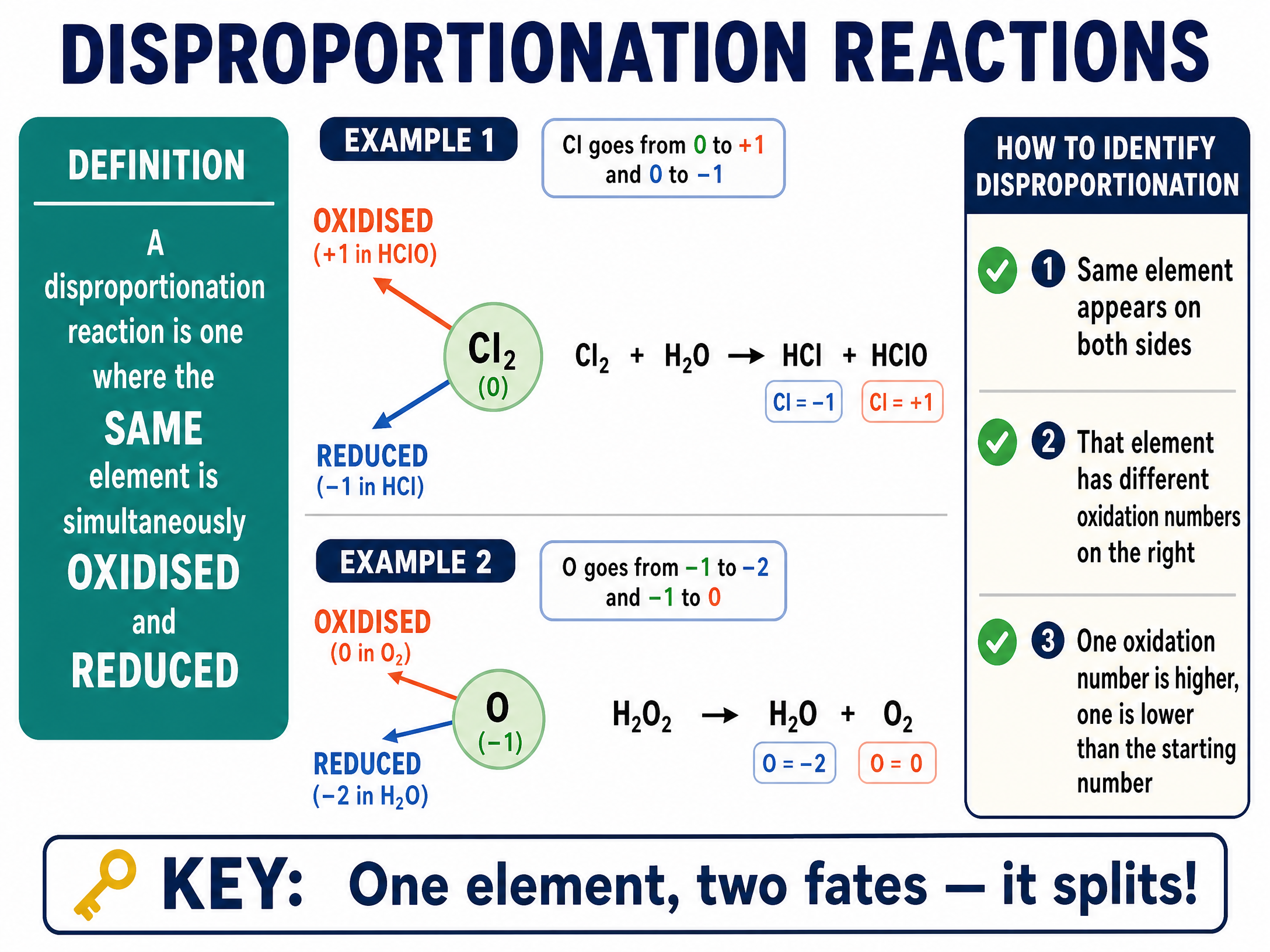
A disproportionation reaction is a specific type of redox reaction where the same element is simultaneously oxidised and reduced.
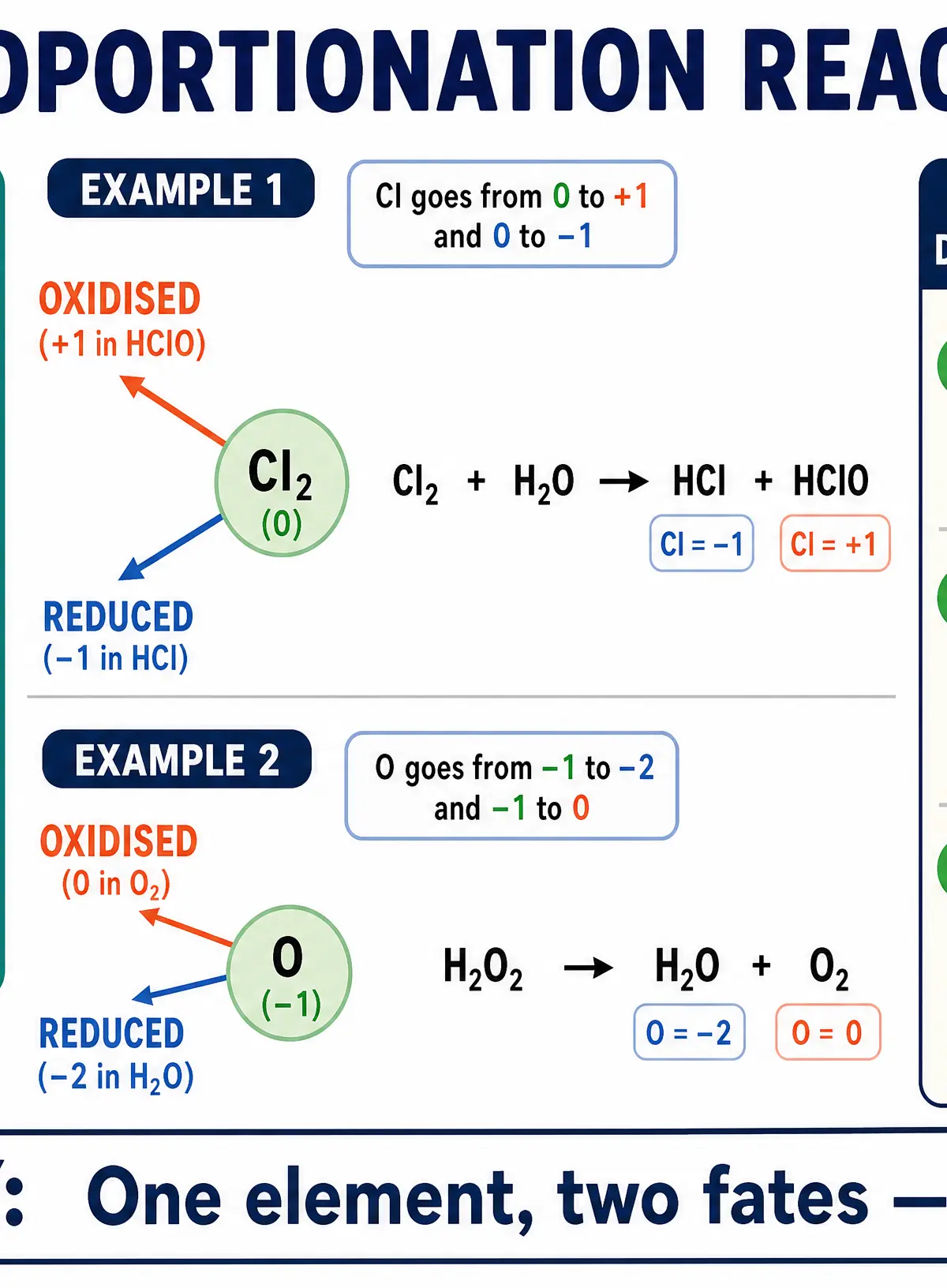
Example: The reaction of chlorine with water.
\text{Cl}_2 + \text{H}_2\text{O} \rightarrow \text{HCl} + \text{HClO}
In \text{Cl}_2, the oxidation number of Cl is 0.
In \text{HCl}, the oxidation number of Cl is -1 (it has been reduced).
In \text{HClO}, the oxidation number of Cl is +1 (it has been oxidised).
Because chlorine has both increased and decreased its oxidation number, this is a disproportionation reaction.
Concept 4: Balancing Ionic Half-Equations
Examiners often ask candidates to construct full ionic equations from half-equations, or to balance a complex half-equation from scratch.
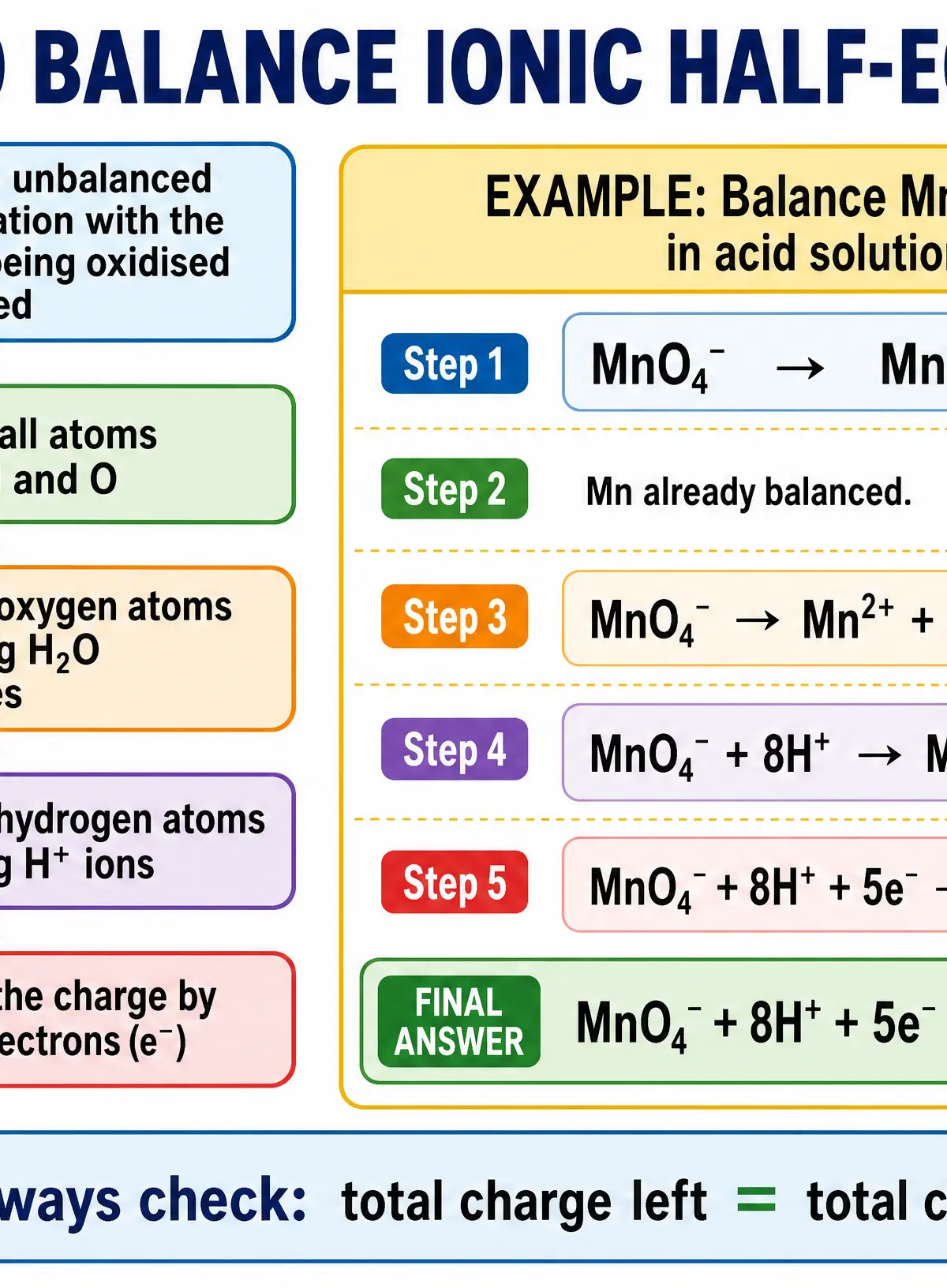
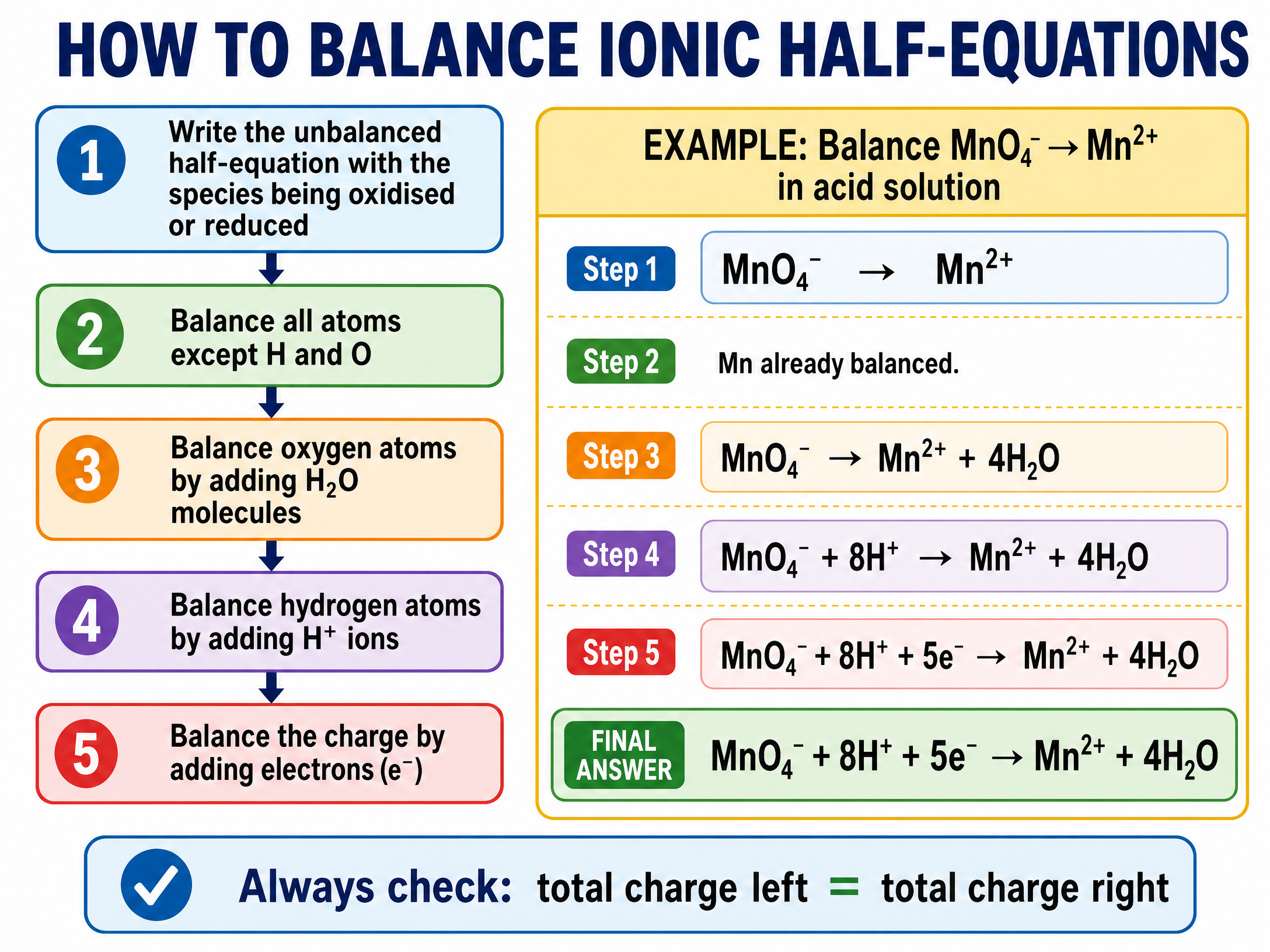
When balancing half-equations, especially in acidic conditions, you must follow a strict sequence: balance the main element, balance oxygen with water, balance hydrogen with \text{H}^+, and finally, balance the overall charge with electrons (\text{e}^-).
Mathematical/Scientific Relationships
There are no complex algebraic formulas to memorise here, but the fundamental mathematical relationship is the conservation of charge:
\sum \text{Charges on Reactants} = \sum \text{Charges on Products}
If the total charge on the left side of your half-equation is +2, the total charge on the right side MUST also be +2. If they do not match, you have not added the correct number of electrons.
Practical Applications
Understanding redox is crucial for industrial applications such as the extraction of iron in the blast furnace (where iron(III) oxide is reduced by carbon monoxide) and in electroplating. While there isn't a specific required practical solely dedicated to oxidation numbers, you will apply these principles when observing displacement reactions of halogens or metals, noting the colour changes that indicate a change in oxidation state.
Audio Resource: Redox Reactions Masterclass
Listen to our comprehensive 10-minute podcast episode where we break down the rules, walk through balancing half-equations step-by-step, and highlight the most common exam pitfalls.
Visual Resources
3 diagrams and illustrations
Interactive Diagrams
2 interactive diagrams to visualise key concepts
Conceptual Flow Outline
The relationship between oxidation, reduction, electron transfer, and agents.
Conceptual Flow Outline
The sequential 5-step method for balancing complex ionic half-equations.
Worked Examples
3 worked examples — open one to explore the question and available guidance.
Practice Questions
Test your understanding — click to reveal model answers
State the oxidation number of sulfur in H₂SO₄. (1 mark)
Hint: Remember that hydrogen is +1 and oxygen is -2. The compound is neutral.
Explain, in terms of electrons, why the reaction between magnesium and chlorine is a redox reaction. Mg + Cl₂ → MgCl₂ (3 marks)
Hint: Look at what happens to the magnesium atom and the chlorine molecules separately to form the ions in MgCl₂.
Identify the oxidising agent in the following reaction and explain your choice using oxidation numbers: 2Fe³⁺ + 2I⁻ → 2Fe²⁺ + I₂ (3 marks)
Hint: The oxidising agent is the species that gets reduced (its oxidation number decreases).
Balance the half-equation for the oxidation of hydrogen peroxide to oxygen gas: H₂O₂ → O₂ (2 marks)
Hint: Oxygen is already balanced. Focus on balancing the hydrogens first, then the charge.
Explain why the decomposition of hydrogen peroxide (2H₂O₂ → 2H₂O + O₂) is classified as a disproportionation reaction. (3 marks)
Hint: Assign the oxidation number to oxygen in all three substances.