Pearson Edexcel · A-Level · Chemistry
Topic 3: Redox I
Master the fundamentals of electron transfer with this comprehensive guide to Redox Reactions. You'll learn how to assign oxidation numbers, identify oxidising and reducing agents, and construct perfectly balanced ionic half-equations to secure top marks in your GCSE Chemistry exam.
- 7 min read
- 3 worked examples
- 5 practice questions
- 6 key terms
Study Notes
Overview
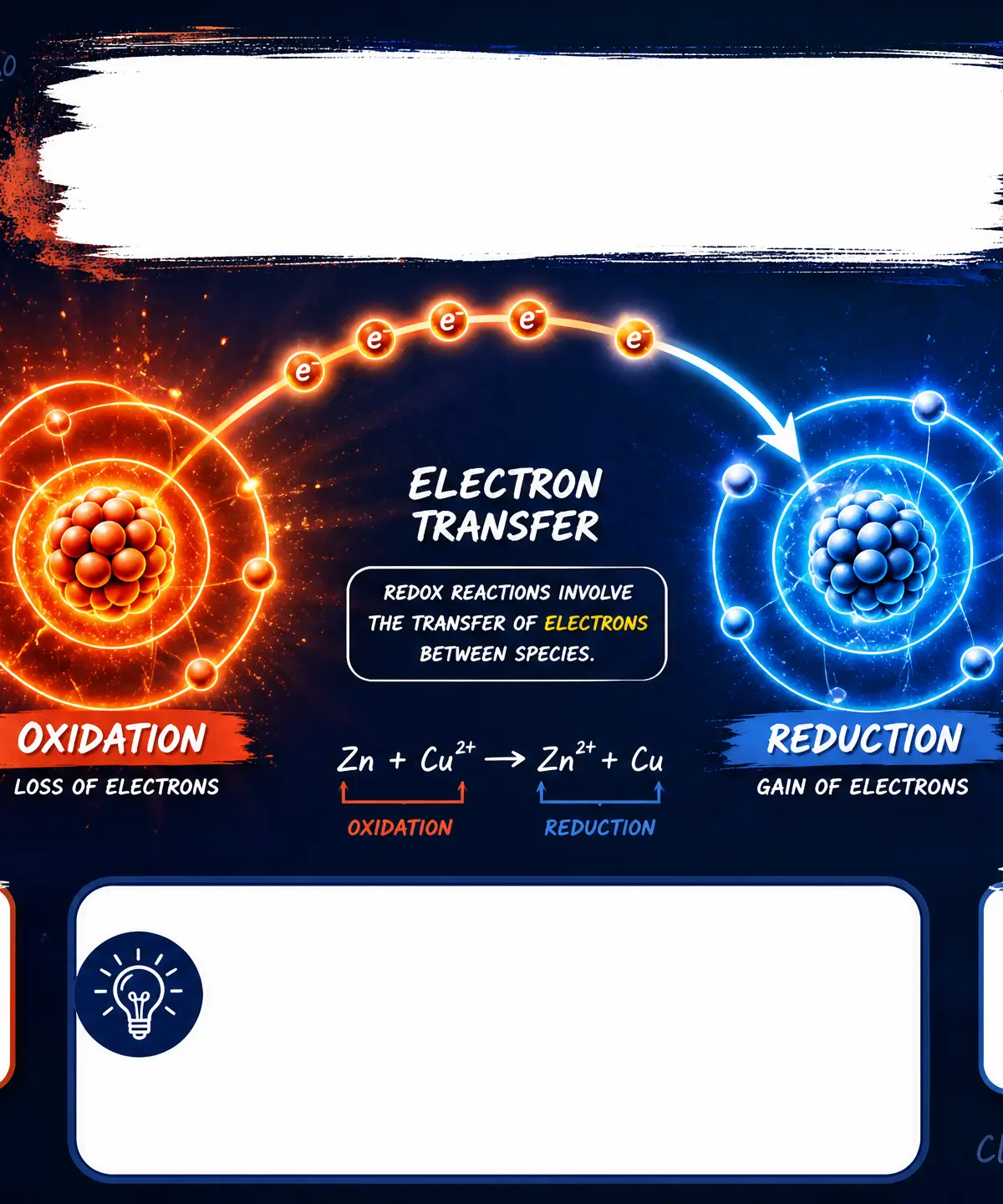
Redox reactions are the beating heart of chemistry, powering everything from the batteries in your smartphone to the respiration in your cells. At its core, this topic is about the invisible economy of electrons—how atoms trade them, who gains them, and who loses them.
Understanding redox is crucial because it connects to almost every other area of chemistry, from electrolysis and metal extraction to organic reaction mechanisms. Examiners love testing this topic because it requires both conceptual understanding and meticulous bookkeeping. You'll often face questions that ask you to identify which species is oxidised or reduced, calculate oxidation numbers in complex ions, or construct balanced ionic half-equations. By mastering the rules and systematic steps laid out in this guide, you will be able to tackle even the most challenging redox questions with confidence and precision.

Key Concepts
Concept 1: Oxidation and Reduction
Historically, oxidation meant gaining oxygen, and reduction meant losing oxygen. However, the modern, more comprehensive definition focuses entirely on electrons.
- Oxidation is the loss of electrons.
- Reduction is the gain of electrons.
These two processes are inseparable; you cannot have one without the other. If one atom loses an electron, another atom must gain it. This simultaneous transfer is why we call them redox (reduction-oxidation) reactions.
Examiner Insight: The most reliable way to remember this is the mnemonic OIL RIG (Oxidation Is Loss, Reduction Is Gain).
Concept 2: Oxidation Numbers (Oxidation States)
Oxidation numbers are a bookkeeping system used by chemists to keep track of electrons during a reaction. Think of it as the hypothetical charge an atom would have if all its bonds were completely ionic. By tracking how these numbers change from reactants to products, you can instantly tell if an atom has been oxidised or reduced.
- If the oxidation number increases (becomes more positive), the element has been oxidised.
- If the oxidation number decreases (becomes more negative), the element has been reduced.
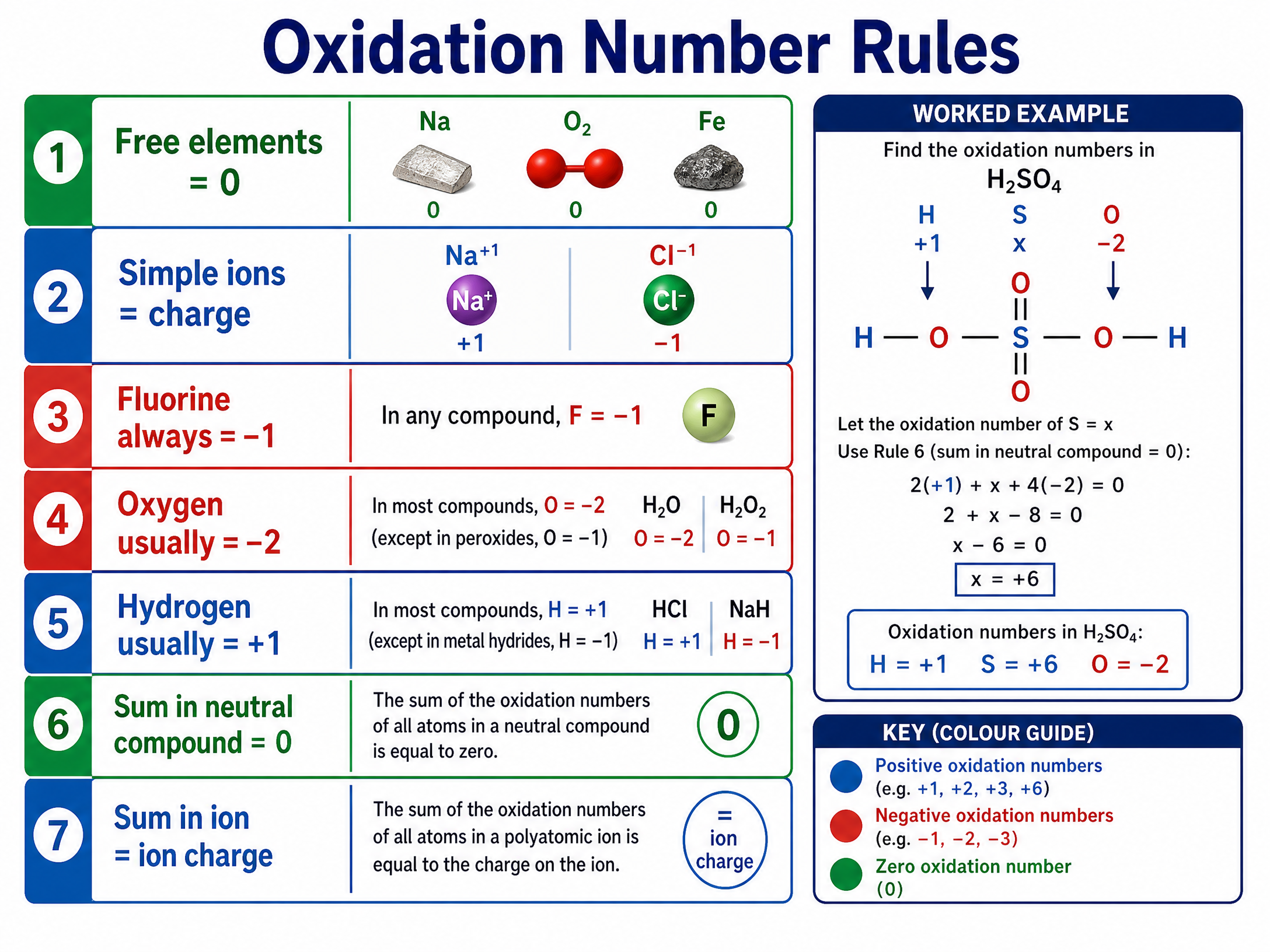
The Rules of Oxidation Numbers
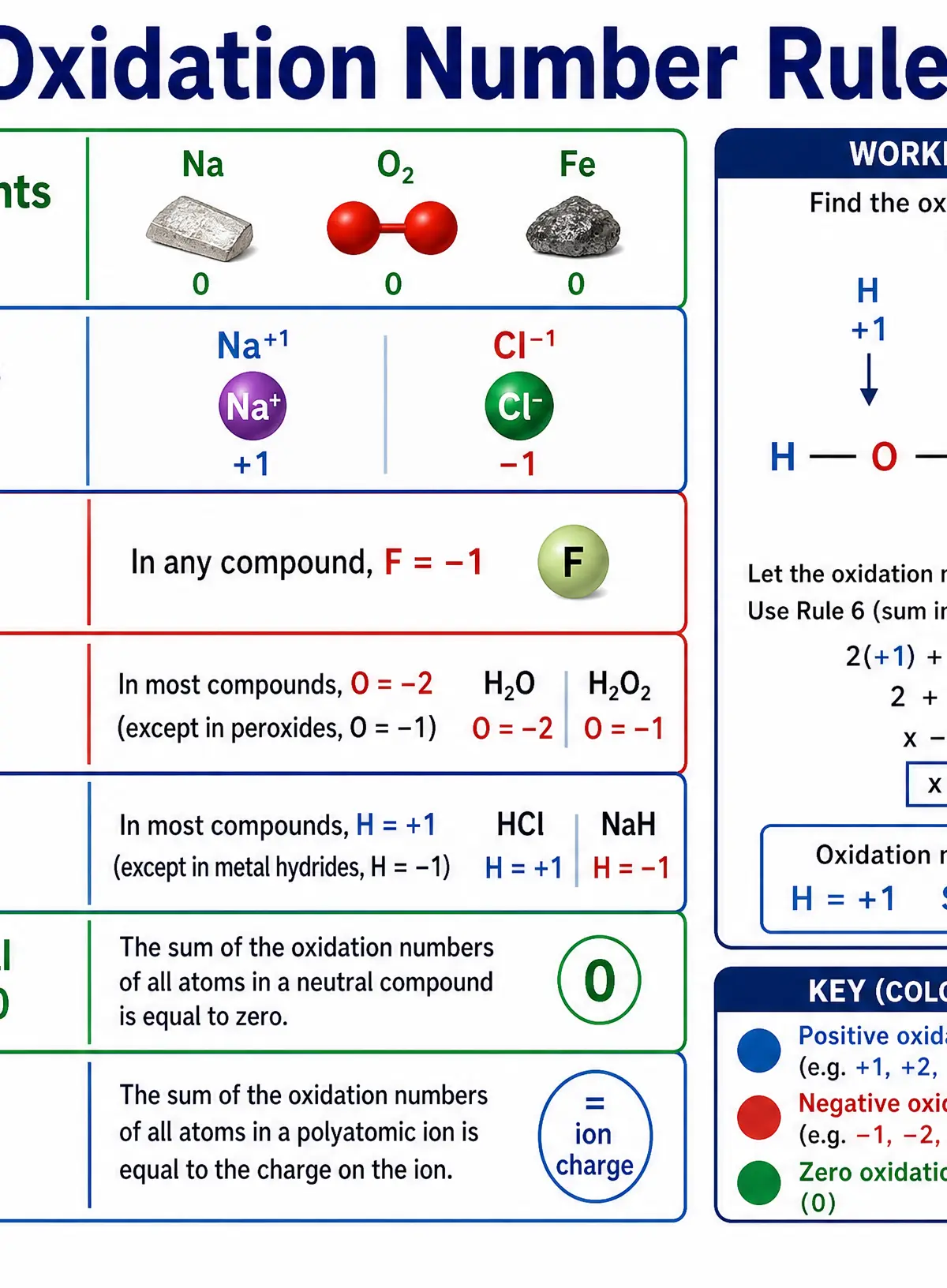
To calculate oxidation numbers, you must apply a specific hierarchy of rules. Always apply them in this order:
- Free Elements: The oxidation number of an uncombined element is always 0 (e.g., Na, O_2, Cl_2, S_8).
- Simple Ions: The oxidation number of a monatomic ion equals its charge (e.g., Na^+ is +1, Cl^- is -1).
- Fluorine: Fluorine is always -1 in compounds.
- Oxygen: Oxygen is usually -2 in compounds.
- Exception: In peroxides (like H_2O_2), oxygen is -1.
- Hydrogen: Hydrogen is usually +1 in compounds.
- Exception: In metal hydrides (like NaH), hydrogen is -1.
- Neutral Compounds: The sum of all oxidation numbers in a neutral compound must equal 0.
- Polyatomic Ions: The sum of all oxidation numbers in a polyatomic ion must equal the overall charge on the ion.
Example: What is the oxidation number of Sulfur in the Sulfate ion (SO_4^{2-})?
- Oxygen is -2. Four oxygens = -8.
- The total charge must equal -2.
- Therefore, Sulfur + (-8) = -2.
- Sulfur = +6.
Concept 3: Oxidising and Reducing Agents
This is where candidates frequently drop marks due to confusion.
An oxidising agent (or oxidant) is the substance that causes another substance to be oxidised. To do this, it must take electrons from the other substance. Therefore, the oxidising agent itself gains electrons and is reduced.
A reducing agent (or reductant) is the substance that causes another substance to be reduced. To do this, it must give electrons to the other substance. Therefore, the reducing agent itself loses electrons and is oxidised.
Memory Hook: The agent gets the opposite of its name. The oxidising agent is reduced; the reducing agent is oxidised.
Concept 4: Disproportionation Reactions
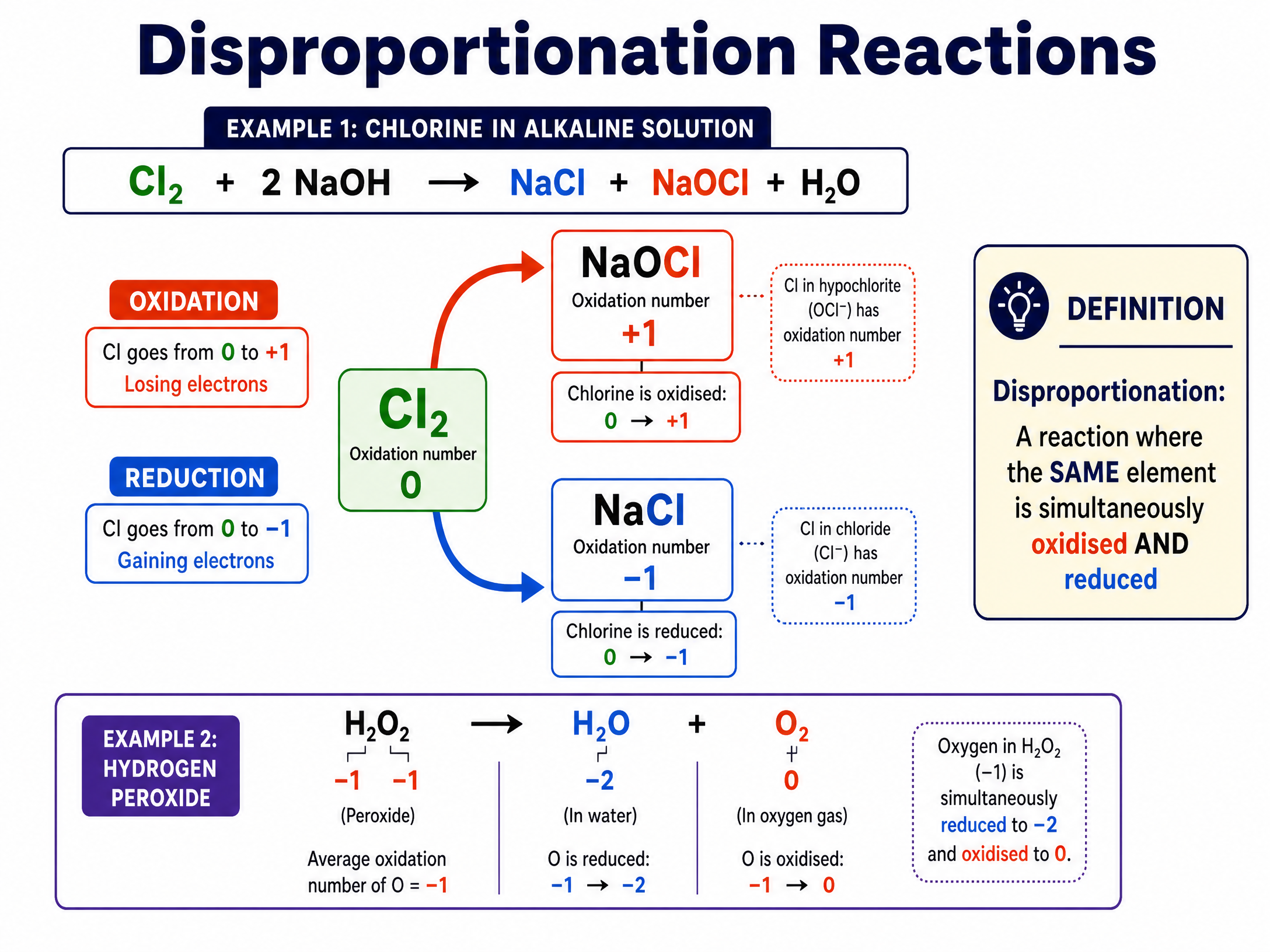
Disproportionation is a special type of redox reaction where the same element is simultaneously oxidised and reduced to form two different products.
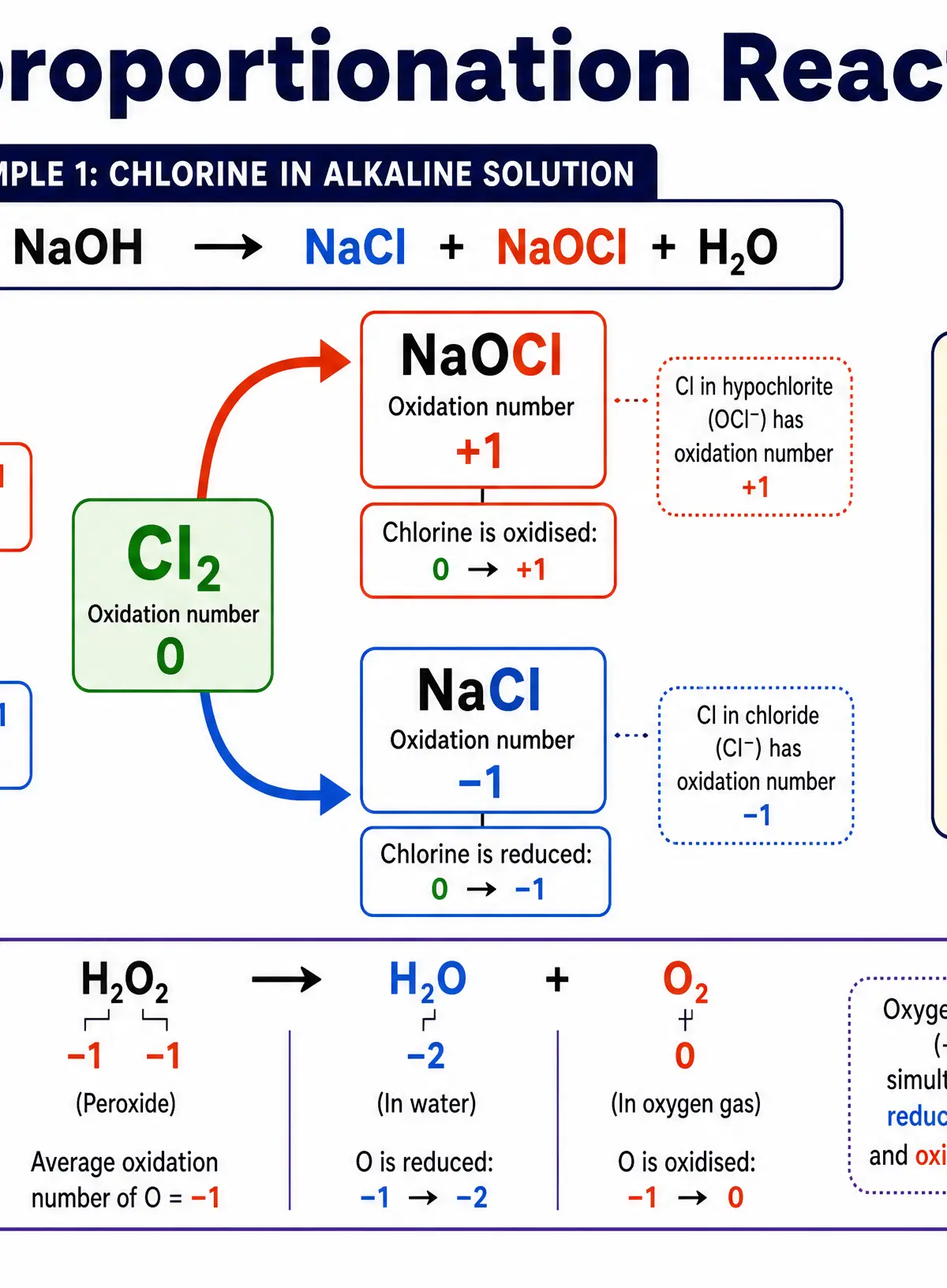
Example: The reaction of chlorine gas with cold, dilute sodium hydroxide.
Cl_2 + 2NaOH \rightarrow NaCl + NaOCl + H_2O
Let's check the oxidation numbers of Chlorine:
- In Cl_2 (reactant): 0
- In NaCl (product): -1 (Chlorine is reduced)
- In NaOCl (product): +1 (Chlorine is oxidised)
Because chlorine goes from 0 to both -1 and +1, it has undergone disproportionation.
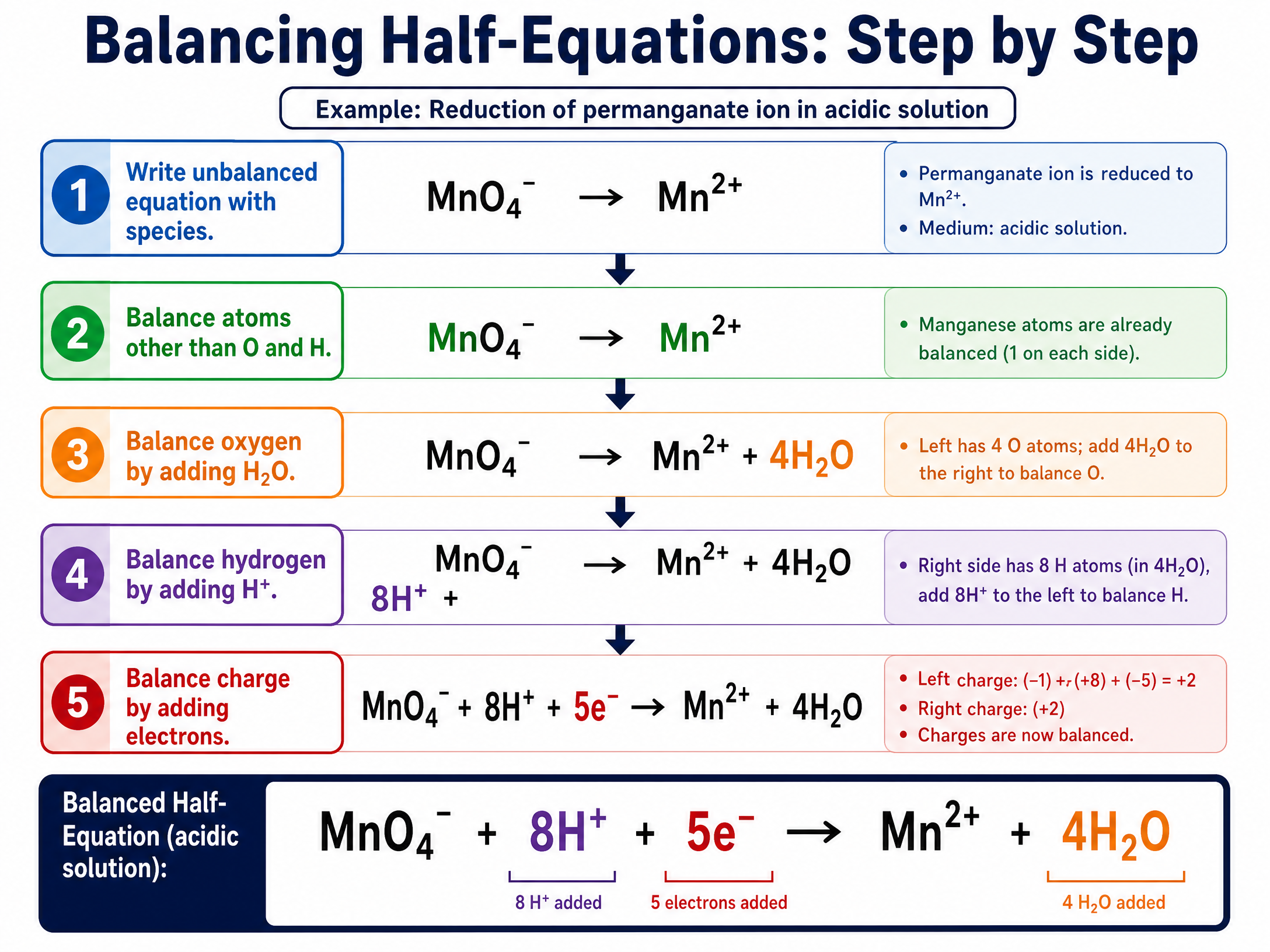
Concept 5: Constructing Ionic Half-Equations
An ionic half-equation shows either the oxidation or the reduction process separately, explicitly showing the electrons transferred. Constructing these accurately is a high-level skill that requires following a strict sequence of steps.
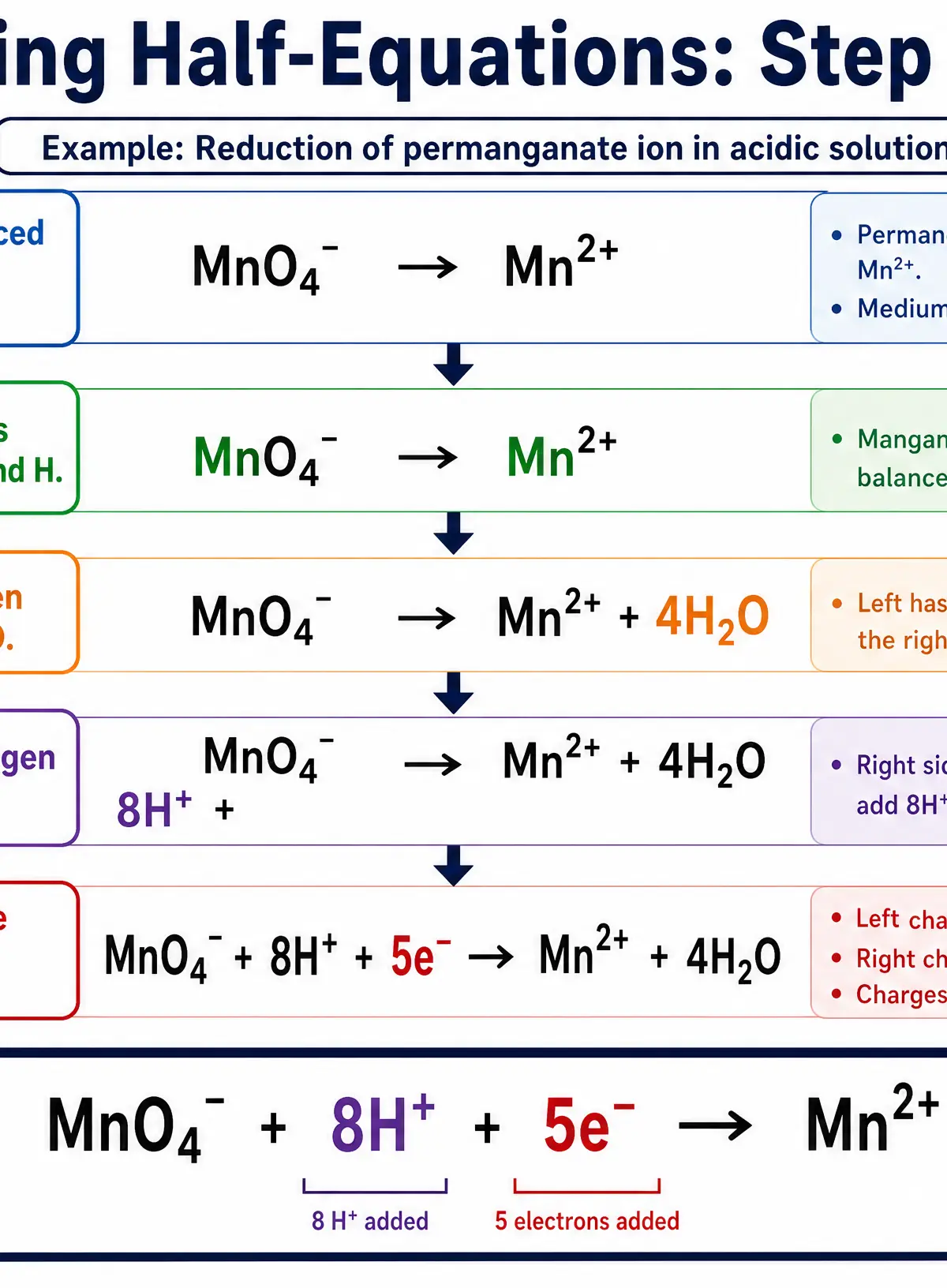
The 5-Step Method for Acidic Solutions:
- Write the unbalanced species: Write down the reactant and product for the element changing oxidation state.
- Balance the main element: Balance all atoms except Oxygen and Hydrogen.
- Balance Oxygen: Add H_2O molecules to the side deficient in oxygen.
- Balance Hydrogen: Add H^+ ions to the side deficient in hydrogen.
- Balance Charge: Add electrons (e^-) to the more positive side so that the total charge on both sides is equal.
**Combining Half-Equations:**To form a full ionic equation, you must multiply the half-equations by integers so that the number of electrons lost in oxidation exactly equals the number of electrons gained in reduction. Then, add the equations together and cancel the electrons.
Mathematical/Scientific Relationships
There are no complex mathematical formulas in this topic, but the algebraic sum of oxidation numbers is critical:
Sum of Oxidation Numbers = Overall Charge
- For a neutral molecule (H_2O, NaCl, CO_2): \sum (Oxidation Numbers) = 0
- For a polyatomic ion (SO_4^{2-}, NH_4^+): \sum (Oxidation Numbers) = Charge of Ion
Practical Applications
Redox chemistry is the foundation of energy storage. The lithium-ion batteries in your phone rely on the oxidation of lithium metal and the reduction of a metal oxide. Rusting (corrosion) is a destructive redox reaction where iron is oxidised by oxygen and water. Bleach (sodium hypochlorite) works via a redox reaction, oxidising the coloured molecules in stains to make them colourless.
Visual Resources
3 diagrams and illustrations
Interactive Diagrams
2 interactive diagrams to visualise key concepts
Conceptual Flow Outline
Concept map showing the relationships between oxidation, reduction, and their respective agents.
Conceptual Flow Outline
The systematic 5-step method for balancing ionic half-equations in acidic solution.
Worked Examples
3 worked examples — open one to explore the question and available guidance.
Practice Questions
Test your understanding — click to reveal model answers
State the oxidation number of nitrogen in the nitrate(V) ion, NO_3^-. (1 mark)
Hint: Remember the rule for oxygen, and that the sum must equal the charge on the ion.
In the reaction Mg + Cl_2 \rightarrow MgCl_2, explain in terms of electrons which substance is the reducing agent. (3 marks)
Hint: Use OIL RIG to decide what happens to Mg, then remember the 'agent' rule.
Construct the balanced ionic half-equation for the oxidation of hydrogen peroxide (H_2O_2) to oxygen gas (O_2) in acidic solution. (3 marks)
Hint: Follow the 5 steps. Oxygen is already balanced, so skip straight to balancing hydrogen.
Iodine reacts with thiosulfate ions (S_2O_3^{2-}) to form iodide ions (I^-) and tetrathionate ions (S_4O_6^{2-}). Deduce the oxidation number of sulfur in the thiosulfate ion and in the tetrathionate ion. (2 marks)
Hint: Set up an algebraic equation for each ion where the sum equals -2.
Nitrous acid (HNO_2) can decompose to form nitric acid (HNO_3), nitrogen monoxide (NO), and water. Use oxidation numbers to show that this is a disproportionation reaction. (4 marks)
Hint: Calculate the oxidation number of Nitrogen in all three nitrogen-containing compounds.