Pearson Edexcel · GCSE · Citizenship Studies
Theme B: Democracy at work in the UK
Master the inner workings of the UK's representative democracy, from how a bill becomes law to the uncodified constitution. This topic is vital for understanding how power is distributed, checked, and exercised across the four nations of the UK.
- 6 min read
- 3 worked examples
- 5 practice questions
- 6 key terms
Study Notes
Overview
Theme B: Democracy at Work in the UK is a core component of the GCSE Citizenship Studies specification. It explores the mechanics of the UK's political system, focusing on the institutions that govern us and the processes by which decisions are made. Examiners expect candidates to demonstrate a precise understanding of key terms like 'parliamentary sovereignty', 'devolution', and 'scrutiny'. You must be able to distinguish between the roles of different institutions (such as the executive and the legislature) and evaluate the strengths and weaknesses of the UK's democratic structures, such as the First Past the Post voting system and the uncodified constitution.
Listen to the Revision Podcast
Key Democratic Concepts
Direct vs Representative Democracy
Direct Democracy: Citizens vote directly on decisions or policies. The primary UK example is a referendum (e.g., the 2016 EU Referendum where 33.5 million people voted directly on Brexit).
Representative Democracy: Citizens elect representatives to make decisions on their behalf. In the UK, voters elect 650 Members of Parliament (MPs) to the House of Commons. MPs are expected to represent the interests of their constituents, scrutinise the government, and vote on legislation.
The Voting System: First Past the Post (FPTP)
The UK uses FPTP for general elections. The country is divided into 650 constituencies. Voters cast one vote for a candidate. The candidate with the most votes in that constituency wins the seat, even if they do not achieve a majority (over 50%) of the total votes cast.
Examiner Focus: You must be able to evaluate FPTP. Strengths include simplicity and a strong MP-constituency link. Weaknesses include 'wasted votes' and the fact that national vote share rarely translates proportionally into parliamentary seats.
The Three Branches of Government
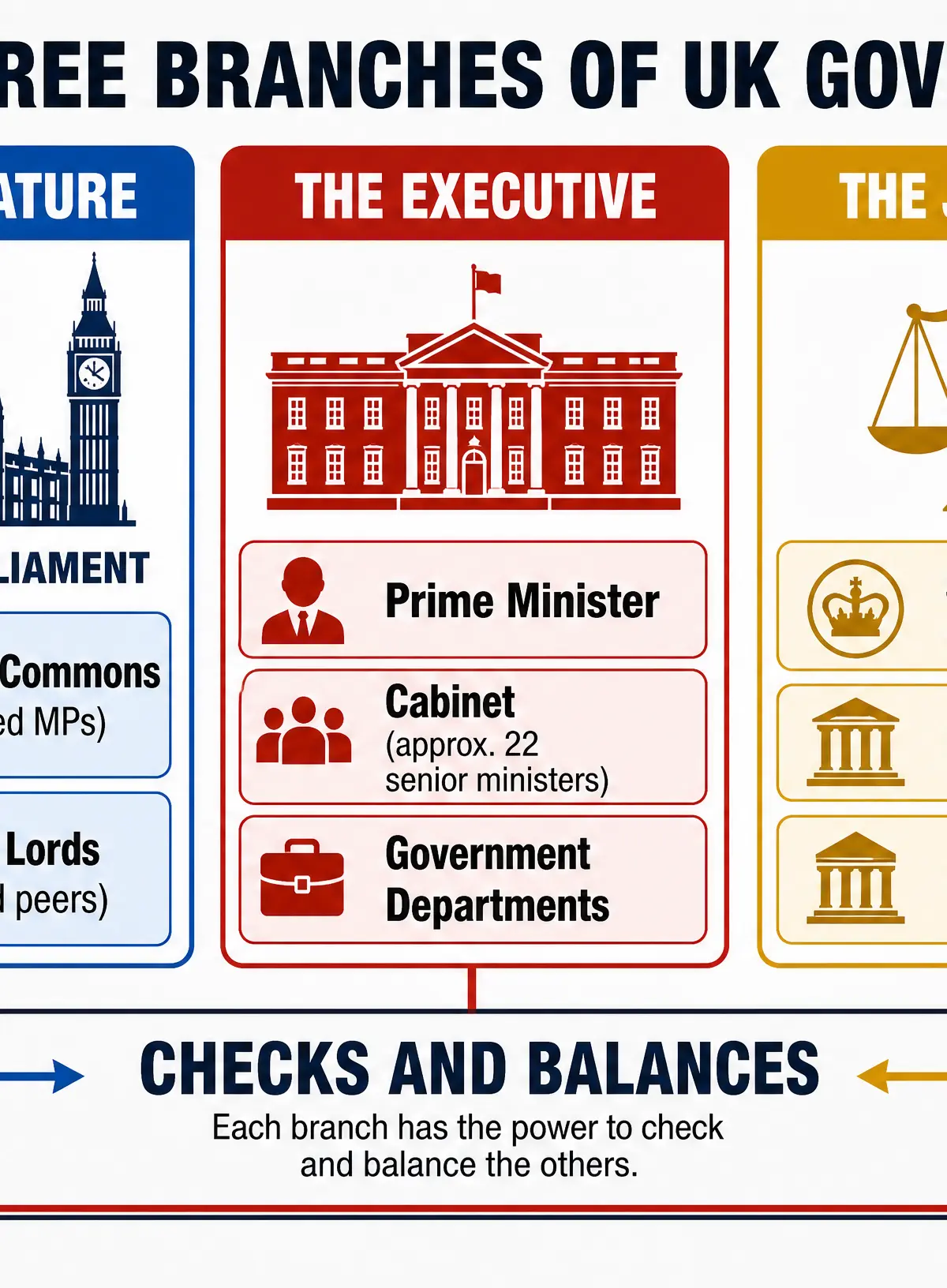
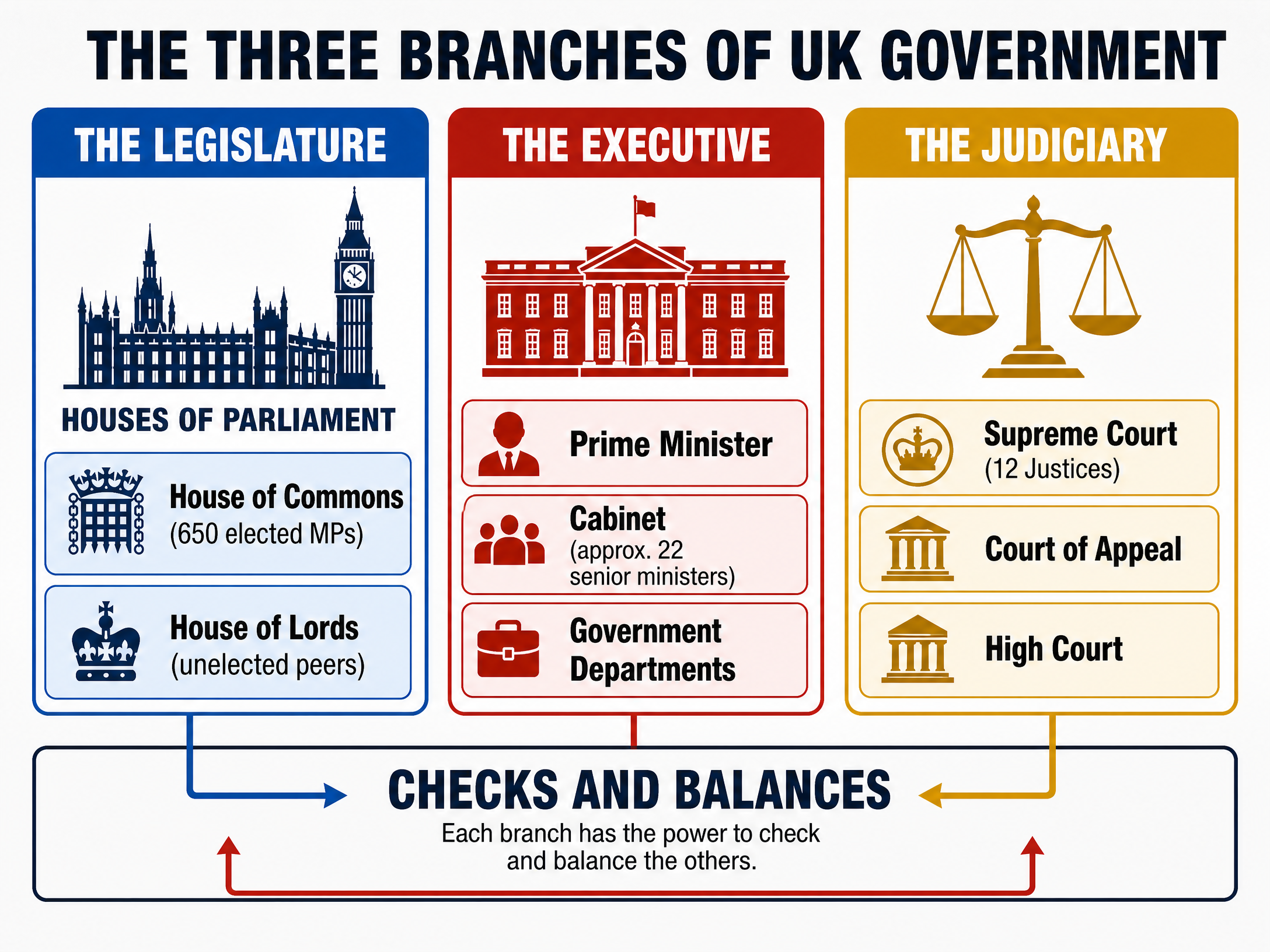
To prevent tyranny, power is divided into three branches, a concept known as the separation of powers. In the UK, there is overlap (e.g., the Prime Minister sits in the legislature), but checks and balances exist.
1. The Legislature (Parliament)
Role: To make and amend laws, scrutinise the executive, and represent the people.
Composition:
- House of Commons: 650 elected MPs. The dominant chamber.
- House of Lords: Unelected chamber comprising Life Peers, Hereditary Peers (capped at 92), and Lords Spiritual (26 Bishops). It revises legislation and can delay bills for up to a year (under the Parliament Acts 1911 and 1949).
2. The Executive (The Government)
Role: To run the country, implement laws, and propose new legislation (the legislative agenda).
Composition:
- Prime Minister: Head of government, leader of the largest party in the Commons.
- Cabinet: Approx. 22 senior ministers (e.g., Chancellor of the Exchequer, Home Secretary) who lead government departments.
3. The Judiciary (The Courts)
Role: To interpret and apply the law, ensuring it is upheld fairly.
Composition: Headed by the Supreme Court (established in 2009 to separate the highest court from the House of Lords). Judges must maintain strict judicial independence from the government.
How a Bill Becomes Law
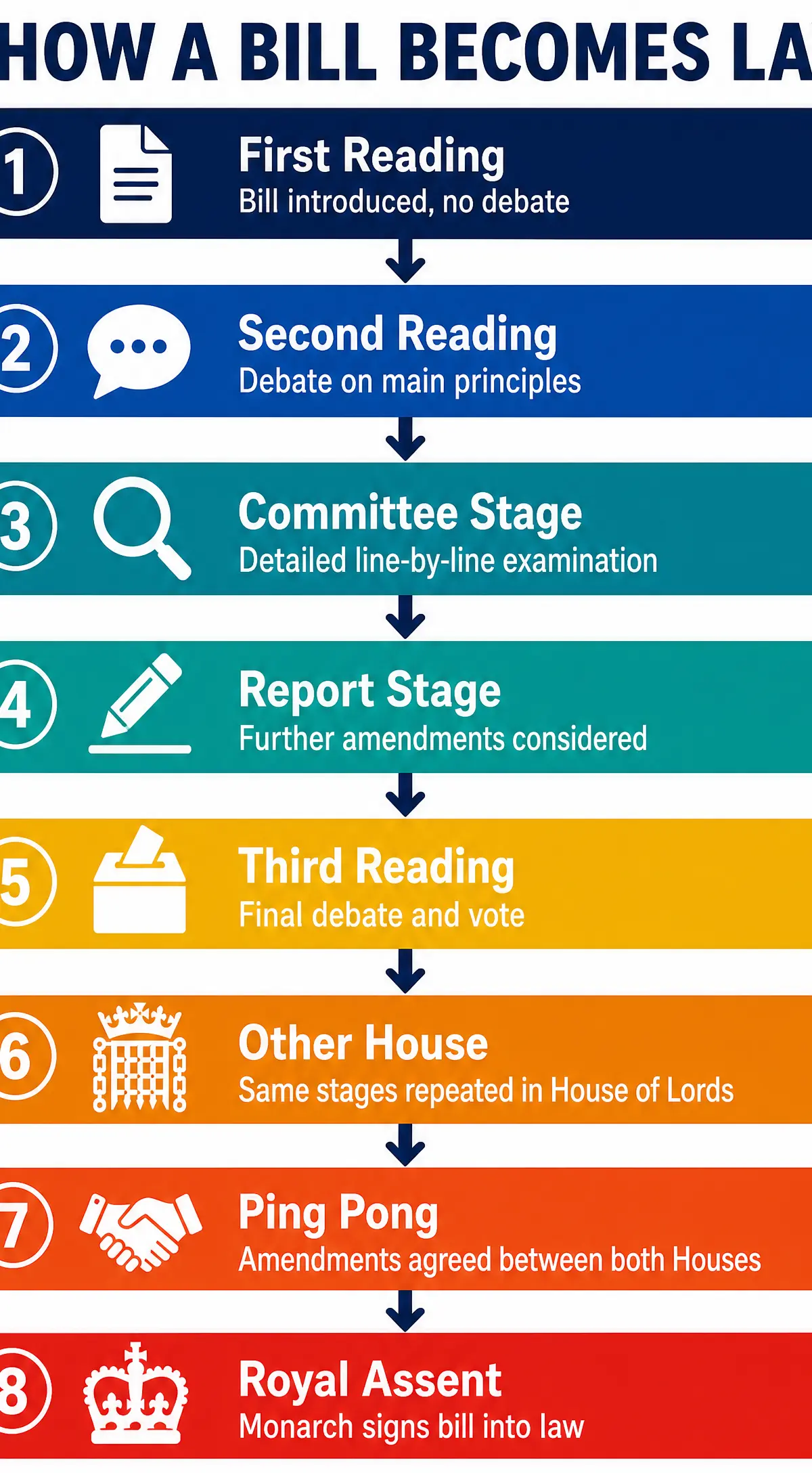
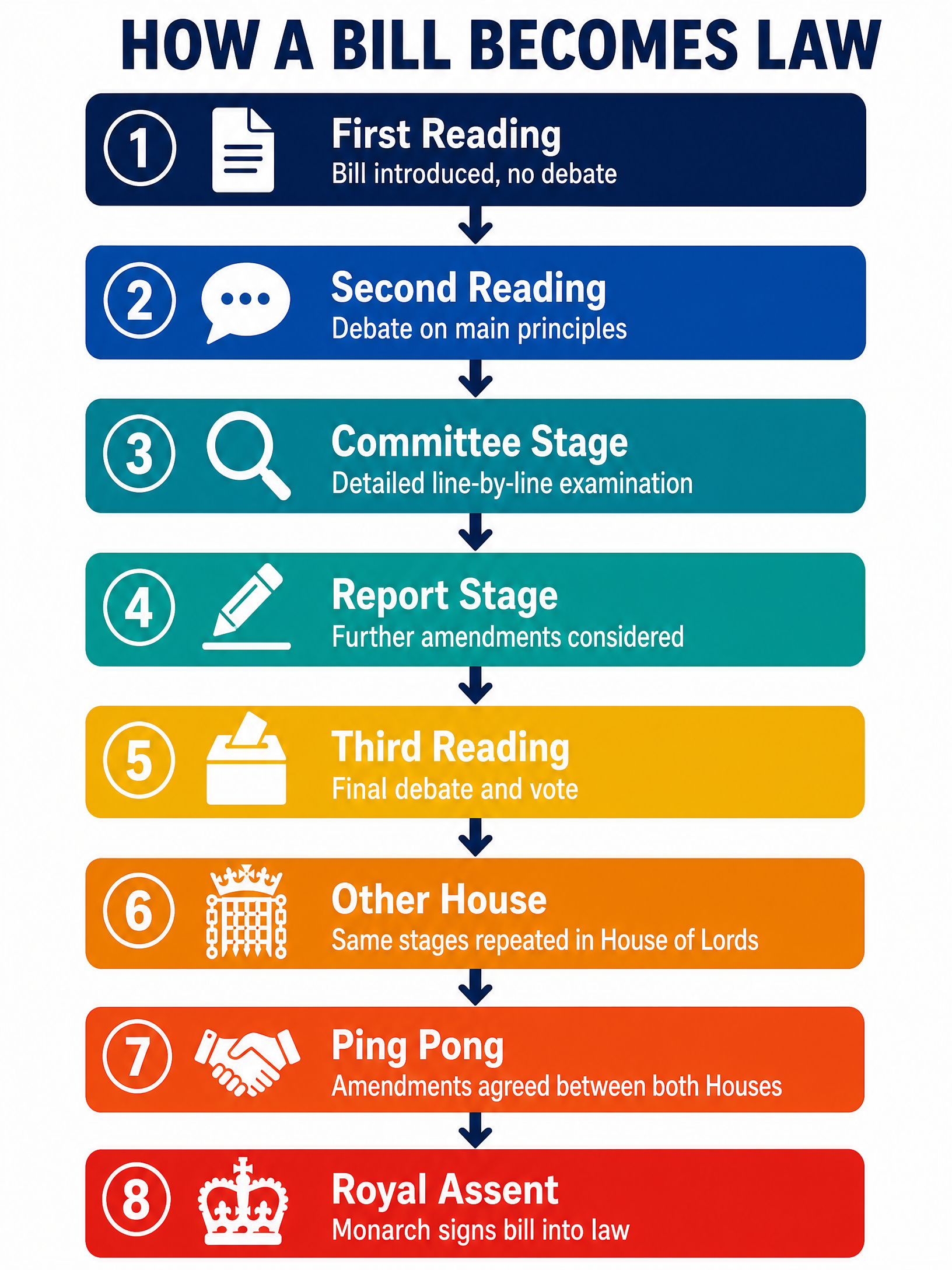
The legislative process is rigorous to ensure laws are carefully scrutinised. The stages in the House of Commons are:
- First Reading: Formal introduction of the bill. No debate.
- Second Reading: Main debate on the principles of the bill.
- Committee Stage: Detailed line-by-line scrutiny by a Public Bill Committee. Amendments are proposed.
- Report Stage: The whole House considers the amended bill.
- Third Reading: Final debate and vote on the bill.
The bill then passes to the House of Lords for the same stages. If the Lords make amendments, it returns to the Commons ('ping pong'). Once both Houses agree, it receives Royal Assent from the Monarch and becomes an Act of Parliament.
The Uncodified Constitution
Unlike the USA, the UK does not have a single written constitutional document. It is uncodified, drawing from multiple sources:
- Statute Law: Acts of Parliament (e.g., Human Rights Act 1998).
- Common Law: Legal principles established by judges in court rulings.
- Conventions: Unwritten traditions and customs (e.g., the Monarch always grants Royal Assent).
- Authoritative Works: Historical texts guiding procedure (e.g., Erskine May).
Key Concept: Parliamentary Sovereignty. Parliament is the supreme legal authority. It can make or unmake any law, and no Parliament can bind its successor.
Devolution
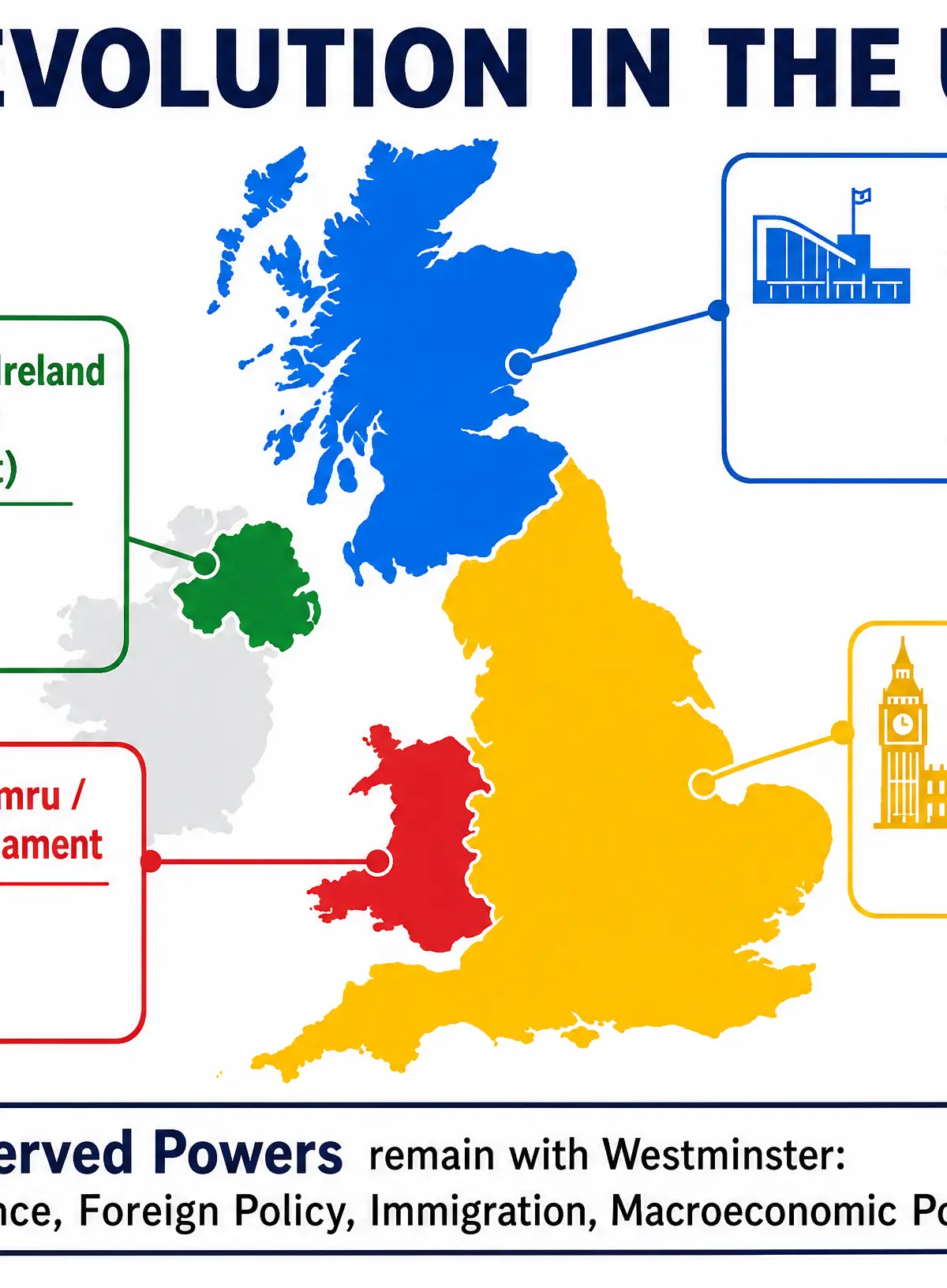
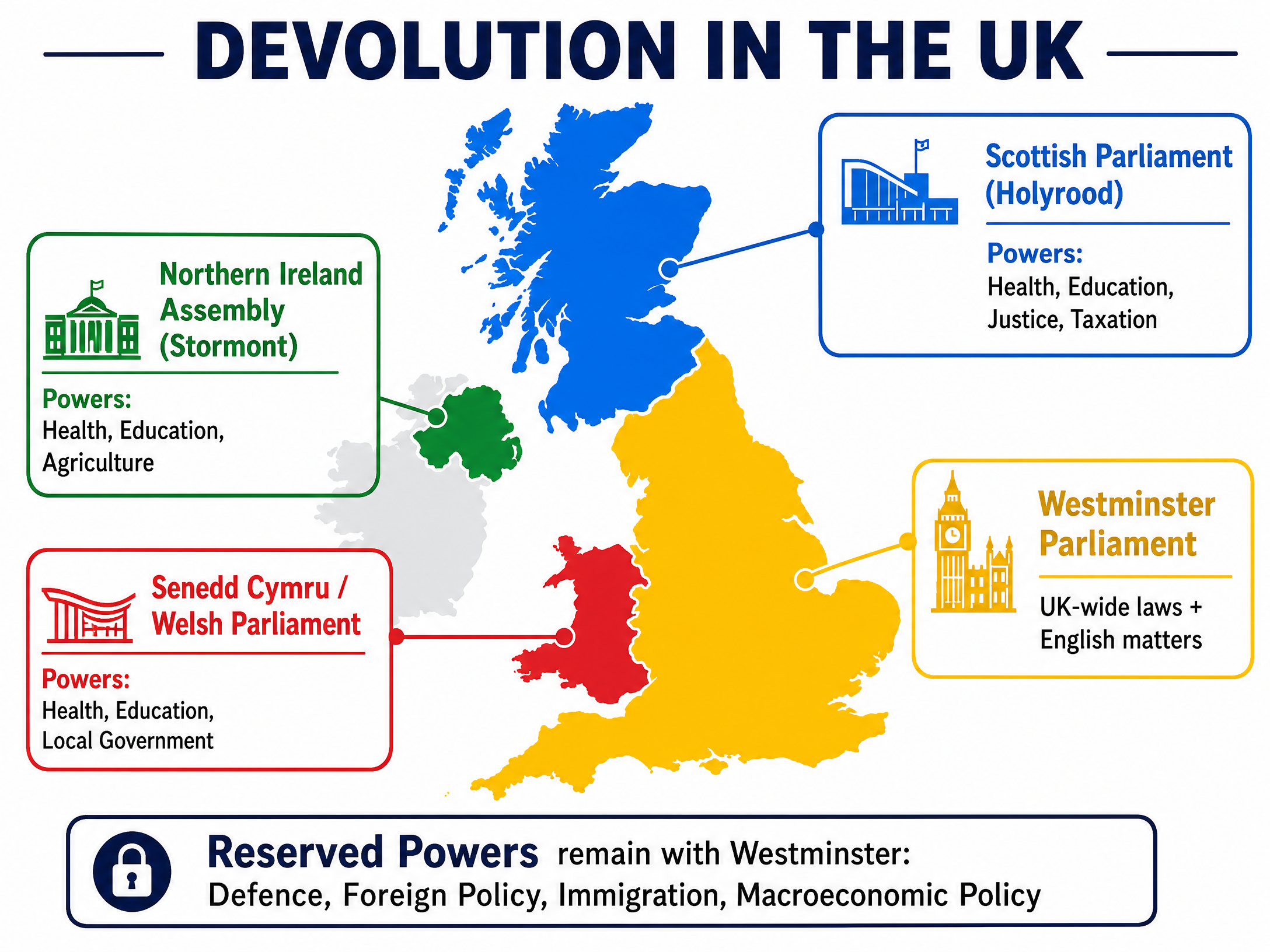
Devolution is the transfer of power from the central UK Parliament (Westminster) to regional administrations. This occurred following referendums in 1997.
- Scottish Parliament (Holyrood): Primary legislative powers over health, education, justice, and some taxation.
- Senedd Cymru / Welsh Parliament: Powers over health, education, and local government.
- Northern Ireland Assembly (Stormont): Powers over health, education, and agriculture, operating under a unique power-sharing arrangement.
Reserved Powers: Crucial national issues remain controlled by Westminster, including Defence, Foreign Policy, and Macroeconomic Policy.
Visual Resources
3 diagrams and illustrations
Interactive Diagrams
1 interactive diagram to visualise key concepts
Conceptual Flow Outline
Flowchart: How a Bill becomes an Act of Parliament
Worked Examples
3 worked examples — open one to explore the question and available guidance.
Practice Questions
Test your understanding — click to reveal model answers
State the name of the voting system used to elect MPs to the UK Parliament. (1 mark)
Hint: It's an acronym with four letters.
Explain two ways in which the House of Lords differs from the House of Commons. (4 marks)
Hint: Think about how members get their jobs and the limits on their power.
Explain the role of the Chancellor of the Exchequer. (2 marks)
Hint: Think about money and the annual speech made in Parliament.
Discuss the view that devolution has been successful in the UK. (8 marks)
Hint: Argue both sides: how has it helped local areas, but what problems has it caused (e.g., differences in services)?
Explain why the UK's constitution is described as 'uncodified'. (2 marks)
Hint: Where are the rules written down?
Test your understanding of Theme B: Democracy at work in the UK
Active recall beats re-reading. Take an instant quiz now to test what you’ve learned and lock it into long-term memory.
7 days Premium · Then free forever · No card, no charge