Pearson Edexcel · GCSE · Citizenship Studies
Theme C: Law and justice
Master the fundamentals of Law and Justice in England and Wales. This guide breaks down the complex court system, the vital roles of legal professionals and citizens, and the true purposes of sentencing, giving you the precise knowledge needed to secure top marks.
- 7 min read
- 3 worked examples
- 3 practice questions
- 6 key terms
Study Notes
Overview
Theme C: Law and Justice is a cornerstone of GCSE Citizenship Studies. Examiners expect candidates to go beyond common-sense answers and demonstrate a precise understanding of the legal system in England and Wales. This topic explores why laws exist, the fundamental differences between criminal and civil law, the hierarchy of the courts, and the roles of those who work within them—from high court judges to volunteer magistrates and jurors. A strong grasp of specific legal terminology, the purposes of sentencing, and the distinct nature of the youth justice system is essential for accessing the highest mark bands.
Listen to the Podcast
The Purposes of Law
Laws are essential for a functioning democratic society. Examiners frequently test candidates on why laws are needed. A strong answer will reference multiple specific purposes:
- Protecting the public: Ensuring safety from violence, theft, and harm (e.g., laws against assault).
- Settling disputes: Providing a peaceful mechanism to resolve disagreements (e.g., civil courts for contract breaches).
- Ensuring fairness: Upholding the Rule of Law, meaning everyone is equal before the law regardless of status.
- Achieving justice: Ensuring that victims receive redress and offenders face appropriate consequences.
- Changing behaviour: Nudging society towards safer or more responsible actions (e.g., mandatory seatbelt laws, taxation on sugary drinks).
- Responding to new situations: Updating legislation to deal with modern challenges (e.g., cybercrime, revenge porn, AI regulation).
Criminal vs. Civil Law
Candidates frequently lose marks by confusing criminal and civil law. You must understand the distinction clearly.
Criminal Law
Deals with offences against the state and society (e.g., murder, theft, assault). Cases are brought by the Crown Prosecution Service (CPS) on behalf of the Crown. The standard of proof is "beyond reasonable doubt". If found guilty, the defendant receives a punishment (e.g., prison, fine, community order).
Civil Law
Deals with disputes between private individuals or organisations (e.g., divorce, personal injury, contract disputes, housing issues). Cases are brought by the claimant against the defendant. The standard of proof is the "balance of probabilities". The outcome is usually a remedy for the claimant (e.g., financial compensation, an injunction).
The Court Hierarchy
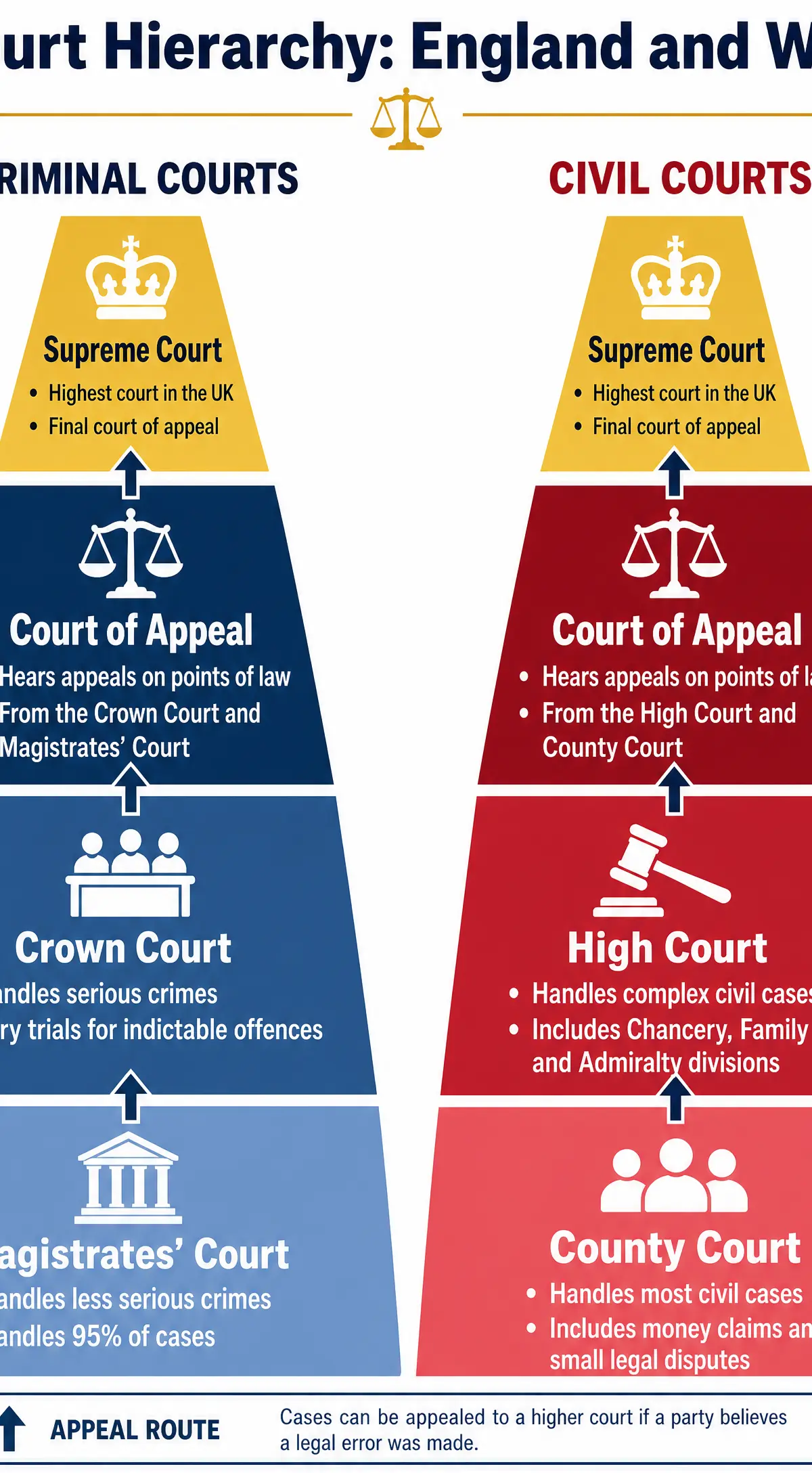
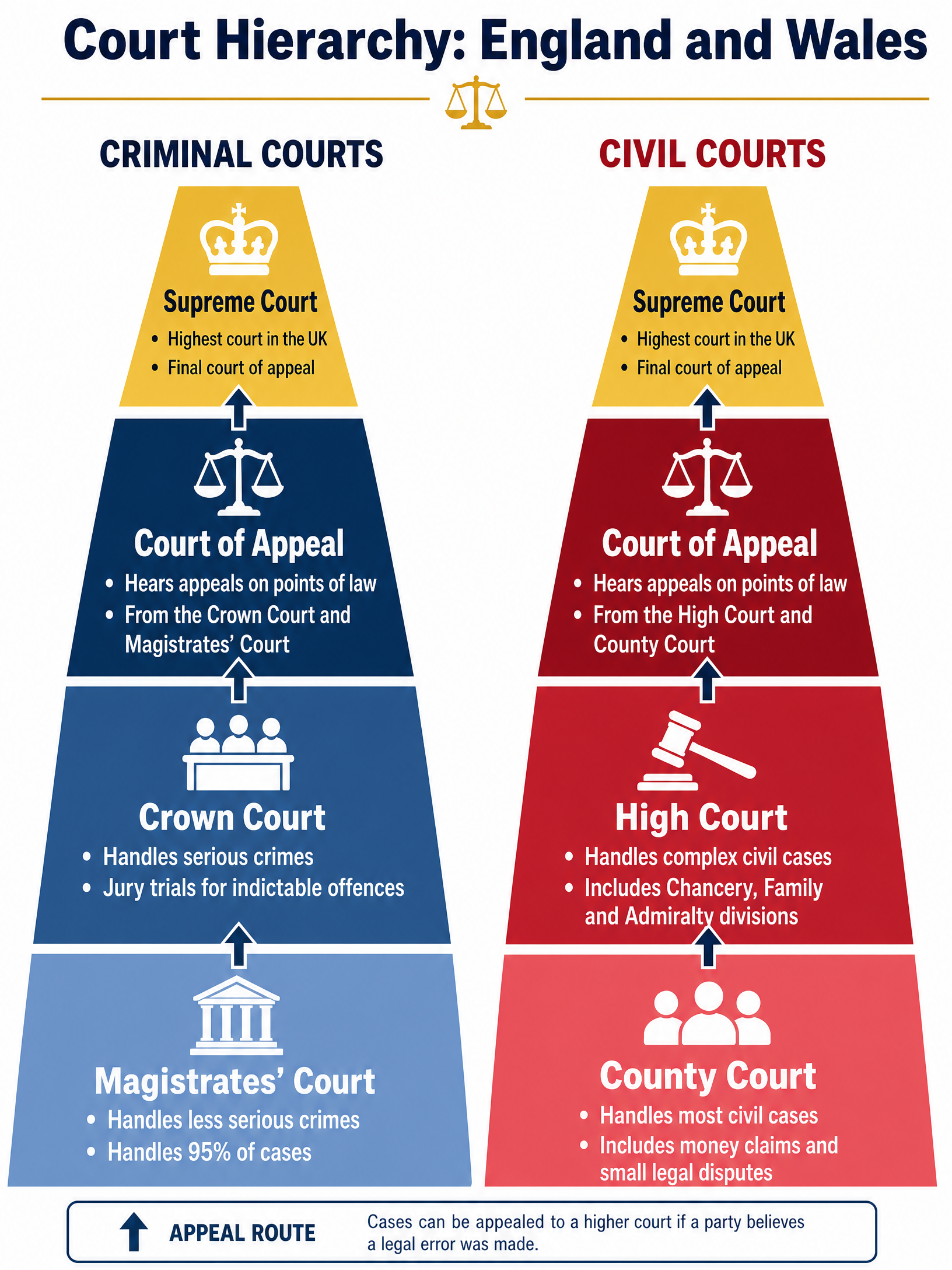
The legal system in England and Wales has a distinct hierarchy for both criminal and civil matters.
Criminal Courts
- Magistrates' Court: Handles ~95% of criminal cases. Deals with summary offences (less serious crimes like speeding, minor theft). Cases are heard by three volunteer magistrates or a District Judge. No jury is present. Maximum sentence is usually 12 months imprisonment.
- Crown Court: Deals with indictable offences (serious crimes like murder, rape, robbery). Cases are presided over by a Judge, and guilt is determined by a Jury of 12 citizens.
Civil Courts
- County Court: Handles the majority of civil cases, including small claims, debt recovery, and personal injury.
- High Court: Deals with more complex, high-value civil cases. It has specialist divisions (Chancery, Family, King's Bench).
Appellate Courts
- Court of Appeal: Hears appeals from the Crown Court and High Court on points of law or against sentences.
- Supreme Court: The highest court in the UK. Hears only the most complex cases involving significant points of law. Its decisions set precedent for all lower courts.
Key Roles in the Legal System
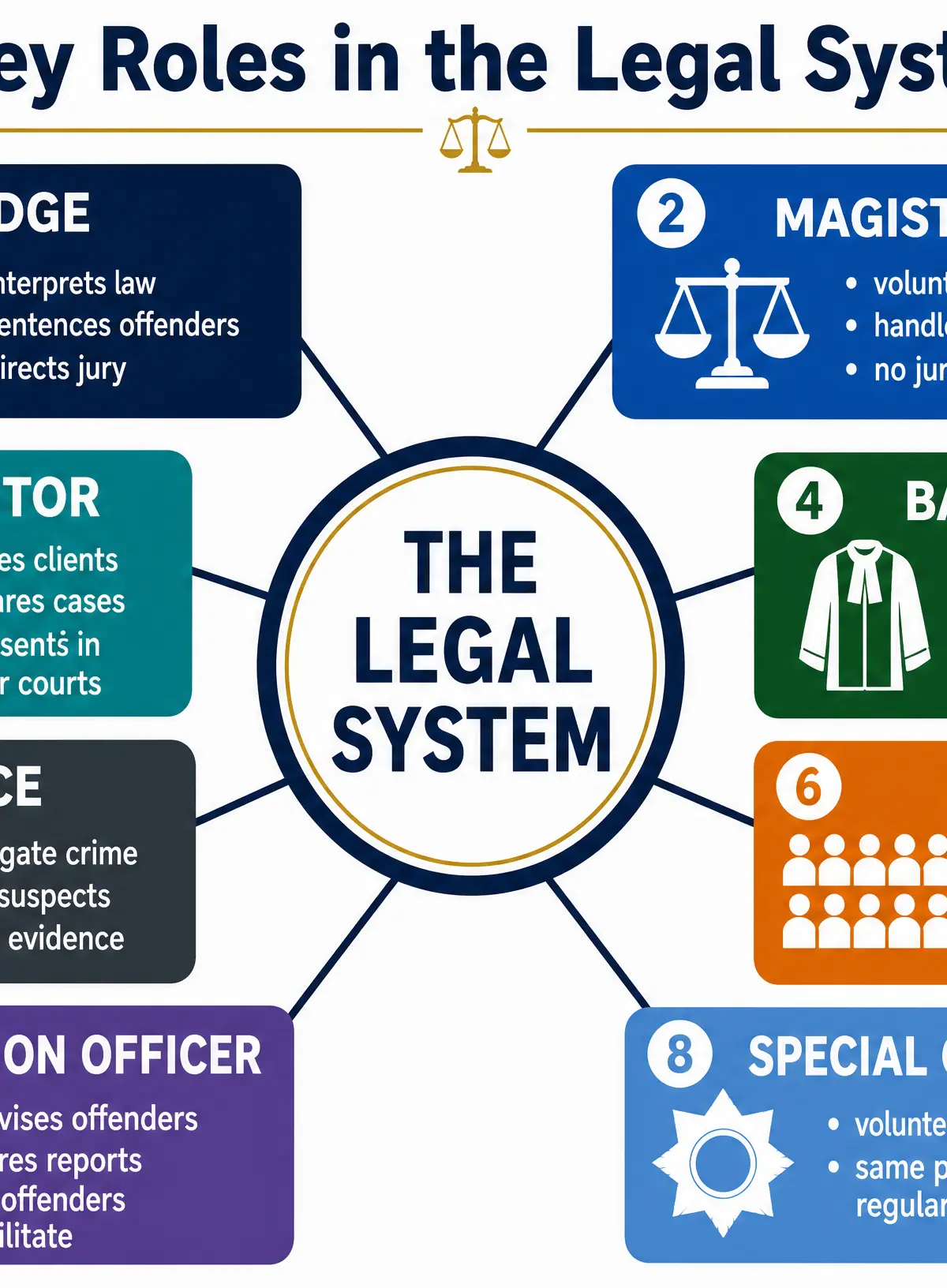
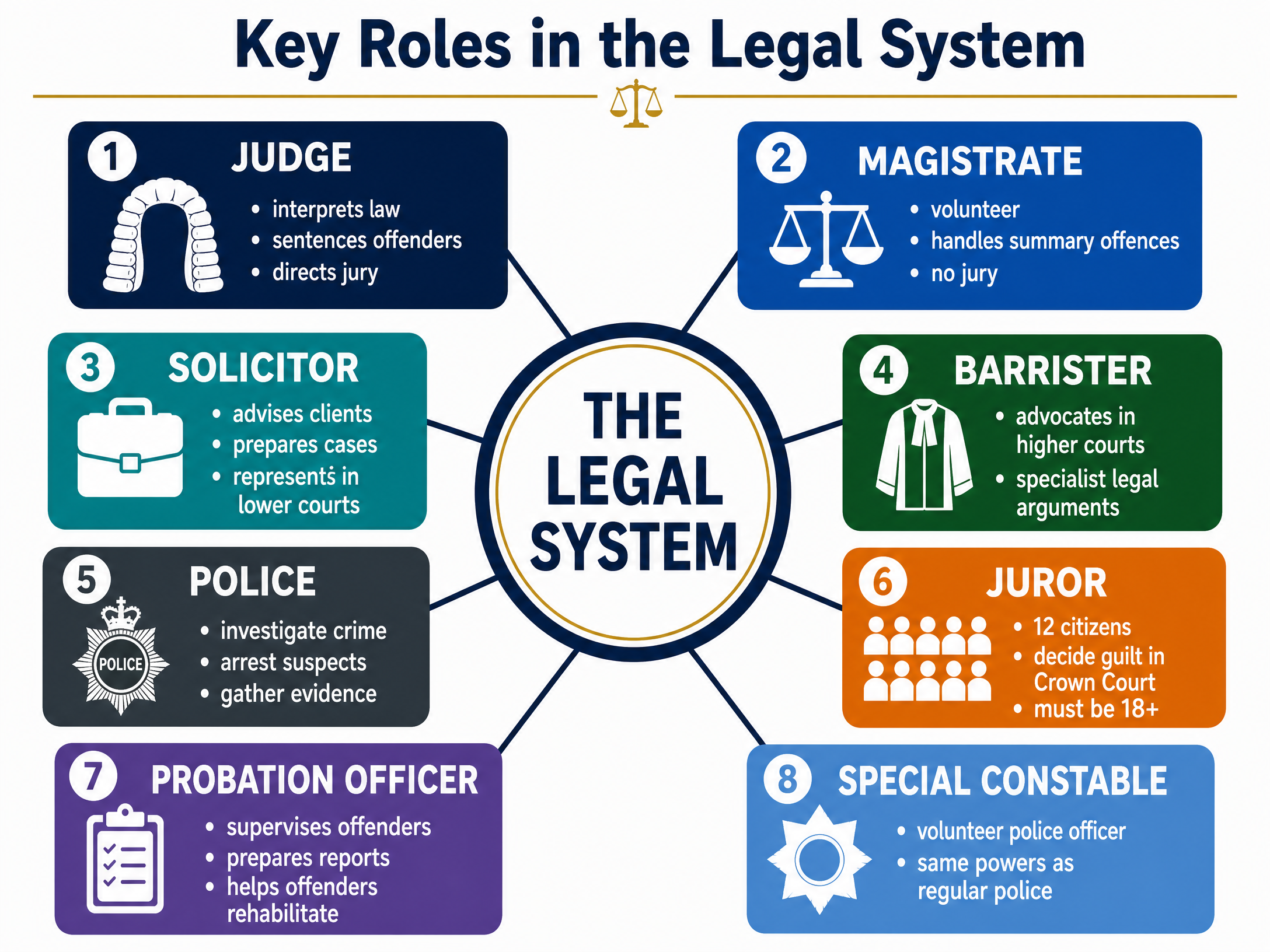
Examiners expect you to know the specific duties of various legal figures, distinguishing between professionals and active citizens.
- Judges: Legally qualified professionals who interpret the law, ensure fair trials, direct juries, and pass sentences.
- Magistrates: Volunteer citizens (Justices of the Peace) who hear cases in the Magistrates' Court. They receive training but are not legally qualified; they are advised by a legal clerk.
- Solicitors: Qualified lawyers who advise clients, prepare legal documents, and represent clients in lower courts.
- Barristers: Specialist legal advocates who represent clients in higher courts (like the Crown Court) and provide expert legal opinions.
- Police: Responsible for maintaining order, investigating crime, gathering evidence, and arresting suspects under the Police and Criminal Evidence Act 1984 (PACE).
- Jurors: 12 randomly selected citizens (aged 18-75) who listen to evidence in the Crown Court and decide the verdict (guilty/not guilty). A prime example of citizen participation in justice.
- Special Constables: Volunteer police officers who have the same powers as regular officers.
Sentencing and Punishment
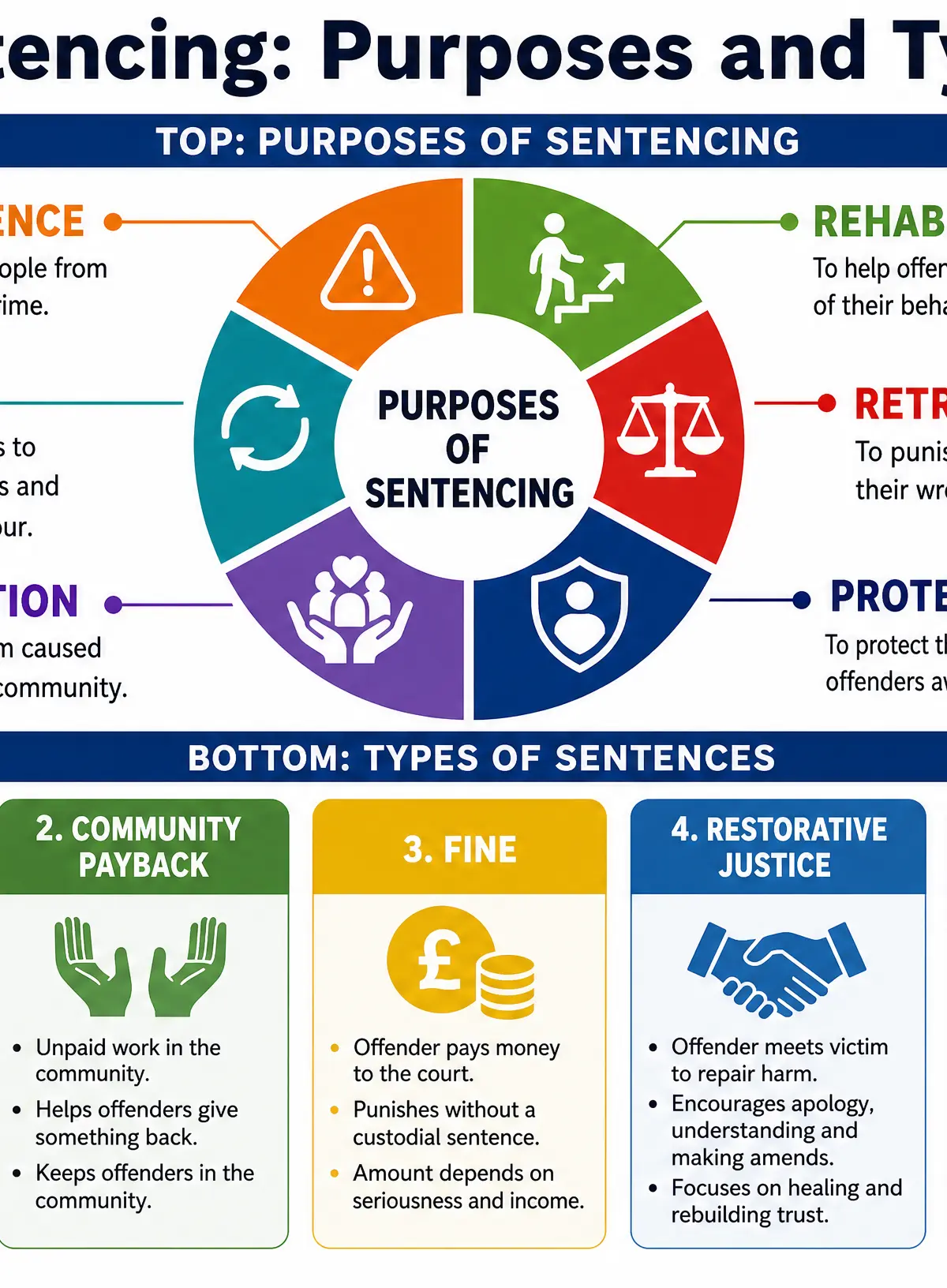
When evaluating sentencing, you must link the type of punishment to its intended purpose.
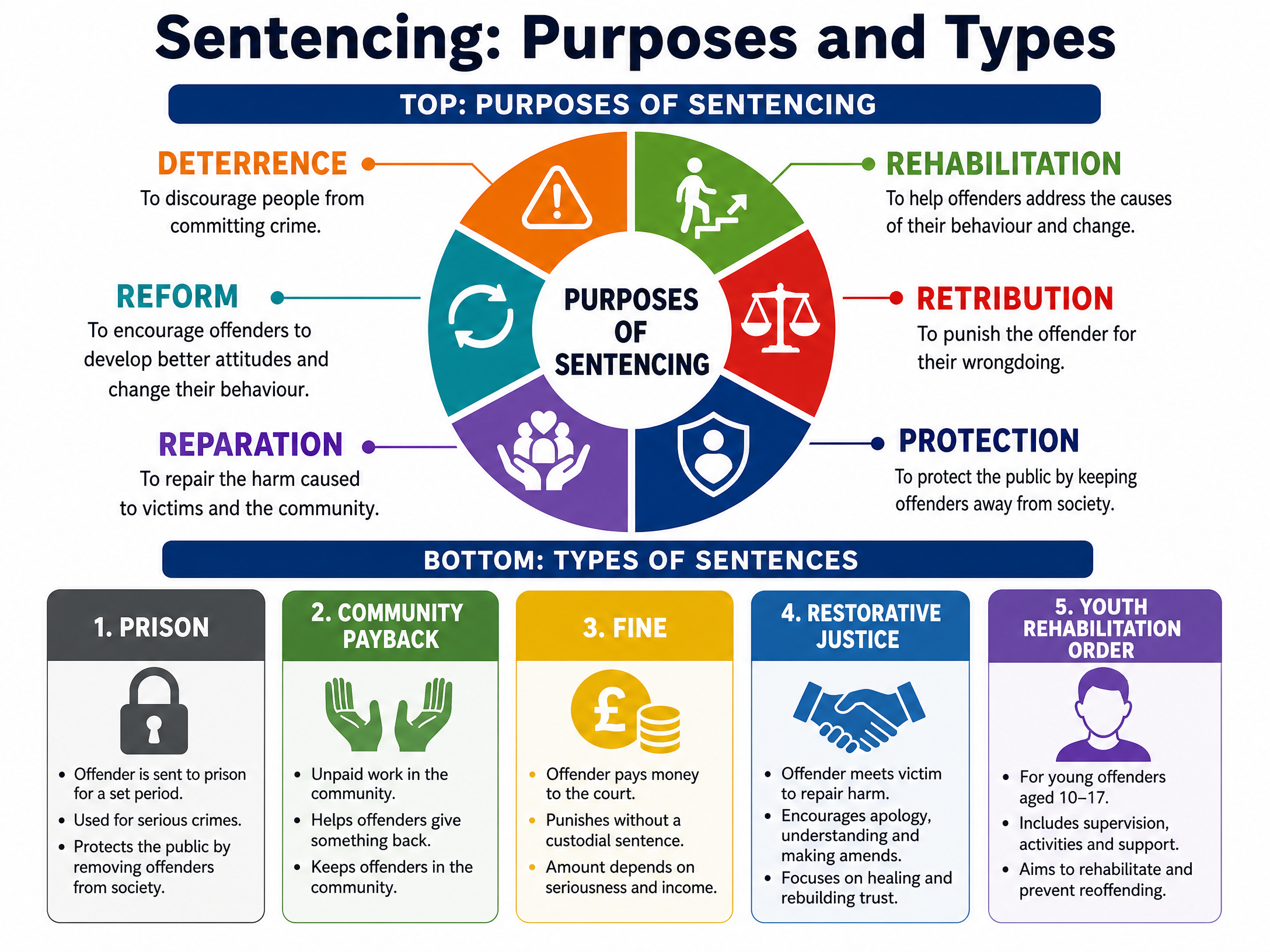
Purposes of Sentencing
- Deterrence: Discouraging the offender (specific) or the public (general) from committing crimes.
- Rehabilitation: Helping the offender address the root causes of their behaviour (e.g., drug treatment, education).
- Retribution: Punishing the offender proportionately to the crime committed (society's revenge).
- Protection: Keeping the public safe from dangerous individuals.
- Reparation: Making amends to the victim or the community.
- Reform: Encouraging long-term changes in the offender's attitude.
Types of Sentences
- Custodial Sentences (Prison): Used for serious offences. Primarily serves protection and retribution.
- Community Payback: Unpaid work in the community (e.g., removing graffiti). Serves reparation and rehabilitation.
- Fines: Financial penalties paid to the court. Serves as deterrence and retribution.
- Restorative Justice: A process where the offender meets the victim to understand the impact of their crime and make amends. Highly effective for rehabilitation and reparation.
The Youth Justice System
The age of criminal responsibility in England and Wales is 10 years old. Young offenders (aged 10-17) are treated differently from adults, with the primary focus on rehabilitation and preventing reoffending rather than retribution.
- Youth Courts: Specially trained magistrates hear cases. Proceedings are less formal, defendants are addressed by their first names, and the public is not allowed in.
- Youth Offending Teams (YOTs): Multi-agency teams (social workers, police, probation officers) that work with young people to address why they offended and support their rehabilitation.
- Sentencing: Includes Youth Rehabilitation Orders (curfews, supervision) and, as a last resort, detention in Young Offender Institutions.
Visual Resources
3 diagrams and illustrations
Interactive Diagrams
1 interactive diagram to visualise key concepts
Conceptual Flow Outline
Simplified Appeals Route (England and Wales)
Worked Examples
3 worked examples — open one to explore the question and available guidance.
Practice Questions
Test your understanding — click to reveal model answers
State two purposes of the law. (2 marks)
Hint: Think about the phrase 'Pretty Silly Frogs...'
Explain two differences between a magistrate and a judge. (4 marks)
Hint: Think about qualifications, pay, and which courts they sit in.
Explain the role of the youth justice system. (8 marks)
Hint: Mention the age of criminal responsibility, youth courts, and the main goal (rehabilitation).
Test your understanding of Theme C: Law and justice
Active recall beats re-reading. Take an instant quiz now to test what you’ve learned and lock it into long-term memory.
7 days Premium · Then free forever · No card, no charge