AQA · GCSE · Combined Science
Course version: 8464 · Version from Sept 2018
Abiotic factors: carbon dioxide levels for plants
Carbon dioxide is an abiotic factor because it is a non-living gas in the environment, and its concentration in air strongly affects plants.
Checked against the AQA 8464 specification (opens in a new tab) on .
- Point 8 of 10
- 2 key terms
Study notes
From the checked teaching notes for this specification point.
The idea
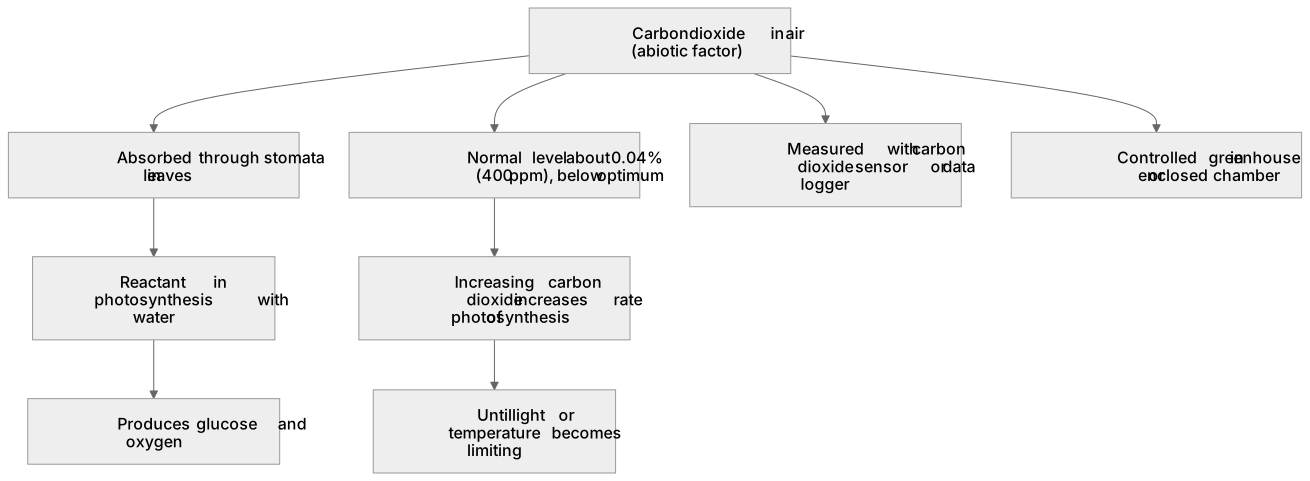
Carbon dioxide is an abiotic factor because it is a non-living gas in the environment, and its concentration in air strongly affects plants. Plants absorb carbon dioxide through stomata in their leaves and use it as a reactant in photosynthesis, where it is combined with water to make glucose and oxygen. The normal atmospheric concentration is about 0.04% (around 400 parts per million), which is lower than the optimum for photosynthesis, so increasing carbon dioxide concentration usually increases the rate of photosynthesis, provided light and temperature are not limiting. In enclosed spaces such as greenhouses, growers may raise carbon dioxide levels to boost growth.
What earns the marks
- Carbon dioxide is an abiotic factor because it is a non-living component of the environment, not an organism.
- Plants take in carbon dioxide through stomata in their leaves; it is a reactant in photosynthesis along with water.
- Photosynthesis produces glucose and oxygen: carbon dioxide + water → glucose + oxygen (in the presence of light and chlorophyll).
- The normal atmospheric carbon dioxide concentration is about 0.04% (approximately 400 parts per million), which is below the optimum for many plants.
- Increasing carbon dioxide concentration increases the rate of photosynthesis, but only until another factor such as light intensity or temperature becomes limiting.
- Carbon dioxide concentration can be measured with a carbon dioxide sensor or data logger, and controlled in a greenhouse or enclosed chamber.
- In an investigation, carbon dioxide level is the independent variable when it is changed, and the rate of photosynthesis (for example oxygen bubbles produced by pondweed) is the dependent variable.
- Plants in dense woodland or near the ground may experience different carbon dioxide levels because of respiration, decomposition and reduced air movement.
Common mistakes and how to put them right
Saying plants take in carbon dioxide for respiration.
Put it right: Plants absorb carbon dioxide for photosynthesis; respiration uses oxygen and releases carbon dioxide.
Writing that carbon dioxide is a biotic factor.
Put it right: It is a gas, so it is abiotic; biotic factors are living organisms and their interactions.
Claiming more carbon dioxide always increases growth without limit.
Put it right: Another factor such as light or temperature will eventually become limiting.
Confusing the gas exchange surface.
Put it right: Carbon dioxide enters through stomata, which are mainly in the leaves, not through the roots.
Exam tips
- Quote the approximate atmospheric value, about 0.04% or 400 ppm, to show precise knowledge of normal carbon dioxide levels.
- When explaining limiting factors, state clearly that increasing carbon dioxide raises the rate only until light or temperature becomes limiting.
- Use the word equation for photosynthesis accurately and name glucose and oxygen as the products.
- In practical questions, identify the independent variable (carbon dioxide concentration), dependent variable (rate of photosynthesis) and a control variable such as temperature or light intensity.
Try the lesson
The start of the Abiotic factors: carbon dioxide levels for plants lesson, made from checked teaching notes for this specification point.
Have a go first
Which gas do plants take in from the air to use during photosynthesis?
Listen
Carbon dioxide is an abiotic factor because it is a non-living gas in the environment, and its concentration in air strongly affects plants. Plants absorb carbon dioxide through stomata in their leaves and use it as a reactant in photosynthesis, where it is combined with water to make glucose and oxygen. The normal atmospheric concentration is about 0.04% (around 400 parts per million), which is lower than the optimum for photosynthesis, so increasing carbon dioxide concentration usually increases the rate of photosynthesis, provided light and temperature are not limiting. In enclosed spaces such as greenhouses, growers may raise carbon dioxide levels to boost growth. A strong answer earns marks for these points. Carbon dioxide is an abiotic factor because it is a non-living component of the environment, not an organism. Plants take in carbon dioxide through stomata in their leaves; it is a reactant in photosynthesis along with water. Photosynthesis produces glucose and oxygen: carbon dioxide + water → glucose + oxygen (in the presence of light and chlorophyll). The normal atmospheric carbon dioxide concentration is about 0.04% (approximately 400 parts per million), which is below the optimum for many plants. Exam tip: Quote the approximate atmospheric value, about 0.04% or 400 ppm, to show precise knowledge of normal carbon dioxide levels.
See it
Key words
Say what each word means before you turn the card.
Abiotic factor
Try answering aloud or in your head before turning the card.
Independent variable
Try answering aloud or in your head before turning the card.
See every definition
- Abiotic factor
- A non-living component of the environment, such as carbon dioxide, which is a gas rather than an organism.
- Independent variable
- The variable that is changed in an investigation, such as the carbon dioxide level.
Label the diagram
Some boxes have lost their names. Pick the right name for each number.
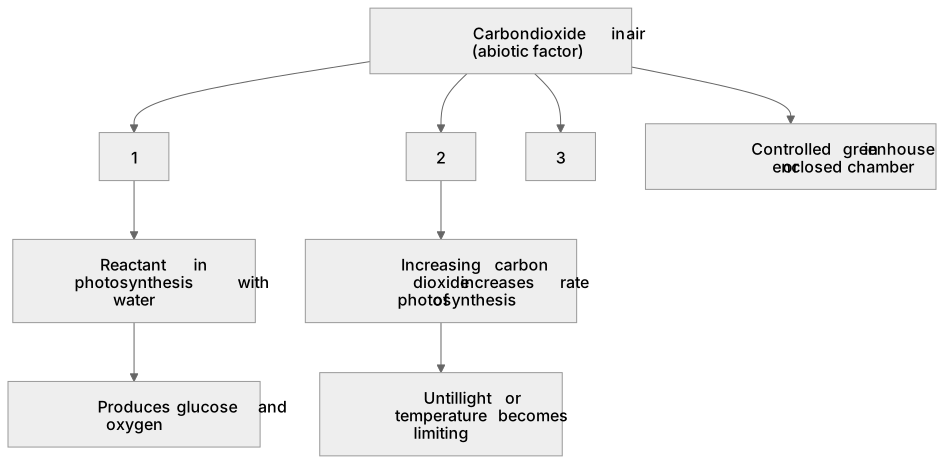
1Box 1
2Box 2
3Box 3
There is more to this lesson
The full lesson goes on to check your understanding and help you earn the marks. Create a free account to carry on, with your progress saved.
A week of Premium from your first lesson · Then the free plan continues · No card, no charge
Test your understanding of Abiotic factors: carbon dioxide levels for plants
Active recall beats re-reading. Take an instant quiz now to test what you’ve learned and lock it into long-term memory.
A week of Premium from your first lesson · Then the free plan continues · No card, no charge