AQA · GCSE · Combined Science
Course version: 8464 · Version from Sept 2018
Abiotic factors: soil pH and mineral content
Soil pH and mineral content are abiotic factors because they are non-living chemical conditions.
Checked against the AQA 8464 specification (opens in a new tab) on .
- Point 6 of 10
- 4 key terms
Study notes
From the checked teaching notes for this specification point.
The idea
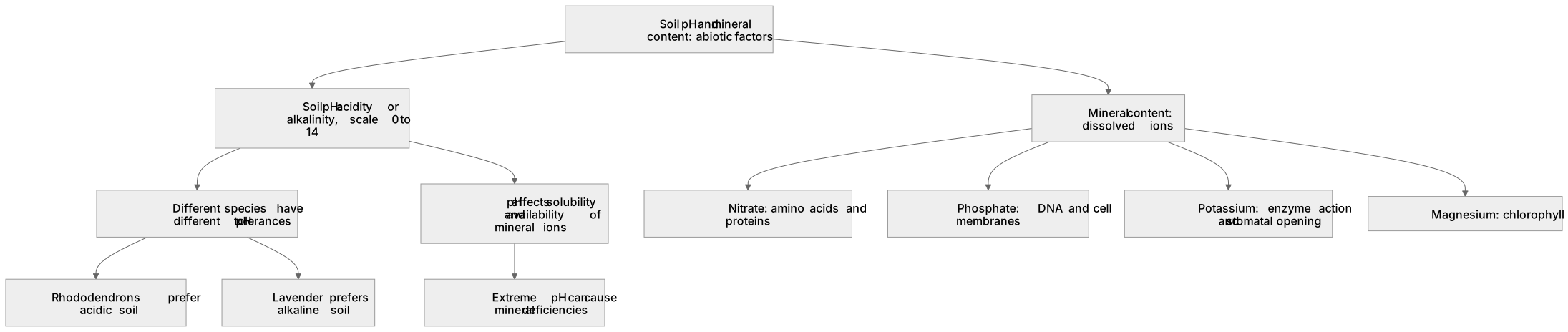
Soil pH and mineral content are abiotic factors because they are non-living chemical conditions. Soil pH measures acidity or alkalinity, usually on a scale from 0 to 14. Most plants grow best between pH 6 and pH 7, but some, such as rhododendrons, prefer acidic soil, and others, such as lavender, prefer alkaline soil. Mineral content refers to dissolved ions such as nitrate, phosphate, potassium and magnesium. Nitrate is needed for amino acids and proteins; phosphate for DNA and cell membranes; potassium for enzyme action and stomatal opening; magnesium for chlorophyll. They should explain how pH affects mineral availability and therefore plant growth and distribution.
What earns the marks
- Soil pH and mineral content are abiotic factors because they are non-living chemical conditions.
- Soil pH is a measure of acidity or alkalinity, typically on a scale from 0 to 14.
- Different plant species have different pH tolerances, which affects where they can grow.
- Mineral ions in soil include nitrate, phosphate, potassium and magnesium, each with specific roles in plants.
- Nitrate is used to make amino acids and proteins; magnesium is needed for chlorophyll; phosphate is needed for DNA and cell membranes; potassium is needed for enzyme action and stomatal opening.
- pH affects the solubility and availability of mineral ions, so extreme pH can cause mineral deficiencies even when minerals are present.
- Soil pH can be measured with a soil pH test kit or pH meter; mineral content can be assessed by soil tests or by observing plant deficiency symptoms.
Common mistakes and how to put them right
Confusing soil pH with mineral content.
Put it right: pH is a measure of acidity or alkalinity, while mineral content is the amount of dissolved ions such as nitrate and magnesium.
Stating that all plants need the same soil pH.
Put it right: Different species have different pH ranges; for example, rhododendrons prefer acidic soil while lavender prefers alkaline soil.
Saying plants absorb minerals directly from soil particles without water.
Put it right: Minerals are usually taken up as dissolved ions in water, so water availability and pH both affect uptake.
Exam tips
- Name the mineral and its plant use, for example 'nitrate for amino acids and proteins' or 'magnesium for chlorophyll'.
- When explaining distribution, link soil pH to mineral availability and then to plant growth or survival.
- Describe a measurement method precisely, such as mixing soil with distilled water and using a pH meter or indicator chart.
Try the lesson
The start of the Abiotic factors: soil pH and mineral content lesson, made from checked teaching notes for this specification point.
Have a go first
Which of these is an abiotic factor that affects organisms living in soil?
Listen
Soil pH and mineral content are abiotic factors because they are non-living chemical conditions. Soil pH measures acidity or alkalinity, usually on a scale from 0 to 14. Most plants grow best between pH 6 and pH 7, but some, such as rhododendrons, prefer acidic soil, and others, such as lavender, prefer alkaline soil. Mineral content refers to dissolved ions such as nitrate, phosphate, potassium and magnesium. Nitrate is needed for amino acids and proteins; phosphate for DNA and cell membranes; potassium for enzyme action and stomatal opening; magnesium for chlorophyll. They should explain how pH affects mineral availability and therefore plant growth and distribution. A strong answer earns marks for these points. Soil pH and mineral content are abiotic factors because they are non-living chemical conditions. Soil pH is a measure of acidity or alkalinity, typically on a scale from 0 to 14. Different plant species have different pH tolerances, which affects where they can grow. Mineral ions in soil include nitrate, phosphate, potassium and magnesium, each with specific roles in plants. A common slip: confusing soil pH with mineral content. Instead, pH is a measure of acidity or alkalinity, while mineral content is the amount of dissolved ions such as nitrate and magnesium. Exam tip: Name the mineral and its plant use, for example 'nitrate for amino acids and proteins' or 'magnesium for chlorophyll'.
See it
Key words
Say what each word means before you turn the card.
Soil pH
Try answering aloud or in your head before turning the card.
Mineral content
Try answering aloud or in your head before turning the card.
Nitrate
Try answering aloud or in your head before turning the card.
Magnesium
Try answering aloud or in your head before turning the card.
See every definition
- Soil pH
- A measure of acidity or alkalinity, usually on a scale from 0 to 14, with most plants growing best between pH 6 and pH 7.
- Mineral content
- The dissolved ions in soil, such as nitrate, phosphate, potassium and magnesium, each with specific roles in plants.
- Nitrate
- A mineral ion needed for amino acids and proteins.
- Magnesium
- A mineral ion needed for chlorophyll.
Label the diagram
Some boxes have lost their names. Pick the right name for each number.
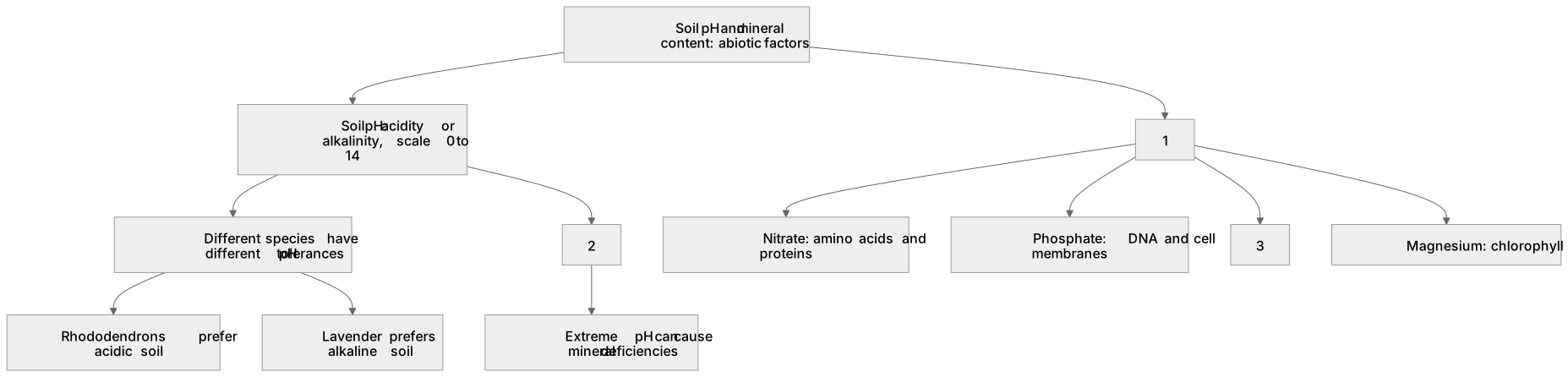
1Box 1
2Box 2
3Box 3
There is more to this lesson
The full lesson goes on to check your understanding and help you earn the marks. Create a free account to carry on, with your progress saved.
A week of Premium from your first lesson · Then the free plan continues · No card, no charge
Test your understanding of Abiotic factors: soil pH and mineral content
Active recall beats re-reading. Take an instant quiz now to test what you’ve learned and lock it into long-term memory.
A week of Premium from your first lesson · Then the free plan continues · No card, no charge