AQA · GCSE · Combined Science
Course version: 8464 · Version from Sept 2018
Acceleration: acceleration, a, in metres per second squared, m/s²
Acceleration is the rate at which velocity changes and is measured in metres per second squared, m/s².
Checked against the AQA 8464 specification (opens in a new tab) on .
- Point 4 of 21
- 3 key terms
Study notes
From the checked teaching notes for this specification point.
The idea
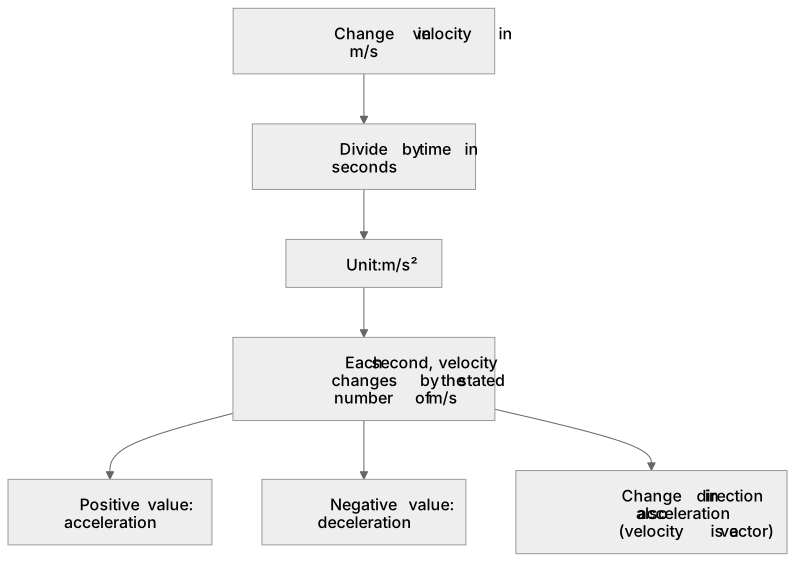
Acceleration is the rate at which velocity changes and is measured in metres per second squared, m/s². The unit comes from dividing a velocity change in metres per second (m/s) by a time in seconds (s), giving m/s ÷ s = m/s². This means that each second, the velocity changes by the stated number of metres per second. For example, an acceleration of 3 m/s² means the velocity increases by 3 m/s every second. Because velocity is a vector, a change in direction also produces acceleration, even at constant speed. A negative value, such as −2 m/s², indicates deceleration. Always write the unit as m/s², not m/s, and include it with your numerical answer.
What earns the marks
- States that acceleration is measured in metres per second squared, written as m/s².
- Explains that the unit arises from dividing a change in velocity in m/s by a time in seconds.
- Interprets a value such as 3 m/s² as a velocity increase of 3 m/s every second.
- Recognises that a change in direction is also an acceleration, because velocity is a vector.
- Uses the correct unit consistently in calculations and final answers, including negative values for deceleration.
Common mistakes and how to put them right
Writing the unit as m/s instead of m/s².
Put it right by remembering that velocity is divided by time, giving an extra per second.
Thinking acceleration only occurs when speed changes.
Put it right by noting that a change in direction at constant speed is also acceleration.
Omitting the unit or the sign from the final answer.
Put it right by writing the value with m/s² and stating whether it is acceleration or deceleration.
Exam tips
- Write the unit m/s² immediately after your numerical answer to secure the unit mark.
- If a question asks what an acceleration value means, explain it as the change in velocity each second, for example 'velocity increases by 3 m/s every second'.
- Check whether the answer should be negative by deciding whether the object is speeding up or slowing down.
Try the lesson
The start of the Acceleration: acceleration, a, in metres per second squared, m/s² lesson, made from checked teaching notes for this specification point.
Have a go first
A student measures the acceleration of a trolley moving down a ramp. Which of the following is the correct unit for acceleration?
Listen
Acceleration is the rate at which velocity changes and is measured in metres per second squared, m/s². The unit comes from dividing a velocity change in metres per second (m/s) by a time in seconds (s), giving m/s ÷ s = m/s². This means that each second, the velocity changes by the stated number of metres per second. For example, an acceleration of 3 m/s² means the velocity increases by 3 m/s every second. Because velocity is a vector, a change in direction also produces acceleration, even at constant speed. A negative value, such as −2 m/s², indicates deceleration. Always write the unit as m/s², not m/s, and include it with your numerical answer. A strong answer earns marks for these points. States that acceleration is measured in metres per second squared, written as m/s². Explains that the unit arises from dividing a change in velocity in m/s by a time in seconds. Interprets a value such as 3 m/s² as a velocity increase of 3 m/s every second. Recognises that a change in direction is also an acceleration, because velocity is a vector. A common slip: Writing the unit as m/s instead of m/s². Instead, remembering that velocity is divided by time, giving an extra per second. Exam tip: Write the unit m/s² immediately after your numerical answer to secure the unit mark.
See it
Key words
Say what each word means before you turn the card.
Acceleration
Try answering aloud or in your head before turning the card.
Metres per second squared
Try answering aloud or in your head before turning the card.
Deceleration
Try answering aloud or in your head before turning the card.
See every definition
- Acceleration
- The rate at which velocity changes, measured in metres per second squared, m/s².
- Metres per second squared
- The unit of acceleration, written as m/s², arising from dividing a velocity change in m/s by a time in seconds.
- Deceleration
- A negative value, such as −2 m/s², indicating that the object is slowing down.
Label the diagram
Some boxes have lost their names. Pick the right name for each number.
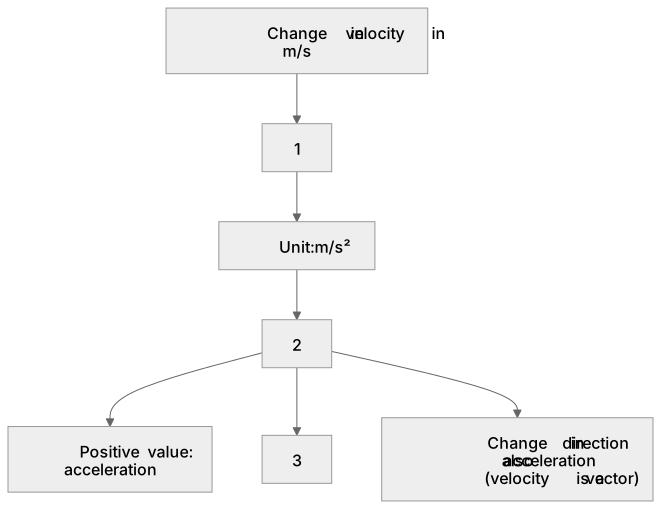
1Box 1
2Box 2
3Box 3
There is more to this lesson
The full lesson goes on to check your understanding and help you earn the marks. Create a free account to carry on, with your progress saved.
A week of Premium from your first lesson · Then the free plan continues · No card, no charge
Test your understanding of Acceleration: acceleration, a, in metres per second squared, m/s²
Active recall beats re-reading. Take an instant quiz now to test what you’ve learned and lock it into long-term memory.
A week of Premium from your first lesson · Then the free plan continues · No card, no charge