AQA · GCSE · Combined Science
Course version: 8464 · Version from Sept 2018
Acceleration: acceleration = change in velocitʸ
This statement gives the relationship used to find average acceleration: acceleration equals change in velocity divided by time taken.
Checked against the AQA 8464 specification (opens in a new tab) on .
- Point 2 of 21
Study notes
From the checked teaching notes for this specification point.
The idea
This statement gives the relationship used to find average acceleration: acceleration equals change in velocity divided by time taken. Change in velocity is final velocity minus initial velocity, so you must record both values and subtract in the correct order. Time is the duration over which that change happens. For example, a train slowing from 30 m/s to 10 m/s in 8 s has change in velocity = 10 m/s − 30 m/s = −20 m/s, so acceleration = −20 m/s ÷ 8 s = −2.5 m/s². The negative sign shows deceleration relative to the forward direction. The unit m/s² arises because velocity in m/s is divided by time in s. This calculation gives an average acceleration; if the acceleration varies, the value applies to the whole interval. Always include direction when interpreting the sign.
What earns the marks
- Identify the initial and final velocities and calculate change in velocity as final minus initial.
- Divide the change in velocity by the time taken to obtain average acceleration.
- Include the correct unit, m/s², and interpret a negative value as deceleration in the chosen positive direction.
- Recognise that the equation gives an average acceleration over the time interval, not necessarily an instantaneous value.
- Rearrange the relationship to find change in velocity or time when those quantities are required.
Common mistakes and how to put them right
Using initial velocity minus final velocity.
Put it right by using final velocity minus initial velocity.
Forgetting to convert units such as km/h to m/s before dividing.
Put it right by converting all velocities to m/s first.
Omitting the unit or writing m/s instead of m/s².
Put it right by checking that velocity divided by time gives m/s².
Exam tips
- Underline the initial and final velocities in the question before substituting to avoid reversing the subtraction.
- Show the change in velocity calculation separately from the division so method marks are clear.
- If the answer is negative, state that the object is decelerating or accelerating in the opposite direction to the chosen positive direction.
Try the lesson
The start of the Acceleration: acceleration = change in velocitʸ lesson, made from checked teaching notes for this specification point.
Have a go first
A drone speeds up from 3 m/s to 15 m/s in 4 s. What is the drone's acceleration?
Listen
This statement gives the relationship used to find average acceleration: acceleration equals change in velocity divided by time taken. Change in velocity is final velocity minus initial velocity, so you must record both values and subtract in the correct order. Time is the duration over which that change happens. For example, a train slowing from 30 m/s to 10 m/s in 8 s has change in velocity = 10 m/s − 30 m/s = −20 m/s, so acceleration = −20 m/s ÷ 8 s = −2.5 m/s². The negative sign shows deceleration relative to the forward direction. The unit m/s² arises because velocity in m/s is divided by time in s. This calculation gives an average acceleration; if the acceleration varies, the value applies to the whole interval. Always include direction when interpreting the sign. A strong answer earns marks for these points. Identify the initial and final velocities and calculate change in velocity as final minus initial. Divide the change in velocity by the time taken to obtain average acceleration. Include the correct unit, m/s², and interpret a negative value as deceleration in the chosen positive direction. Recognise that the equation gives an average acceleration over the time interval, not necessarily an instantaneous value. A common slip: Using initial velocity minus final velocity. Instead, using final velocity minus initial velocity. Exam tip: Underline the initial and final velocities in the question before substituting to avoid reversing the subtraction.
See it
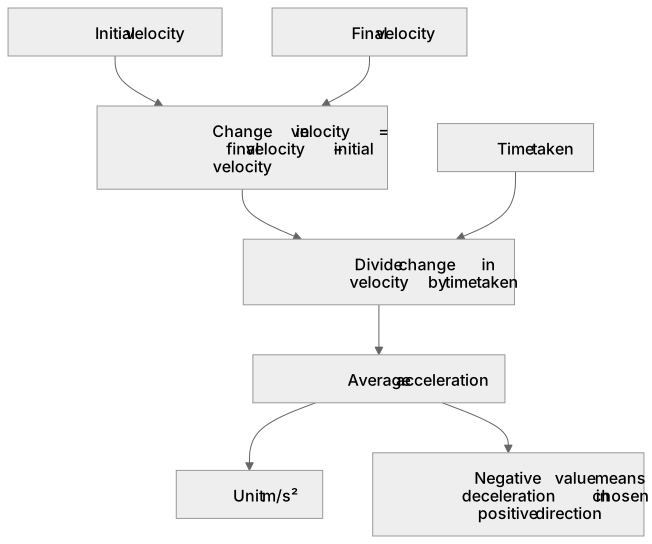
Label the diagram
Some boxes have lost their names. Pick the right name for each number.
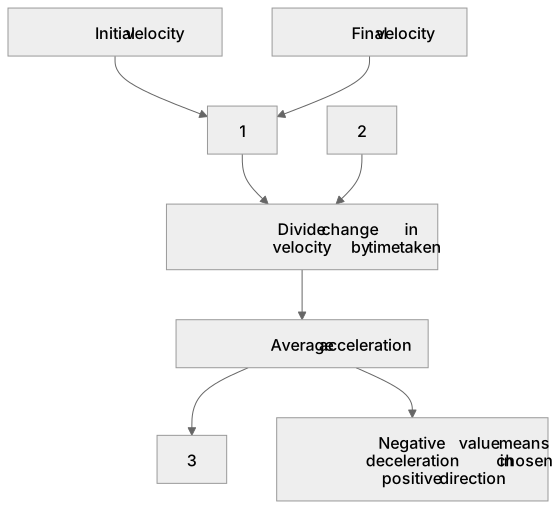
1Box 1
2Box 2
3Box 3
There is more to this lesson
The full lesson goes on to check your understanding and help you earn the marks. Create a free account to carry on, with your progress saved.
A week of Premium from your first lesson · Then the free plan continues · No card, no charge
Test your understanding of Acceleration: acceleration = change in velocitʸ
Active recall beats re-reading. Take an instant quiz now to test what you’ve learned and lock it into long-term memory.
A week of Premium from your first lesson · Then the free plan continues · No card, no charge