AQA · GCSE · Combined Science
Course version: 8464 · Version from Sept 2018
Specific latent heat, L, in joules per kilogram, J/kg
Full specification wording
Changes of state and specific latent heat: specific latent heat, L, in joules per kilogram, J/kg
Specific latent heat, L, is the energy needed to change the state of one kilogram of a substance without changing its temperature.
Checked against the AQA 8464 specification (opens in a new tab) on .
- Point 8 of 12
- 4 key terms
Study notes
From the checked teaching notes for this specification point.
The idea
Specific latent heat, L, is the energy needed to change the state of one kilogram of a substance without changing its temperature. It is measured in joules per kilogram, J/kg. During a change of state, energy is transferred to or from the substance, but the temperature stays constant because the energy is used to overcome forces between particles rather than increase their kinetic energy. For example, melting 0.50 kg of ice requires energy E = mL. If L for ice is 334 000 J/kg, then E = 0.50 × 334 000 = 167 000 J. The same value of L applies when the substance changes back, so freezing releases energy. You must be able to use the equation E = mL, rearrange it, and interpret the unit J/kg as energy per kilogram.
What earns the marks
- State that specific latent heat is the energy required to change the state of 1 kg of a substance with no temperature change.
- Use the equation E = mL, where E is energy in joules, m is mass in kilograms and L is specific latent heat in J/kg.
- Rearrange the equation to find L = E/m or m = E/L when required.
- Interpret J/kg as the energy in joules needed to change the state of each kilogram of a substance.
- Explain that temperature remains constant during a change of state because energy is used to break or form intermolecular bonds rather than increase kinetic energy.
Common mistakes and how to put them right
Using grams instead of kilograms in E = mL.
Put it right: Convert mass to kilograms before calculating, because L is in J/kg.
Thinking that temperature rises during melting or boiling.
Put it right: Temperature stays constant during a change of state; the energy changes the arrangement of particles, not their average kinetic energy.
Confusing specific latent heat with specific heat capacity.
Put it right: Specific heat capacity is energy per kilogram per degree Celsius for a temperature change; specific latent heat is energy per kilogram for a change of state at constant temperature.
Exam tips
- Always write the equation E = mL, substitute values with units, and show your working clearly.
- Check that mass is in kilograms and energy is in joules before calculating; convert if necessary.
- When explaining why temperature is constant, refer to energy being transferred to overcome forces between particles, not to increasing kinetic energy.
Try the lesson
The start of the Changes of state and specific latent heat: specific latent heat, L, in joules per kilogram, J/kg lesson, made from checked teaching notes for this specification point.
Have a go first
What is the unit of specific latent heat?
Listen
Specific latent heat, L, is the energy needed to change the state of one kilogram of a substance without changing its temperature. It is measured in joules per kilogram, J/kg. During a change of state, energy is transferred to or from the substance, but the temperature stays constant because the energy is used to overcome forces between particles rather than increase their kinetic energy. For example, melting 0.50 kg of ice requires energy E = mL. If L for ice is 334 000 J/kg, then E = 0.50 × 334 000 = 167 000 J. The same value of L applies when the substance changes back, so freezing releases energy. You must be able to use the equation E = mL, rearrange it, and interpret the unit J/kg as energy per kilogram. A strong answer earns marks for these points. State that specific latent heat is the energy required to change the state of 1 kg of a substance with no temperature change. Use the equation E = mL, where E is energy in joules, m is mass in kilograms and L is specific latent heat in J/kg. Rearrange the equation to find L = E/m or m = E/L when required. Interpret J/kg as the energy in joules needed to change the state of each kilogram of a substance. A common slip: Using grams instead of kilograms in E = mL. Instead, convert mass to kilograms before calculating, because L is in J/kg. Exam tip: Always write the equation E = mL, substitute values with units, and show your working clearly.
See it
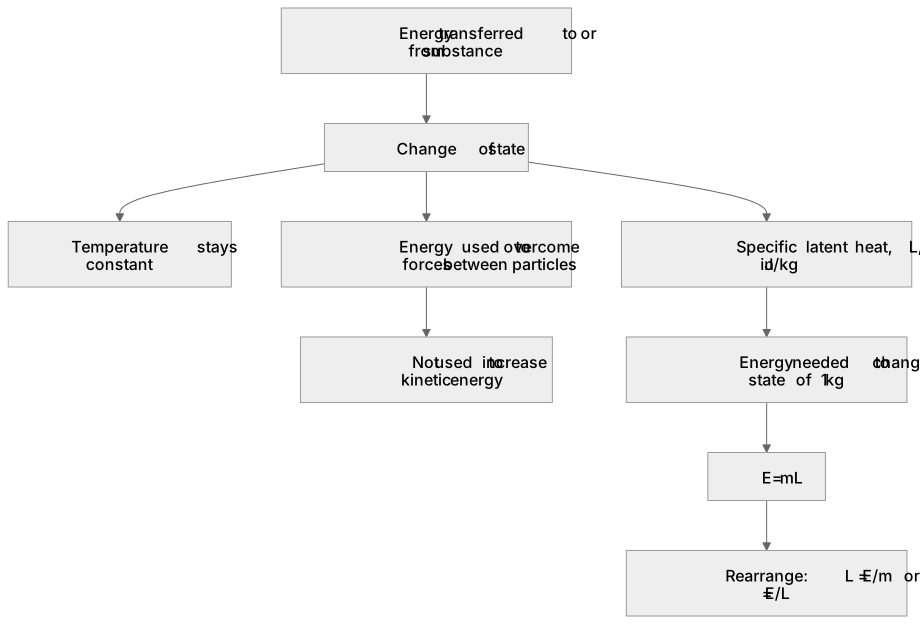
Key words
Say what each word means before you turn the card.
Specific latent heat
Try answering aloud or in your head before turning the card.
E = mL
Try answering aloud or in your head before turning the card.
J/kg
Try answering aloud or in your head before turning the card.
Temperature during a change of state
Try answering aloud or in your head before turning the card.
See every definition
- Specific latent heat
- The energy needed to change the state of one kilogram of a substance without changing its temperature, measured in joules per kilogram, J/kg.
- E = mL
- The equation where E is energy in joules, m is mass in kilograms and L is specific latent heat in J/kg.
- J/kg
- The energy in joules needed to change the state of each kilogram of a substance.
- Temperature during a change of state
- It stays constant because energy is used to overcome forces between particles rather than increase their kinetic energy.
Label the diagram
Some boxes have lost their names. Pick the right name for each number.
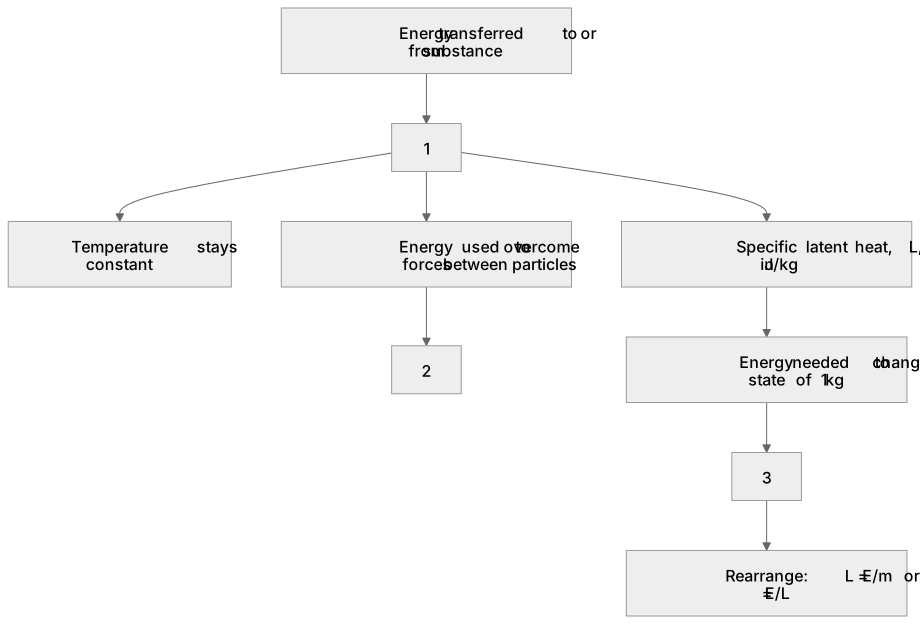
1Box 1
2Box 2
3Box 3
There is more to this lesson
The full lesson goes on to check your understanding and help you earn the marks. Create a free account to carry on, with your progress saved.
A week of Premium from your first lesson · Then the free plan continues · No card, no charge
Test your understanding of Changes of state and specific latent heat: specific latent heat, L, in joules per kilogram, J/kg
Active recall beats re-reading. Take an instant quiz now to test what you’ve learned and lock it into long-term memory.
A week of Premium from your first lesson · Then the free plan continues · No card, no charge