AQA · GCSE · Combined Science
Course version: 8464 · Version from Sept 2018
Students should be able to distinguish between specific heat capacity and…
Full specification wording
Changes of state and specific latent heat: Students should be able to distinguish between specific heat capacity and specific latent heat.
Specific heat capacity and specific latent heat both describe energy transfer per unit mass, but they apply to different situations.
Checked against the AQA 8464 specification (opens in a new tab) on .
- Point 12 of 12
- 3 key terms
Study notes
From the checked teaching notes for this specification point.
The idea
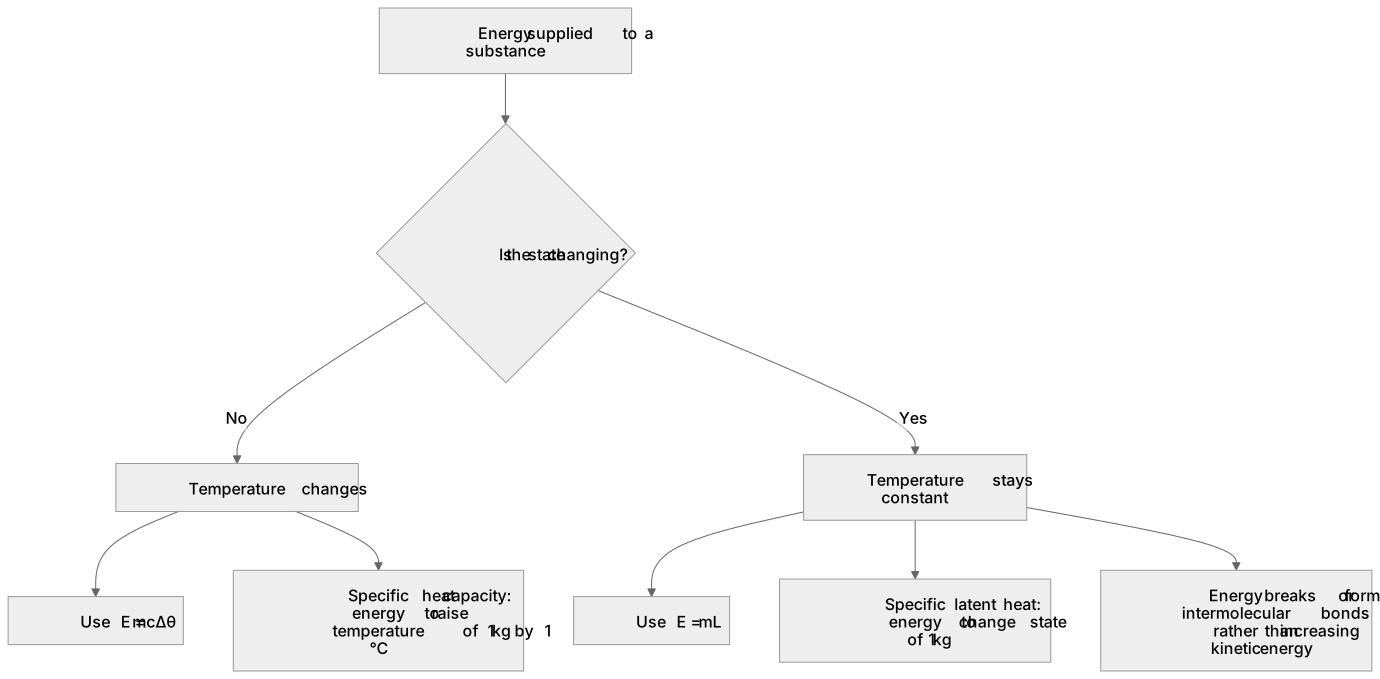
Specific heat capacity and specific latent heat both describe energy transfer per unit mass, but they apply to different situations. Specific heat capacity, c, is the energy needed to raise the temperature of 1 kg of a substance by 1 °C without changing state, calculated using E = mcΔθ. Specific latent heat, L, is the energy needed to change the state of 1 kg of a substance without changing its temperature, calculated using E = mL. For example, heating 2 kg of water from 20 °C to 100 °C uses E = mcΔθ, while boiling that water at 100 °C uses E = mL. During a change of state, energy breaks or forms intermolecular bonds rather than increasing kinetic energy, so temperature stays constant.
What earns the marks
- State that specific heat capacity relates to a temperature change with no change of state, whereas specific latent heat relates to a change of state at constant temperature.
- Define specific heat capacity as the energy required to raise the temperature of 1 kg of a substance by 1 °C, and specific latent heat as the energy required to change the state of 1 kg of a substance.
- Use E = mcΔθ for temperature changes and E = mL for changes of state, selecting the correct equation for the scenario described.
- Explain that during melting or boiling, supplied energy increases the internal energy stored in intermolecular bonds rather than the average kinetic energy of the particles, so the thermometer reading does not change.
- Interpret a heating graph showing sloping sections where temperature rises and flat sections where state changes, linking each section to the appropriate quantity.
Common mistakes and how to put them right
Using E = mcΔθ during a change of state.
Put it right by recognising that Δθ is zero while melting or boiling, so E = mL must be used instead.
Treating specific latent heat as a temperature change.
Put it right by stating that latent heat produces no temperature change and is measured in J/kg.
Confusing the units J/kg °C for specific heat capacity with J/kg for specific latent heat.
Put it right by checking that the unit matches the quantity and equation used.
Exam tips
- Underline the words 'temperature change' or 'change of state' in the question before choosing an equation.
- When explaining a flat section on a heating graph, refer explicitly to energy being transferred to break intermolecular bonds rather than to increase kinetic energy.
- Show the equation, substitution and unit in calculation answers so that method and final value can both be credited.
Try the lesson
The start of the Changes of state and specific latent heat: Students should be able to distinguish between specific heat capacity and specific latent heat. lesson, made from checked teaching notes for this specification point.
Have a go first
Which quantity describes the energy needed to raise the temperature of 1 kg of a substance by 1 °C?
Listen
Specific heat capacity and specific latent heat both describe energy transfer per unit mass, but they apply to different situations. Specific heat capacity, c, is the energy needed to raise the temperature of 1 kg of a substance by 1 °C without changing state, calculated using E = mcΔθ. Specific latent heat, L, is the energy needed to change the state of 1 kg of a substance without changing its temperature, calculated using E = mL. For example, heating 2 kg of water from 20 °C to 100 °C uses E = mcΔθ, while boiling that water at 100 °C uses E = mL. During a change of state, energy breaks or forms intermolecular bonds rather than increasing kinetic energy, so temperature stays constant. A strong answer earns marks for these points. State that specific heat capacity relates to a temperature change with no change of state, whereas specific latent heat relates to a change of state at constant temperature. Define specific heat capacity as the energy required to raise the temperature of 1 kg of a substance by 1 °C, and specific latent heat as the energy required to change the state of 1 kg of a substance. Use E = mcΔθ for temperature changes and E = mL for changes of state, selecting the correct equation for the scenario described. Explain that during melting or boiling, supplied energy increases the internal energy stored in intermolecular bonds rather than the average kinetic energy of the particles, so the thermometer reading does not change. A common slip: Using E = mcΔθ during a change of state. Instead, recognising that Δθ is zero while melting or boiling, so E = mL must be used instead. Exam tip: Underline the words 'temperature change' or 'change of state' in the question before choosing an equation.
See it
Key words
Say what each word means before you turn the card.
Specific heat capacity
Try answering aloud or in your head before turning the card.
Specific latent heat
Try answering aloud or in your head before turning the card.
Change of state
Try answering aloud or in your head before turning the card.
See every definition
- Specific heat capacity
- The energy needed to raise the temperature of 1 kg of a substance by 1 °C without changing state, calculated using E = mcΔθ.
- Specific latent heat
- The energy needed to change the state of 1 kg of a substance without changing its temperature, calculated using E = mL.
- Change of state
- A process in which energy breaks or forms intermolecular bonds rather than increasing kinetic energy, so temperature stays constant.
There is more to this lesson
The full lesson goes on to check your understanding and help you earn the marks. Create a free account to carry on, with your progress saved.
A week of Premium from your first lesson · Then the free plan continues · No card, no charge
Test your understanding of Changes of state and specific latent heat: Students should be able to distinguish between specific heat capacity and specific latent heat.
Active recall beats re-reading. Take an instant quiz now to test what you’ve learned and lock it into long-term memory.
A week of Premium from your first lesson · Then the free plan continues · No card, no charge