AQA · GCSE · Combined Science
Course version: 8464 · Version from Sept 2018
Whenever a measurement is made there is always some uncertainty about the…
Full specification wording
Chemical measurements: Whenever a measurement is made there is always some uncertainty about the result obtained.
Every measurement carries uncertainty because instruments have finite resolution and readings vary.
Checked against the AQA 8464 specification (opens in a new tab) on .
- Point 1 of 3
- 4 key terms
Study notes
From the checked teaching notes for this specification point.
The idea
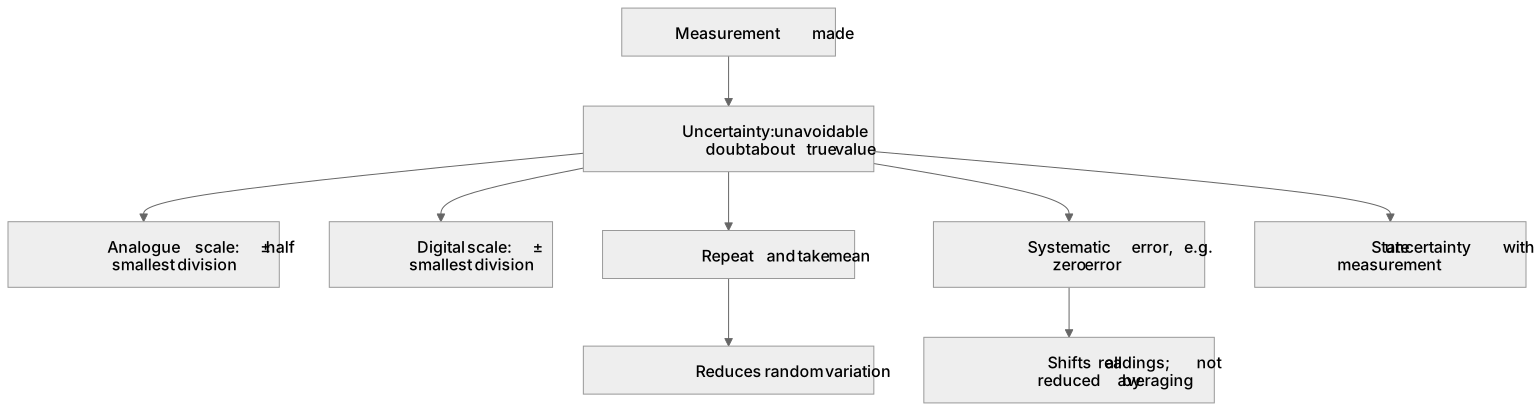
Every measurement carries uncertainty because instruments have finite resolution and readings vary. When you read a burette, the true volume lies within a small range around your recorded value. Uncertainty is not the same as a mistake: it is the unavoidable doubt about the true value. You estimate it from the scale division: for analogue instruments like a burette read to 0.1 cm³, it is often ± half the smallest division (±0.05 cm³), whereas for digital instruments like a balance reading to 0.01 g, it is ± the smallest division (±0.01 g). Repeating a measurement and taking a mean reduces the effect of random variation, but a systematic offset, such as a zero error, shifts all results and is not removed by averaging.
What earns the marks
- Uncertainty arises because every instrument has a smallest scale division, so a reading is only known to lie within a range around the recorded value.
- Repeating a measurement and calculating a mean reduces the effect of random variation on the reported value.
- Systematic errors, such as a zero error or a mis-set balance, shift all readings in one direction and are not reduced by averaging.
- Uncertainty should be stated with the measurement, for example 24.60 cm³ ± 0.05 cm³, so the precision of the result is clear.
- The size of the uncertainty affects how many significant figures are justified in a final calculated answer.
Common mistakes and how to put them right
Treating uncertainty as a mistake.
Put it right: Describe it as the unavoidable doubt about the true value and to estimate its size from the instrument scale.
Believing that repeating a measurement removes all uncertainty.
Put it right: Repeats reduce random variation but a systematic offset remains.
Quoting a mean to more decimal places than the instrument justifies.
Put it right: Round the mean to the precision of the readings, such as 24.60 cm³.
Exam tips
- State the uncertainty with the correct unit and sign, for example ±0.05 cm³, rather than writing only a number.
- When asked to improve reliability, link repeating and averaging to reducing random variation, and mention checking for zero error to address systematic error.
- In calculations, carry the uncertainty through to the final answer and round the result to a sensible number of significant figures.
Try the lesson
The start of the Chemical measurements: Whenever a measurement is made there is always some uncertainty about the result obtained. lesson, made from checked teaching notes for this specification point.
Have a go first
A student reads the volume of liquid in a measuring cylinder. Why is the value recorded never exact?
Listen
Every measurement carries uncertainty because instruments have finite resolution and readings vary. When you read a burette, the true volume lies within a small range around your recorded value. Uncertainty is not the same as a mistake: it is the unavoidable doubt about the true value. You estimate it from the scale division: for analogue instruments like a burette read to 0.1 cm³, it is often ± half the smallest division (±0.05 cm³), whereas for digital instruments like a balance reading to 0.01 g, it is ± the smallest division (±0.01 g). Repeating a measurement and taking a mean reduces the effect of random variation, but a systematic offset, such as a zero error, shifts all results and is not removed by averaging. A strong answer earns marks for these points. Uncertainty arises because every instrument has a smallest scale division, so a reading is only known to lie within a range around the recorded value. The uncertainty of a single reading is commonly estimated as half the smallest scale division for analogue scales (e.g. ±0.05 cm³ for a 0.1 cm³ burette), or the smallest division for digital scales (e.g. ±0.01 g for a 0.01 g balance). Repeating a measurement and calculating a mean reduces the effect of random variation on the reported value. Systematic errors, such as a zero error or a mis-set balance, shift all readings in one direction and are not reduced by averaging. A common slip: Treating uncertainty as a mistake: the error is calling it an error to be eliminated. Instead, describe it as the unavoidable doubt about the true value and to estimate its size from the instrument scale. Exam tip: State the uncertainty with the correct unit and sign, for example ±0.05 cm³, rather than writing only a number.
See it
Key words
Say what each word means before you turn the card.
Measurement and uncertainty
Try answering aloud or in your head before turning the card.
Instrument resolution and precision
Try answering aloud or in your head before turning the card.
Random and systematic error
Try answering aloud or in your head before turning the card.
Reliability and repeatability of data
Try answering aloud or in your head before turning the card.
See every definition
- Measurement and uncertainty
- Whenever a measurement is made there is always some uncertainty about the result obtained, an unavoidable doubt about the true value rather than a mistake.
- Instrument resolution and precision
- Every instrument has a smallest scale division, so a reading is only known to lie within a range around the recorded value.
- Random and systematic error
- Repeating a measurement and taking a mean reduces the effect of random variation, but a systematic offset such as a zero error shifts all results and is not removed by averaging.
- Reliability and repeatability of data
- Repeating a measurement and calculating a mean reduces the effect of random variation on the reported value.
Label the diagram
Some boxes have lost their names. Pick the right name for each number.
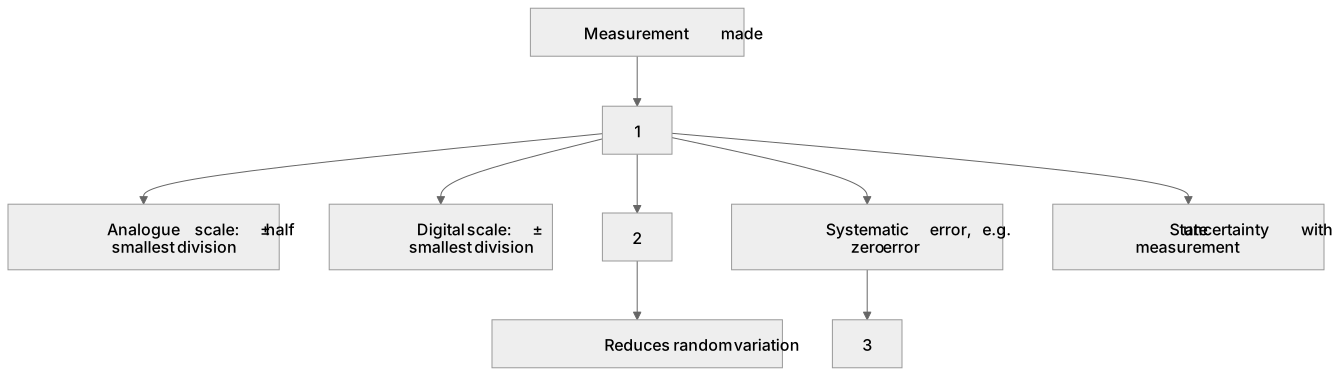
1Box 1
2Box 2
3Box 3
There is more to this lesson
The full lesson goes on to check your understanding and help you earn the marks. Create a free account to carry on, with your progress saved.
A week of Premium from your first lesson · Then the free plan continues · No card, no charge
Test your understanding of Chemical measurements: Whenever a measurement is made there is always some uncertainty about the result obtained.
Active recall beats re-reading. Take an instant quiz now to test what you’ve learned and lock it into long-term memory.
A week of Premium from your first lesson · Then the free plan continues · No card, no charge