AQA · GCSE · Combined Science
Course version: 8464 · Version from Sept 2018
In a closed system, the total momentum before an event is equal to the…
Full specification wording
Conservation of momentum: In a closed system, the total momentum before an event is equal to the total momentum after the event.
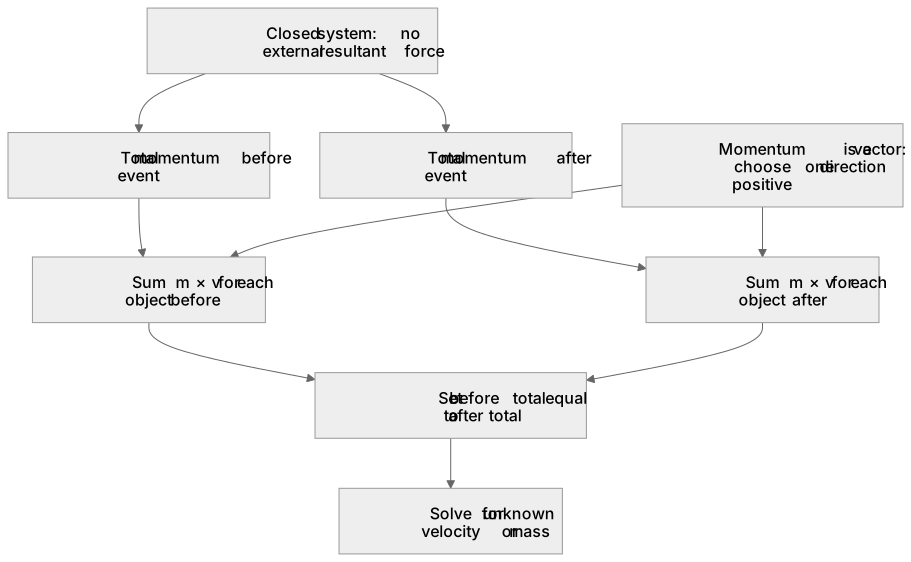
In a closed system, no external resultant force acts, so the total momentum before an event equals the total momentum after it.
Checked against the AQA 8464 specification (opens in a new tab) on .
- Point 1 of 3
- 4 key terms
Study notes
From the checked teaching notes for this specification point.
The idea
In a closed system, no external resultant force acts, so the total momentum before an event equals the total momentum after it. This is the conservation of momentum, which is assessed at Higher Tier only. The principle applies to collisions, explosions and other interactions. To use it, add the momentum of every object before the event, add the momentum of every object after the event, and set the two totals equal. For example, a 2 kg trolley moving at 3 m/s hits a stationary 1 kg trolley and they stick together. Before: (2 × 3) + (1 × 0) = 6 kg m/s. After: (2 + 1) × v = 3v, so 3v = 6 and v = 2 m/s. Momentum is a vector, so assign one direction as positive and give velocities in the opposite direction a negative sign.
What earns the marks
- State that a closed system has no external resultant force acting on it.
- Calculate total momentum before an event by summing m × v for each object.
- Calculate total momentum after an event by summing m × v for each object.
- Equate total momentum before and total momentum after to solve for an unknown velocity or mass.
- Apply a positive direction convention and use negative values for velocities in the opposite direction.
Common mistakes and how to put them right
Adding speeds instead of calculating momentum.
Put it right by multiplying each mass by its velocity before adding.
Forgetting to include a stationary object's momentum.
Put it right by including its m × v term, which is zero but still part of the total.
Mixing up before and after totals.
Put it right by labelling the two sides of the equation clearly before substituting values.
Ignoring the vector nature of momentum.
Put it right by assigning a negative sign to velocities in the opposite direction.
Exam tips
- Draw a before-and-after diagram and label each mass and velocity with its direction.
- Choose one direction as positive at the start and show negative signs for motion in the opposite direction.
- Check that the unit of momentum is kg m/s throughout the calculation.
- Remember that conservation of momentum is a Higher Tier only topic, so expect it in more challenging calculation contexts.
Try the lesson
The start of the Conservation of momentum: In a closed system, the total momentum before an event is equal to the total momentum after the event. lesson, made from checked teaching notes for this specification point.
Have a go first
A closed system contains two trolleys. Before they collide, the total momentum of the system is 12 kg m/s. What is the total momentum of the system after the collision?
Listen
In a closed system, no external resultant force acts, so the total momentum before an event equals the total momentum after it. This is the conservation of momentum, which is assessed at Higher Tier only. The principle applies to collisions, explosions and other interactions. To use it, add the momentum of every object before the event, add the momentum of every object after the event, and set the two totals equal. For example, a 2 kg trolley moving at 3 m/s hits a stationary 1 kg trolley and they stick together. Before: (2 × 3) + (1 × 0) = 6 kg m/s. After: (2 + 1) × v = 3v, so 3v = 6 and v = 2 m/s. Momentum is a vector, so assign one direction as positive and give velocities in the opposite direction a negative sign. A strong answer earns marks for these points. State that a closed system has no external resultant force acting on it. Calculate total momentum before an event by summing m × v for each object. Calculate total momentum after an event by summing m × v for each object. Equate total momentum before and total momentum after to solve for an unknown velocity or mass. A common slip: Adding speeds instead of calculating momentum. Instead, multiplying each mass by its velocity before adding. Exam tip: Draw a before-and-after diagram and label each mass and velocity with its direction.
See it
Key words
Say what each word means before you turn the card.
Closed systems
Try answering aloud or in your head before turning the card.
Conservation of momentum
Try answering aloud or in your head before turning the card.
Momentum as a vector
Try answering aloud or in your head before turning the card.
Collisions and explosions
Try answering aloud or in your head before turning the card.
See every definition
- Closed systems
- A system in which no external resultant force acts on it.
- Conservation of momentum
- The total momentum before an event is equal to the total momentum after the event in a closed system.
- Momentum as a vector
- Momentum has direction, so one direction is assigned as positive and velocities in the opposite direction are given a negative sign.
- Collisions and explosions
- Interactions to which the principle that total momentum before an event equals total momentum after it applies.
Label the diagram
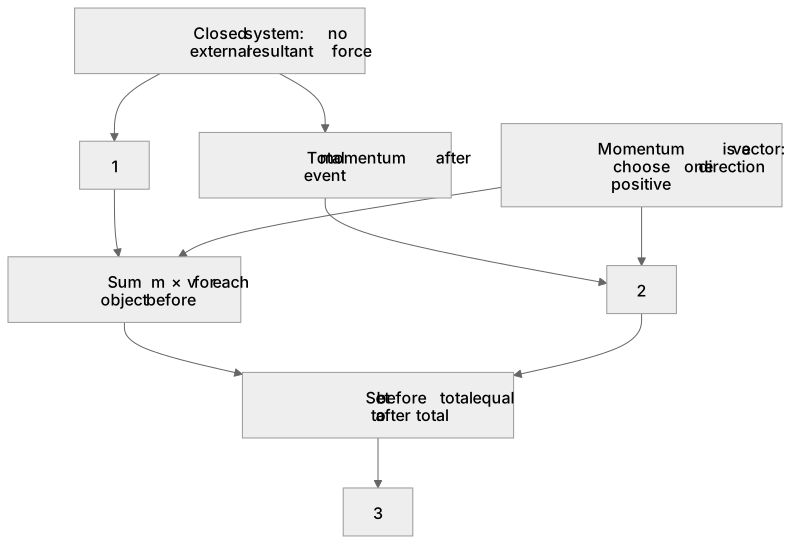
Some boxes have lost their names. Pick the right name for each number.
1Box 1
2Box 2
3Box 3
There is more to this lesson
The full lesson goes on to check your understanding and help you earn the marks. Create a free account to carry on, with your progress saved.
A week of Premium from your first lesson · Then the free plan continues · No card, no charge
Test your understanding of Conservation of momentum: In a closed system, the total momentum before an event is equal to the total momentum after the event.
Active recall beats re-reading. Take an instant quiz now to test what you’ve learned and lock it into long-term memory.
A week of Premium from your first lesson · Then the free plan continues · No card, no charge