AQA · GCSE · Combined Science
Course version: 8464 · Version from Sept 2018
A force is a push or pull that acts on an object due to the interaction…
Full specification wording
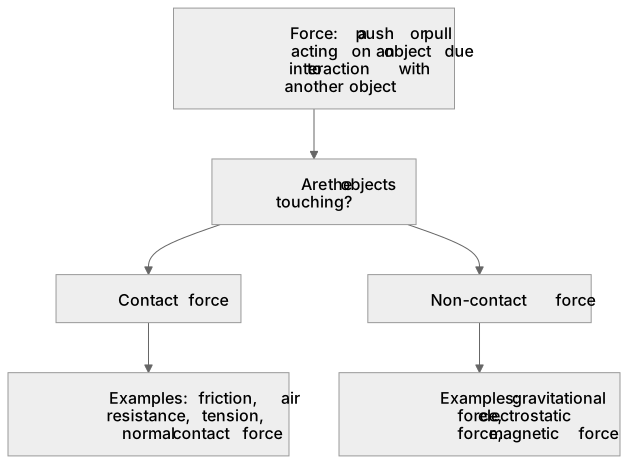
Contact and non-contact forces: A force is a push or pull that acts on an object due to the interaction with another object. All forces between objects are either:
A force is a push or a pull acting on an object because it interacts with another object; forces arise from interactions and are measured in newtons (N).
Checked against the AQA 8464 specification (opens in a new tab) on .
- Point 1 of 7
- 4 key terms
Study notes
From the checked teaching notes for this specification point.
The idea
A force is a push or a pull acting on an object because it interacts with another object; forces arise from interactions and are measured in newtons (N). Forces between objects are classified as contact or non-contact. Contact forces require the objects to be touching, for example friction, air resistance, tension and normal contact force. Non-contact forces act at a distance without touching, for example gravitational force, electrostatic force and magnetic force. Every force has a direction and magnitude, so it is a vector. When identifying a force, name the two interacting objects and state whether they touch, then classify the force accordingly.
What earns the marks
- Define a force as a push or pull acting on an object due to interaction with another object.
- State that forces are measured in newtons (N) and have both magnitude and direction.
- Classify contact forces as those requiring the objects to be touching, giving examples such as friction, air resistance, tension or normal contact force.
- Classify non-contact forces as those acting at a distance, giving examples such as gravitational, electrostatic or magnetic force.
- Identify the two interacting objects and decide whether they touch in order to classify a named force.
Common mistakes and how to put them right
Calling gravity a contact force.
Put it right: Gravitational force acts at a distance, so it is non-contact.
Thinking a force can exist from one object alone.
Put it right: Every force arises from an interaction between two objects.
Confusing mass with force.
Put it right: Mass is measured in kilograms and is a scalar, while force is measured in newtons and is a vector.
Exam tips
- Name the two objects involved in the interaction before classifying the force.
- Use the test 'are the objects touching?' to decide between contact and non-contact.
- Give a specific example, such as friction between a shoe and the ground, rather than only naming the category.
Try the lesson
The start of the Contact and non-contact forces: A force is a push or pull that acts on an object due to the interaction with another object. All forces between objects are either: lesson, made from checked teaching notes for this specification point.
Have a go first
A student holds a bar magnet above a steel paper clip. The magnet pulls the clip upwards without touching it. Which type of force is acting between the magnet and the clip?
Listen
A force is a push or a pull acting on an object because it interacts with another object; forces arise from interactions and are measured in newtons (N). Forces between objects are classified as contact or non-contact. Contact forces require the objects to be touching, for example friction, air resistance, tension and normal contact force. Non-contact forces act at a distance without touching, for example gravitational force, electrostatic force and magnetic force. Every force has a direction and magnitude, so it is a vector. When identifying a force, name the two interacting objects and state whether they touch, then classify the force accordingly. A strong answer earns marks for these points. Define a force as a push or pull acting on an object due to interaction with another object. State that forces are measured in newtons (N) and have both magnitude and direction. Classify contact forces as those requiring the objects to be touching, giving examples such as friction, air resistance, tension or normal contact force. Classify non-contact forces as those acting at a distance, giving examples such as gravitational, electrostatic or magnetic force. Exam tip: Name the two objects involved in the interaction before classifying the force.
See it
Key words
Say what each word means before you turn the card.
Forces as interactions
Try answering aloud or in your head before turning the card.
Contact and non-contact forces
Try answering aloud or in your head before turning the card.
Newton as the unit of force
Try answering aloud or in your head before turning the card.
Vector nature of forces
Try answering aloud or in your head before turning the card.
See every definition
- Forces as interactions
- A push or pull that acts on an object due to the interaction with another object.
- Contact and non-contact forces
- Forces between objects are either contact forces, which require the objects to be touching, or non-contact forces, which act at a distance without touching.
- Newton as the unit of force
- Forces are measured in newtons (N).
- Vector nature of forces
- Every force has a direction and magnitude, so it is a vector.
Label the diagram
Some boxes have lost their names. Pick the right name for each number.
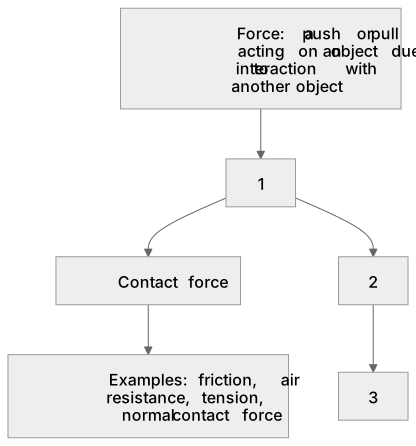
1Box 1
2Box 2
3Box 3
There is more to this lesson
The full lesson goes on to check your understanding and help you earn the marks. Create a free account to carry on, with your progress saved.
A week of Premium from your first lesson · Then the free plan continues · No card, no charge
Test your understanding of Contact and non-contact forces: A force is a push or pull that acts on an object due to the interaction with another object. All forces between objects are either:
Active recall beats re-reading. Take an instant quiz now to test what you’ve learned and lock it into long-term memory.
A week of Premium from your first lesson · Then the free plan continues · No card, no charge