AQA · GCSE · Combined Science
Course version: 8464 · Version from Sept 2018
Examples of contact forces include friction, air resistance, tension and…
Full specification wording
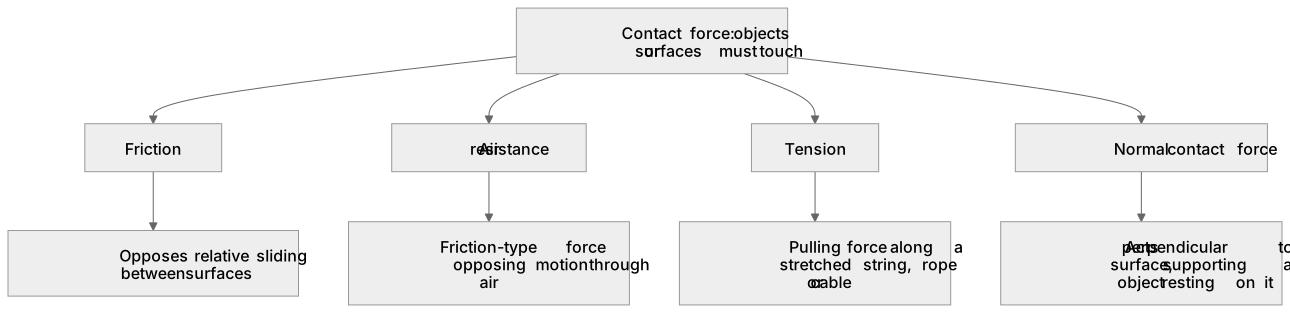
Contact and non-contact forces: Examples of contact forces include friction, air resistance, tension and normal contact force.
A contact force acts only where two objects or surfaces touch, so removing the contact removes the force.
Checked against the AQA 8464 specification (opens in a new tab) on .
- Point 4 of 7
- 4 key terms
Study notes
From the checked teaching notes for this specification point.
The idea
A contact force acts only where two objects or surfaces touch, so removing the contact removes the force. Friction opposes relative sliding between surfaces, for example a book dragged across a desk. Air resistance is a form of friction acting on an object moving through air, opposing its motion. Tension is the pulling force transmitted along a stretched string, rope or cable, acting towards the object at each end. The normal contact force acts perpendicular to a surface, supporting an object resting on it; on a horizontal table it balances the object's weight. To identify a contact force, ask whether the objects must touch for the force to exist. If they must, it is a contact force.
What earns the marks
- States that a contact force requires the objects or surfaces to be touching.
- Describes friction as a force opposing relative motion or attempted sliding between surfaces in contact.
- Describes air resistance as a friction-type force opposing motion through air.
- Describes tension as a pulling force along a stretched string, rope or cable.
- Describes the normal contact force as acting perpendicular to a surface, supporting an object resting on it.
- Classifies each named example as a contact force and links it to a situation where surfaces touch.
Common mistakes and how to put them right
Calling air resistance a non-contact force because air is invisible.
Put it right by noting that air particles must collide with the moving object, so contact occurs.
Drawing the normal contact force along the surface rather than perpendicular to it.
Put it right by drawing it at 90° to the surface.
Treating tension as a pushing force.
Put it right by stating that tension pulls along the string towards the object at each end.
Exam tips
- Name the two surfaces or objects in contact when justifying a contact force.
- Use the word perpendicular when describing the normal contact force.
- For each example, state the direction of the force relative to motion or to the surface.
Try the lesson
The start of the Contact and non-contact forces: Examples of contact forces include friction, air resistance, tension and normal contact force. lesson, made from checked teaching notes for this specification point.
Have a go first
A book rests on a table without moving. Which contact force does the table exert on the book?
Listen
A contact force acts only where two objects or surfaces touch, so removing the contact removes the force. Friction opposes relative sliding between surfaces, for example a book dragged across a desk. Air resistance is a form of friction acting on an object moving through air, opposing its motion. Tension is the pulling force transmitted along a stretched string, rope or cable, acting towards the object at each end. The normal contact force acts perpendicular to a surface, supporting an object resting on it; on a horizontal table it balances the object's weight. To identify a contact force, ask whether the objects must touch for the force to exist. If they must, it is a contact force. A strong answer earns marks for these points. States that a contact force requires the objects or surfaces to be touching. Describes friction as a force opposing relative motion or attempted sliding between surfaces in contact. Describes air resistance as a friction-type force opposing motion through air. Describes tension as a pulling force along a stretched string, rope or cable. A common slip: Calling air resistance a non-contact force because air is invisible. Instead, noting that air particles must collide with the moving object, so contact occurs. Exam tip: Name the two surfaces or objects in contact when justifying a contact force.
See it
Key words
Say what each word means before you turn the card.
Contact force
Try answering aloud or in your head before turning the card.
Friction
Try answering aloud or in your head before turning the card.
Air resistance
Try answering aloud or in your head before turning the card.
Tension
Try answering aloud or in your head before turning the card.
See every definition
- Contact force
- A force that acts only where two objects or surfaces touch, so removing the contact removes the force.
- Friction
- A force that opposes relative sliding between surfaces, for example a book dragged across a desk.
- Air resistance
- A form of friction acting on an object moving through air, opposing its motion.
- Tension
- The pulling force transmitted along a stretched string, rope or cable, acting towards the object at each end.
Label the diagram
Some boxes have lost their names. Pick the right name for each number.
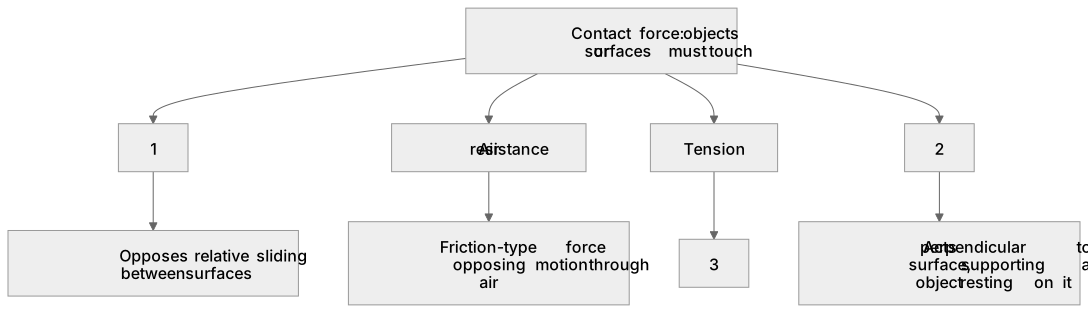
1Box 1
2Box 2
3Box 3
There is more to this lesson
The full lesson goes on to check your understanding and help you earn the marks. Create a free account to carry on, with your progress saved.
A week of Premium from your first lesson · Then the free plan continues · No card, no charge
Test your understanding of Contact and non-contact forces: Examples of contact forces include friction, air resistance, tension and normal contact force.
Active recall beats re-reading. Take an instant quiz now to test what you’ve learned and lock it into long-term memory.
A week of Premium from your first lesson · Then the free plan continues · No card, no charge