AQA · GCSE · Combined Science
Course version: 8464 · Version from Sept 2018
Contact and non-contact forces: Force is a vector quantity.
A vector quantity carries both a size and a direction, and force is one of these because its effect depends on where it pushes or pulls as well as how hard.
Checked against the AQA 8464 specification (opens in a new tab) on .
- Point 6 of 7
- 4 key terms
Study notes
From the checked teaching notes for this specification point.
The idea
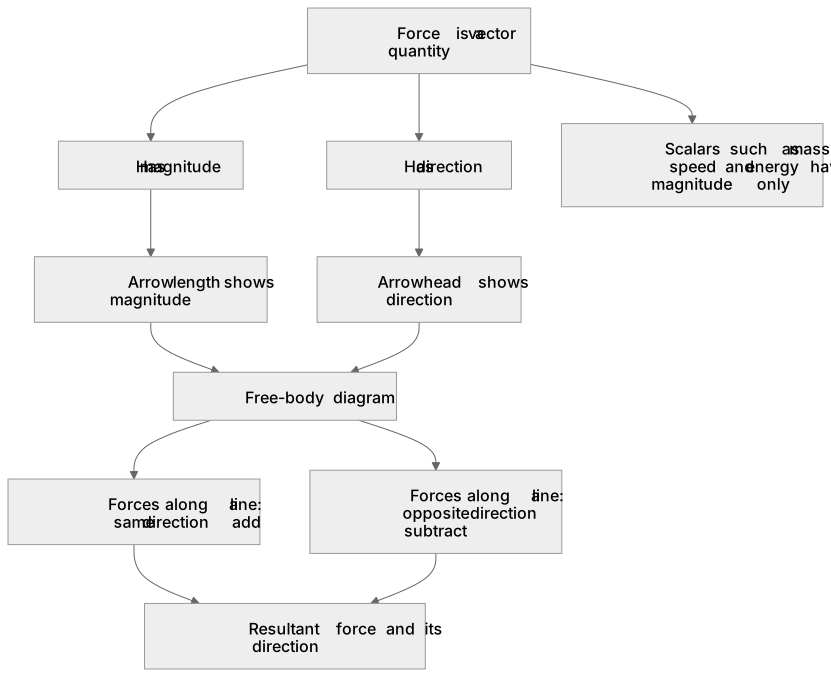
A vector quantity carries both a size and a direction, and force is one of these because its effect depends on where it pushes or pulls as well as how hard. A 20 N push to the right and a 20 N push to the left have equal magnitude but opposite direction, so they do not cancel to zero unless you account for direction. When several forces act, you add them as vectors: forces along the same line combine by direction, and forces at an angle need a scale drawing or calculation. This is why a free-body diagram shows each force as an arrow whose length represents magnitude and whose head shows direction. Scalar quantities such as mass, speed and energy have size only. Recognising force as a vector lets you predict whether an object accelerates, stays still or changes shape.
What earns the marks
- States that a vector quantity has both magnitude and direction, and applies this to force.
- Explains that the direction of a force is as important as its size when predicting its effect.
- Uses arrows to represent forces, with length showing magnitude and arrowhead showing direction.
- Combines forces along a line by adding those acting in the same direction and subtracting those acting in opposite directions.
- Distinguishes force from scalar quantities such as mass, speed and energy, which have magnitude only.
- Applies vector reasoning to a free-body diagram to decide the direction of the resultant force.
Common mistakes and how to put them right
Treating force as a scalar and adding 20 N and 20 N to get 40 N even when the forces oppose each other.
Put it right by assigning opposite directions and subtracting to find the resultant.
Believing that a larger force always wins regardless of direction.
Put it right by comparing the vector sum, since a smaller force can produce a resultant if the larger force acts in the opposite direction.
Drawing force arrows with length but no arrowhead, or with an arrowhead but arbitrary length.
Put it right by making length proportional to magnitude and always including a head to show direction.
Exam tips
- When asked to describe a force, give both its magnitude with unit and its direction, for example 12 N downwards.
- On free-body diagrams, use a ruler so arrow lengths are proportional to the forces, and label each arrow with its value.
- If two forces act along the same line, state the resultant and its direction rather than listing the individual forces only.
Try the lesson
The start of the Contact and non-contact forces: Force is a vector quantity. lesson, made from checked teaching notes for this specification point.
Have a go first
Which statement describes why force is a vector quantity?
Listen
A vector quantity carries both a size and a direction, and force is one of these because its effect depends on where it pushes or pulls as well as how hard. A 20 N push to the right and a 20 N push to the left have equal magnitude but opposite direction, so they do not cancel to zero unless you account for direction. When several forces act, you add them as vectors: forces along the same line combine by direction, and forces at an angle need a scale drawing or calculation. This is why a free-body diagram shows each force as an arrow whose length represents magnitude and whose head shows direction. Scalar quantities such as mass, speed and energy have size only. Recognising force as a vector lets you predict whether an object accelerates, stays still or changes shape. A strong answer earns marks for these points. States that a vector quantity has both magnitude and direction, and applies this to force. Explains that the direction of a force is as important as its size when predicting its effect. Uses arrows to represent forces, with length showing magnitude and arrowhead showing direction. Combines forces along a line by adding those acting in the same direction and subtracting those acting in opposite directions. A common slip: Treating force as a scalar and adding 20 N and 20 N to get 40 N even when the forces oppose each other. Instead, assigning opposite directions and subtracting to find the resultant. Exam tip: When asked to describe a force, give both its magnitude with unit and its direction, for example 12 N downwards.
See it
Key words
Say what each word means before you turn the card.
Vector quantity
Try answering aloud or in your head before turning the card.
Force
Try answering aloud or in your head before turning the card.
Magnitude
Try answering aloud or in your head before turning the card.
Scalar quantities
Try answering aloud or in your head before turning the card.
See every definition
- Vector quantity
- A quantity that carries both a size and a direction.
- Force
- A vector quantity whose effect depends on where it pushes or pulls as well as how hard.
- Magnitude
- The size of a quantity, represented by the length of a force arrow.
- Scalar quantities
- Quantities such as mass, speed and energy that have size only.
Label the diagram
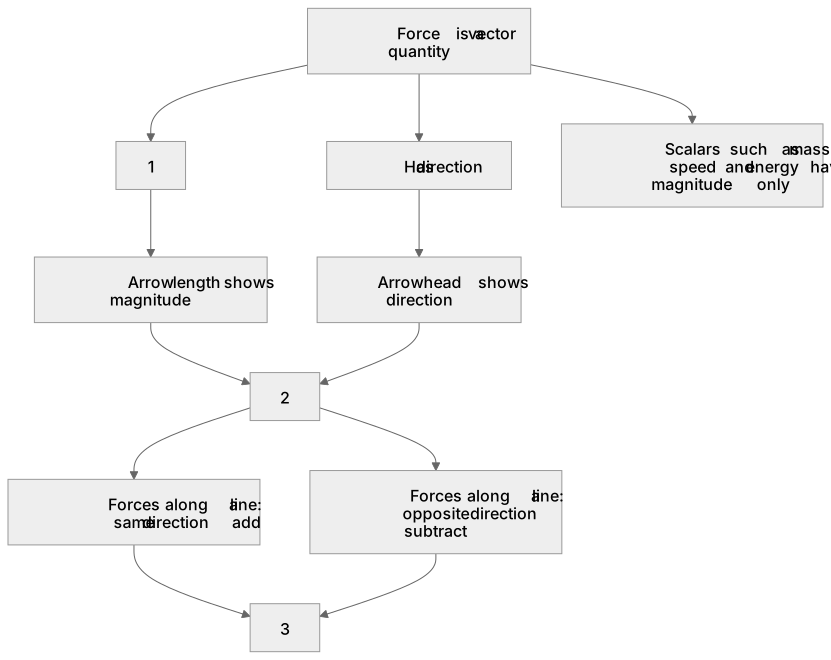
Some boxes have lost their names. Pick the right name for each number.
1Box 1
2Box 2
3Box 3
There is more to this lesson
The full lesson goes on to check your understanding and help you earn the marks. Create a free account to carry on, with your progress saved.
A week of Premium from your first lesson · Then the free plan continues · No card, no charge
Test your understanding of Contact and non-contact forces: Force is a vector quantity.
Active recall beats re-reading. Take an instant quiz now to test what you’ve learned and lock it into long-term memory.
A week of Premium from your first lesson · Then the free plan continues · No card, no charge