AQA · GCSE · Combined Science
Course version: 8464 · Version from Sept 2018
Distance is how far an object moves. Distance does not involve direction.…
Full specification wording
Distance and displacement: Distance is how far an object moves. Distance does not involve direction. Distance is a scalar quantity.
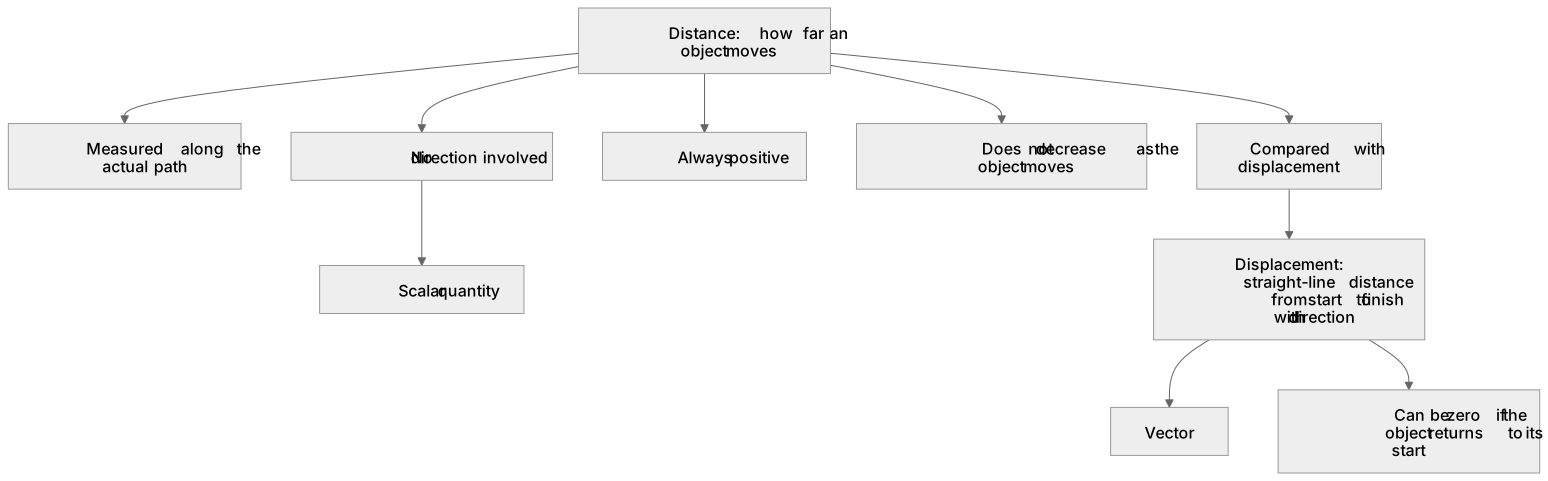
Distance measures how far an object travels along its actual path, regardless of which way it went.
Checked against the AQA 8464 specification (opens in a new tab) on .
- Point 1 of 3
- 3 key terms
Study notes
From the checked teaching notes for this specification point.
The idea
Distance measures how far an object travels along its actual path, regardless of which way it went. Because no direction is needed, distance is a scalar quantity and is fully described by a magnitude with a unit, such as 5 m or 3 km. If you walk 3 m east then 4 m west, the distance travelled is 7 m even though you finish only 1 m from the start. Displacement is different: it is the straight-line distance from start to finish together with the direction, so it is a vector. In the same walk the displacement is 1 m west. Distance is always positive and never decreases as the object moves, while displacement can be zero if you return to the starting point.
What earns the marks
- Define distance as the total length of the path travelled by an object, measured along the route taken.
- State that distance has magnitude only and no direction, so it is a scalar quantity.
- Give the unit of distance as metres or a suitable multiple such as kilometres, and include the unit when quoting a value.
- Distinguish distance from displacement, which is the straight-line distance from start to finish in a stated direction and is a vector.
- Use a worked example, such as 3 m east then 4 m west giving a distance of 7 m but a displacement of 1 m west.
- Explain that distance is always positive and does not decrease, whereas displacement can be zero when the object returns to its start.
Common mistakes and how to put them right
Confusing distance with displacement.
Put it right: Distance follows the whole path, while displacement is the straight line from start to finish with a direction.
Giving a direction with a distance value.
Put it right: Distance is a scalar, so only a magnitude and unit are needed.
Thinking distance must be measured in a straight line.
Put it right: Distance is measured along the actual path taken, however curved it is.
Exam tips
- When asked to classify a quantity, state both that distance is scalar and that it has magnitude but no direction.
- Use a short path example to show the difference between distance and displacement clearly.
- Always attach the correct unit to a distance value, for example 12 m rather than just 12.
Try the lesson
The start of the Distance and displacement: Distance is how far an object moves. Distance does not involve direction. Distance is a scalar quantity. lesson, made from checked teaching notes for this specification point.
Have a go first
A pupil walks 30 m along a straight corridor, then turns round and walks 20 m back towards the start. What is the total distance the pupil has moved?
Listen
Distance measures how far an object travels along its actual path, regardless of which way it went. Because no direction is needed, distance is a scalar quantity and is fully described by a magnitude with a unit, such as 5 m or 3 km. If you walk 3 m east then 4 m west, the distance travelled is 7 m even though you finish only 1 m from the start. Displacement is different: it is the straight-line distance from start to finish together with the direction, so it is a vector. In the same walk the displacement is 1 m west. Distance is always positive and never decreases as the object moves, while displacement can be zero if you return to the starting point. A strong answer earns marks for these points. Define distance as the total length of the path travelled by an object, measured along the route taken. State that distance has magnitude only and no direction, so it is a scalar quantity. Give the unit of distance as metres or a suitable multiple such as kilometres, and include the unit when quoting a value. Distinguish distance from displacement, which is the straight-line distance from start to finish in a stated direction and is a vector. A common slip: Confusing distance with displacement. Instead, distance follows the whole path, while displacement is the straight line from start to finish with a direction. Exam tip: When asked to classify a quantity, state both that distance is scalar and that it has magnitude but no direction.
See it
Key words
Say what each word means before you turn the card.
Distance
Try answering aloud or in your head before turning the card.
Scalar quantity
Try answering aloud or in your head before turning the card.
Displacement
Try answering aloud or in your head before turning the card.
See every definition
- Distance
- How far an object moves, measured along the actual path taken, and it does not involve direction.
- Scalar quantity
- A quantity that has magnitude only and no direction, and distance is one of these.
- Displacement
- The straight-line distance from start to finish together with the direction, so it is a vector.
Label the diagram
Some boxes have lost their names. Pick the right name for each number.
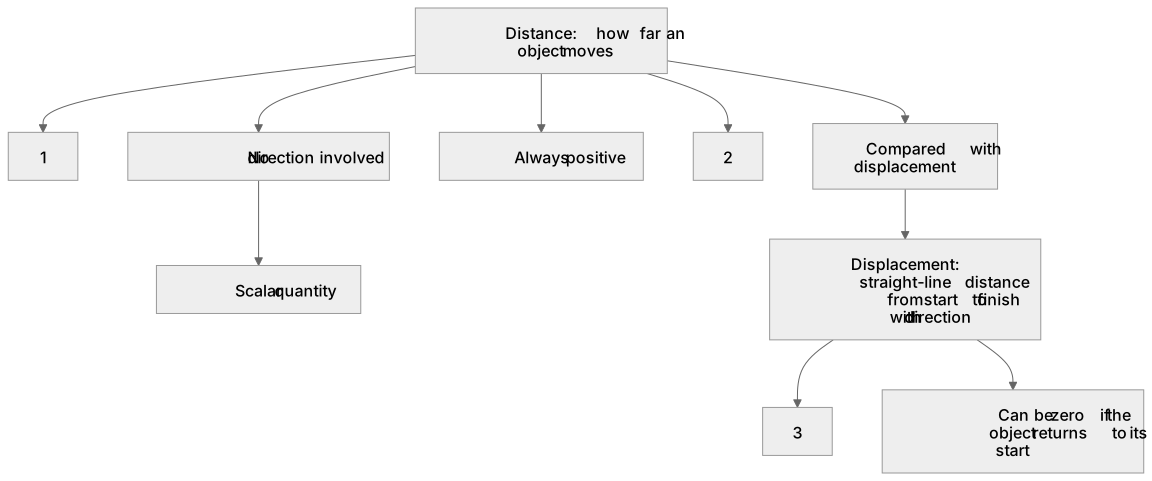
1Box 1
2Box 2
3Box 3
There is more to this lesson
The full lesson goes on to check your understanding and help you earn the marks. Create a free account to carry on, with your progress saved.
A week of Premium from your first lesson · Then the free plan continues · No card, no charge
Test your understanding of Distance and displacement: Distance is how far an object moves. Distance does not involve direction. Distance is a scalar quantity.
Active recall beats re-reading. Take an instant quiz now to test what you’ve learned and lock it into long-term memory.
A week of Premium from your first lesson · Then the free plan continues · No card, no charge