AQA · GCSE · Combined Science
Course version: 8464 · Version from Sept 2018
Evidence for Darwin’s theory is now available as it has been shown that…
Full specification wording
Evidence for evolution: Evidence for Darwin’s theory is now available as it has been shown that characteristics are passed on to offspring in genes. There is further evidence in the fossil record and the knowledge of how resistance to antibiotics evolves in bacteria.
Darwin lacked a mechanism for inheritance, but modern genetics shows that characteristics pass to offspring through genes.
Checked against the AQA 8464 specification (opens in a new tab) on .
- Point 3 of 3
- 4 key terms
Study notes
From the checked teaching notes for this specification point.
The idea
Darwin lacked a mechanism for inheritance, but modern genetics shows that characteristics pass to offspring through genes. Alleles are inherited, and mutations create new alleles, so variation has a genetic basis. The fossil record shows simpler organisms in older rocks and more complex forms in newer rocks, and transitional fossils link groups. Antibiotic resistance in bacteria provides observable evidence: random mutations give some bacteria resistance, antibiotics kill non-resistant bacteria, and resistant bacteria survive and reproduce, so resistance spreads. Each piece of evidence supports the same conclusion: species change over time by natural selection. Together, genetics, fossils and antibiotic resistance make Darwin’s theory widely accepted.
What earns the marks
- Genes are passed from parents to offspring, so characteristics are inherited.
- Mutations produce new alleles, providing the genetic variation on which natural selection acts.
- The fossil record shows changes in organisms over time and links between ancestral and modern forms.
- Antibiotic resistance evolves because resistant bacteria survive treatment and reproduce, increasing the proportion of resistant bacteria.
Common mistakes and how to put them right
Saying bacteria ‘decide’ to become resistant.
Put it right: Resistance arises from random mutation before exposure to the antibiotic.
Confusing the fossil record with a complete record.
Put it right: It is incomplete but still shows patterns of change over time.
Thinking genes were known in Darwin’s time.
Put it right: Darwin lacked a mechanism of inheritance, and genetics later supplied it.
Exam tips
- Use the antibiotic resistance example to show evolution happening in real time.
- State clearly that mutations are random and selection is not random.
- Link each evidence type back to natural selection rather than describing it in isolation.
Try the lesson
The start of the Evidence for evolution: Evidence for Darwin’s theory is now available as it has been shown that characteristics are passed on to offspring in genes. There is further evidence in the fossil record and the knowledge of how resistance to antibiotics evolves in bacteria. lesson, made from checked teaching notes for this specification point.
Have a go first
Which structures pass on characteristics to offspring, providing evidence for Darwin's theory of evolution?
Listen
Darwin lacked a mechanism for inheritance, but modern genetics shows that characteristics pass to offspring through genes. Alleles are inherited, and mutations create new alleles, so variation has a genetic basis. The fossil record shows simpler organisms in older rocks and more complex forms in newer rocks, and transitional fossils link groups. Antibiotic resistance in bacteria provides observable evidence: random mutations give some bacteria resistance, antibiotics kill non-resistant bacteria, and resistant bacteria survive and reproduce, so resistance spreads. Each piece of evidence supports the same conclusion: species change over time by natural selection. Together, genetics, fossils and antibiotic resistance make Darwin’s theory widely accepted. A strong answer earns marks for these points. Genes are passed from parents to offspring, so characteristics are inherited. Mutations produce new alleles, providing the genetic variation on which natural selection acts. The fossil record shows changes in organisms over time and links between ancestral and modern forms. Antibiotic resistance evolves because resistant bacteria survive treatment and reproduce, increasing the proportion of resistant bacteria. A common slip: Saying bacteria ‘decide’ to become resistant. Instead, resistance arises from random mutation before exposure to the antibiotic. Exam tip: Use the antibiotic resistance example to show evolution happening in real time.
See it
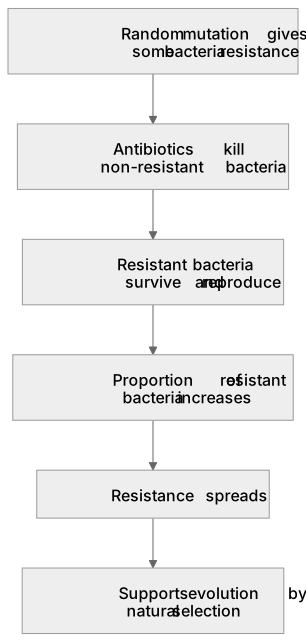
Put it in order
Put these steps in the order they happen.
- 1. Resistant bacteria survive and reproduce
- 2. Antibiotics kill non-resistant bacteria
- 3. Random mutation gives some bacteria resistance
- 4. Supports evolution by natural selection
- 5. Resistance spreads
- 6. Proportion of resistant bacteria increases
Key words
Say what each word means before you turn the card.
Inheritance
Try answering aloud or in your head before turning the card.
Mutation
Try answering aloud or in your head before turning the card.
Fossil record
Try answering aloud or in your head before turning the card.
Antibiotic resistance
Try answering aloud or in your head before turning the card.
See every definition
- Inheritance
- Characteristics are passed on to offspring in genes, which Darwin lacked a mechanism for.
- Mutation
- Random mutations produce new alleles, providing the genetic variation on which natural selection acts.
- Fossil record
- Shows changes in organisms over time and links between ancestral and modern forms, though it is incomplete.
- Antibiotic resistance
- Resistant bacteria survive treatment and reproduce, increasing the proportion of resistant bacteria.
Label the diagram
Some boxes have lost their names. Pick the right name for each number.
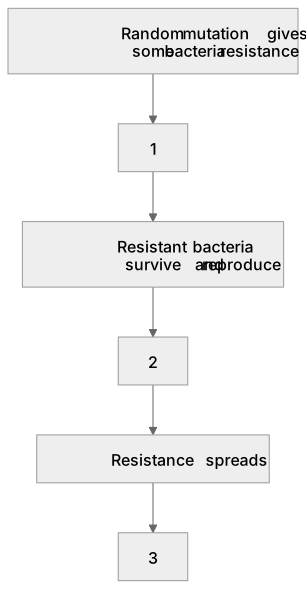
1Box 1
2Box 2
3Box 3
There is more to this lesson
The full lesson goes on to check your understanding and help you earn the marks. Create a free account to carry on, with your progress saved.
A week of Premium from your first lesson · Then the free plan continues · No card, no charge
Test your understanding of Evidence for evolution: Evidence for Darwin’s theory is now available as it has been shown that characteristics are passed on to offspring in genes. There is further evidence in the fossil record and the knowledge of how resistance to antibiotics evolves in bacteria.
Active recall beats re-reading. Take an instant quiz now to test what you’ve learned and lock it into long-term memory.
A week of Premium from your first lesson · Then the free plan continues · No card, no charge