AQA · GCSE · Combined Science
Course version: 8464 · Version from Sept 2018
If two populations of one species become so different in phenotype that…
Full specification wording
Evolution: If two populations of one species become so different in phenotype that they can no longer interbreed to produce fertile offspring they have formed two new species.
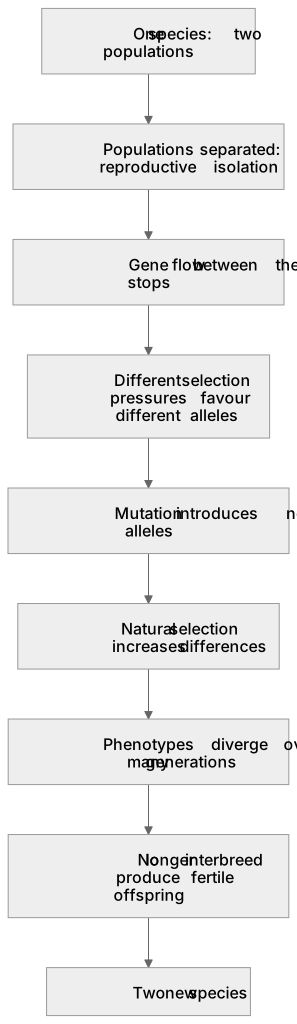
Speciation happens when populations of one species become reproductively isolated, so gene flow between them stops.
Checked against the AQA 8464 specification (opens in a new tab) on .
- Point 4 of 4
- 4 key terms
Study notes
From the checked teaching notes for this specification point.
The idea
Speciation happens when populations of one species become reproductively isolated, so gene flow between them stops. Different selection pressures and random mutations then make their phenotypes diverge. Over many generations the accumulated differences become so great that members of the two populations can no longer interbreed successfully to produce fertile offspring. At that point they are classified as two separate species. For example, a river may split a population of beetles; each group experiences different food and climate, so different alleles are favoured. Eventually the two groups may mate but produce infertile young, or not mate at all, showing that new species have formed.
What earns the marks
- Reproductive isolation occurs when populations are separated so that they no longer interbreed and gene flow between them stops.
- Different selection pressures in the two environments favour different alleles, so phenotypes diverge over many generations.
- Mutation introduces new alleles, and natural selection acting on these variants increases the differences between the populations.
- Speciation is complete when the two populations can no longer interbreed to produce fertile offspring, so they are recognised as separate species.
- A named example, such as two beetle populations separated by a river, can illustrate how isolation and selection lead to new species.
Common mistakes and how to put them right
Thinking that a new species forms as soon as two populations look different.
Put it right: Phenotype differences alone are not enough, because reproductive isolation and infertile or no offspring are the defining test.
Believing that individual organisms change their phenotype to suit the environment.
Put it right: Mutations create new alleles, and natural selection favours those already present, so populations change over generations.
Confusing speciation with extinction.
Put it right: Speciation produces two new species from one ancestral species, whereas extinction is the loss of a species.
Exam tips
- Use the phrase 'no longer interbreed to produce fertile offspring' when defining the point at which two new species have formed.
- Link each stage of your answer in a logical chain: isolation, different selection pressures, mutation, natural selection, reproductive isolation.
- Include a specific example, such as beetles separated by a river, to show how the process works in practice.
Try the lesson
The start of the Evolution: If two populations of one species become so different in phenotype that they can no longer interbreed to produce fertile offspring they have formed two new species. lesson, made from checked teaching notes for this specification point.
Have a go first
Two populations of the same species of bird live on separate islands. Over many generations their phenotypes become so different that they can no longer interbreed to produce fertile offspring. What have these two populations formed?
Listen
Speciation happens when populations of one species become reproductively isolated, so gene flow between them stops. Different selection pressures and random mutations then make their phenotypes diverge. Over many generations the accumulated differences become so great that members of the two populations can no longer interbreed successfully to produce fertile offspring. At that point they are classified as two separate species. For example, a river may split a population of beetles; each group experiences different food and climate, so different alleles are favoured. Eventually the two groups may mate but produce infertile young, or not mate at all, showing that new species have formed. A strong answer earns marks for these points. Reproductive isolation occurs when populations are separated so that they no longer interbreed and gene flow between them stops. Different selection pressures in the two environments favour different alleles, so phenotypes diverge over many generations. Mutation introduces new alleles, and natural selection acting on these variants increases the differences between the populations. Speciation is complete when the two populations can no longer interbreed to produce fertile offspring, so they are recognised as separate species. A common slip: Thinking that a new species forms as soon as two populations look different. Instead, phenotype differences alone are not enough, because reproductive isolation and infertile or no offspring are the defining test. Exam tip: Use the phrase 'no longer interbreed to produce fertile offspring' when defining the point at which two new species have formed.
See it
Key words
Say what each word means before you turn the card.
Reproductive isolation
Try answering aloud or in your head before turning the card.
Natural selection
Try answering aloud or in your head before turning the card.
Mutation and genetic variation
Try answering aloud or in your head before turning the card.
Formation of new species
Try answering aloud or in your head before turning the card.
See every definition
- Reproductive isolation
- Occurs when populations are separated so that they no longer interbreed and gene flow between them stops.
- Natural selection
- Acting on variants, it increases the differences between populations, favouring different alleles in different environments.
- Mutation and genetic variation
- Mutation introduces new alleles, and natural selection acting on these variants increases the differences between the populations.
- Formation of new species
- Complete when two populations can no longer interbreed to produce fertile offspring, so they are recognised as separate species.
Label the diagram
Some boxes have lost their names. Pick the right name for each number.
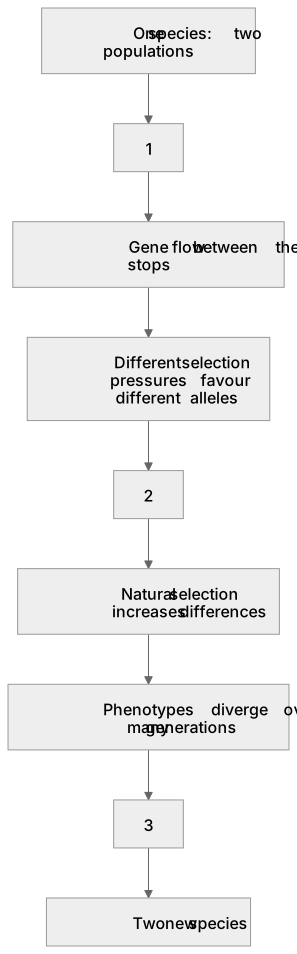
1Box 1
2Box 2
3Box 3
There is more to this lesson
The full lesson goes on to check your understanding and help you earn the marks. Create a free account to carry on, with your progress saved.
A week of Premium from your first lesson · Then the free plan continues · No card, no charge
Test your understanding of Evolution: If two populations of one species become so different in phenotype that they can no longer interbreed to produce fertile offspring they have formed two new species.
Active recall beats re-reading. Take an instant quiz now to test what you’ve learned and lock it into long-term memory.
A week of Premium from your first lesson · Then the free plan continues · No card, no charge