AQA · GCSE · Combined Science
Course version: 8464 · Version from Sept 2018
The theory of evolution by natural selection states that all species of…
Full specification wording
Evolution: The theory of evolution by natural selection states that all species of living things have evolved from simple life forms that first developed more than three billion years ago.
This statement has two linked clauses: the mechanism (evolution by natural selection) and the timescale (all species descended from simple life forms that arose over three billion years ago).
Checked against the AQA 8464 specification (opens in a new tab) on .
- Point 2 of 4
- 4 key terms
Study notes
From the checked teaching notes for this specification point.
The idea
This statement has two linked clauses: the mechanism (evolution by natural selection) and the timescale (all species descended from simple life forms that arose over three billion years ago). Evolution means the inherited characteristics of populations change across generations. Natural selection explains how: individuals vary, some variants survive and reproduce more successfully, so their alleles become more common. Over immense periods, accumulated changes can produce new species. The timescale is supported by evidence such as fossils of simple cells in ancient rocks, and by molecular comparisons showing shared biochemistry. For example, fossil bacteria-like structures in rocks over three billion years old, plus the universality of DNA and genetic code, indicate common ancestry. So all species, including humans, share ancestors with simple early life.
What earns the marks
- Evolution is a change in the inherited characteristics of a population over generations, not a change in an individual during its lifetime.
- Natural selection requires variation, inheritance of that variation, and differential survival and reproduction.
- All species share common ancestors; simple life forms existed more than three billion years ago.
- Evidence includes fossils in ancient rocks and molecular evidence such as shared DNA and genetic code.
- The process is gradual and cumulative over very long time periods, allowing new species to arise.
Common mistakes and how to put them right
Saying an individual organism evolves during its lifetime.
Put it right: Populations evolve across generations as allele frequencies change.
Claiming humans evolved from modern apes.
Put it right: Humans and modern apes share a common ancestor.
Stating life began only a few million years ago.
Put it right: Simple life forms developed more than three billion years ago.
Exam tips
- Define evolution and natural selection precisely before applying them to an example.
- Use the phrase 'more than three billion years ago' when describing the origin of simple life forms.
- Link each evidence type to the conclusion it supports, such as fossils showing simple life in ancient rocks.
Try the lesson
The start of the Evolution: The theory of evolution by natural selection states that all species of living things have evolved from simple life forms that first developed more than three billion years ago. lesson, made from checked teaching notes for this specification point.
Have a go first
According to the theory of evolution by natural selection, how long ago did simple life forms first develop on Earth?
Listen
This statement has two linked clauses: the mechanism (evolution by natural selection) and the timescale (all species descended from simple life forms that arose over three billion years ago). Evolution means the inherited characteristics of populations change across generations. Natural selection explains how: individuals vary, some variants survive and reproduce more successfully, so their alleles become more common. Over immense periods, accumulated changes can produce new species. The timescale is supported by evidence such as fossils of simple cells in ancient rocks, and by molecular comparisons showing shared biochemistry. For example, fossil bacteria-like structures in rocks over three billion years old, plus the universality of DNA and genetic code, indicate common ancestry. So all species, including humans, share ancestors with simple early life. A strong answer earns marks for these points. Evolution is a change in the inherited characteristics of a population over generations, not a change in an individual during its lifetime. Natural selection requires variation, inheritance of that variation, and differential survival and reproduction. All species share common ancestors; simple life forms existed more than three billion years ago. Evidence includes fossils in ancient rocks and molecular evidence such as shared DNA and genetic code. A common slip: Saying an individual organism evolves during its lifetime. Instead, populations evolve across generations as allele frequencies change. Exam tip: Define evolution and natural selection precisely before applying them to an example.
See it
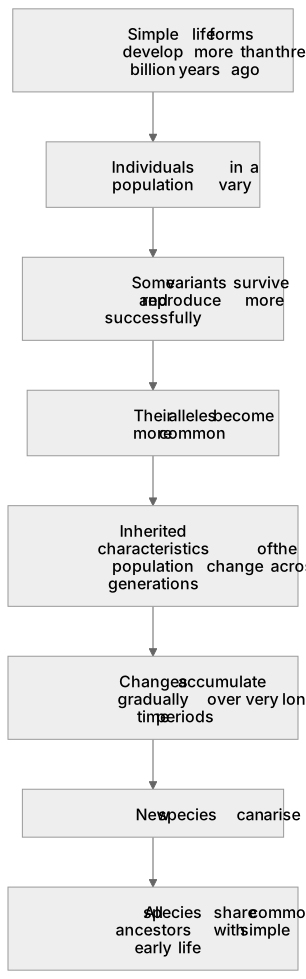
Put it in order
Put these steps in the order they happen.
- 1. Inherited characteristics of the population change across generations
- 2. All species share common ancestors with simple early life
- 3. Changes accumulate gradually over very long time periods
- 4. Simple life forms develop more than three billion years ago
- 5. Individuals in a population vary
- 6. New species can arise
- 7. Some variants survive and reproduce more successfully
- 8. Their alleles become more common
Key words
Say what each word means before you turn the card.
Evolution
Try answering aloud or in your head before turning the card.
Natural selection
Try answering aloud or in your head before turning the card.
Common ancestry
Try answering aloud or in your head before turning the card.
Timescale of life
Try answering aloud or in your head before turning the card.
See every definition
- Evolution
- A change in the inherited characteristics of a population over generations, not a change in an individual during its lifetime.
- Natural selection
- Requires variation, inheritance of that variation, and differential survival and reproduction, so some variants reproduce more successfully.
- Common ancestry
- All species share ancestors with simple early life, including humans, as indicated by fossils and shared biochemistry.
- Timescale of life
- Simple life forms developed more than three billion years ago, and the process is gradual and cumulative over very long time periods.
Label the diagram
Some boxes have lost their names. Pick the right name for each number.
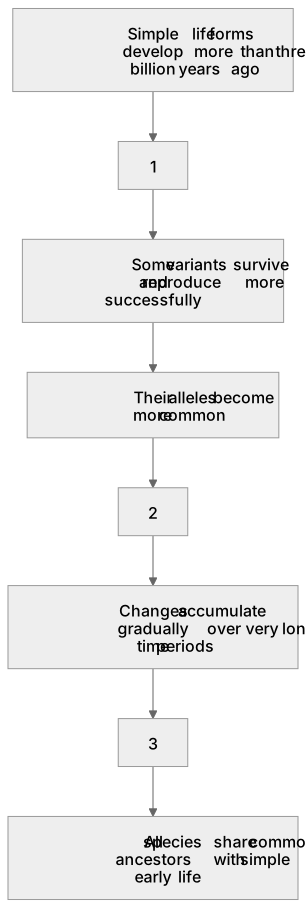
1Box 1
2Box 2
3Box 3
There is more to this lesson
The full lesson goes on to check your understanding and help you earn the marks. Create a free account to carry on, with your progress saved.
A week of Premium from your first lesson · Then the free plan continues · No card, no charge
Test your understanding of Evolution: The theory of evolution by natural selection states that all species of living things have evolved from simple life forms that first developed more than three billion years ago.
Active recall beats re-reading. Take an instant quiz now to test what you’ve learned and lock it into long-term memory.
A week of Premium from your first lesson · Then the free plan continues · No card, no charge