AQA · GCSE · Combined Science
Course version: 8464 · Version from Sept 2018
Estimate how the distance required for road vehicles to stop in an…
Full specification wording
Factors affecting braking distance 1: estimate how the distance required for road vehicles to stop in an emergency varies over a range of typical speeds.
Stopping distance is thinking distance plus braking distance.
Checked against the AQA 8464 specification (opens in a new tab) on .
- Point 4 of 4
- 2 key terms
Study notes
From the checked teaching notes for this specification point.
The idea
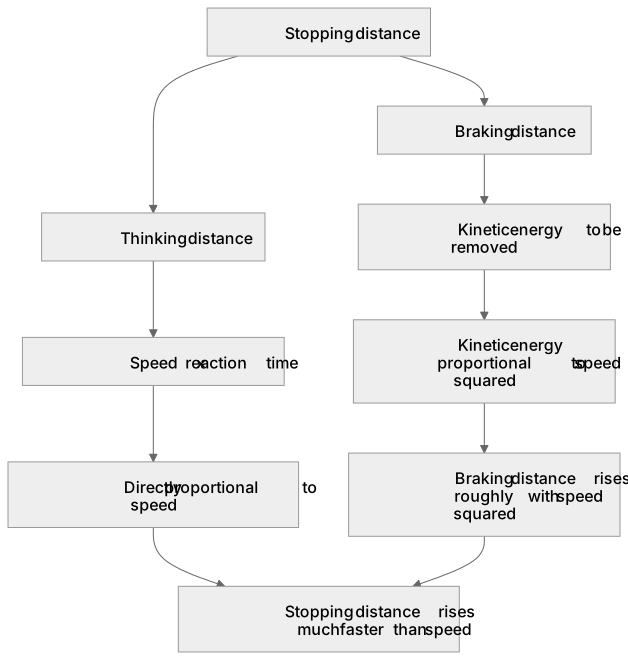
Stopping distance is thinking distance plus braking distance. Thinking distance is the distance travelled during the driver's reaction time, so it is directly proportional to speed: doubling speed doubles thinking distance. Braking distance depends on the kinetic energy that must be removed, and kinetic energy is proportional to speed squared (E_k = ½mv²). Doubling speed therefore roughly quadruples braking distance, so stopping distance rises much faster than speed. For example, at 20 mph a typical stopping distance is about 12 m; at 40 mph it is about 36 m; at 60 mph it is about 73 m; at 70 mph it is about 96 m. These are estimates for dry roads and alert drivers, and the exact values vary with mass, tyres, road surface and reaction time.
What earns the marks
- State that stopping distance = thinking distance + braking distance.
- Explain that thinking distance increases in direct proportion to speed because it equals speed × reaction time.
- Explain that braking distance increases roughly with the square of speed because kinetic energy depends on v².
- Use typical values or a graph to estimate stopping distance at a stated speed, for example about 36 m at 40 mph or about 96 m at 70 mph.
- Recognise that estimates assume dry roads, good tyres and a typical reaction time, so real values vary.
Common mistakes and how to put them right
Treating stopping distance as proportional to speed.
Put it right: Only thinking distance is proportional to speed, while braking distance rises roughly with speed squared.
Adding reaction time to braking distance instead of adding thinking distance to braking distance.
Put it right: Convert reaction time to a distance using speed × time before adding.
Assuming the same braking distance at all speeds.
Put it right: Braking distance increases rapidly with speed, roughly quadrupling when speed doubles.
Exam tips
- Write the equation stopping distance = thinking distance + braking distance before substituting values.
- When comparing speeds, state the ratio clearly, for example doubling speed doubles thinking distance but roughly quadruples braking distance.
- Quote typical stopping distances with units and say they are estimates that depend on road and vehicle conditions.
Try the lesson
The start of the Factors affecting braking distance 1: estimate how the distance required for road vehicles to stop in an emergency varies over a range of typical speeds. lesson, made from checked teaching notes for this specification point.
Have a go first
A delivery van is travelling at 30 mph. At this speed, its thinking distance is 9 m and its braking distance is 14 m. If the van's speed increases to 60 mph under the same conditions, what is the estimated total stopping distance?
Listen
Stopping distance is thinking distance plus braking distance. Thinking distance is the distance travelled during the driver's reaction time, so it is directly proportional to speed: doubling speed doubles thinking distance. Braking distance depends on the kinetic energy that must be removed, and kinetic energy is proportional to speed squared (E_k = ½mv²). Doubling speed therefore roughly quadruples braking distance, so stopping distance rises much faster than speed. For example, at 20 mph a typical stopping distance is about 12 m; at 40 mph it is about 36 m; at 60 mph it is about 73 m; at 70 mph it is about 96 m. These are estimates for dry roads and alert drivers, and the exact values vary with mass, tyres, road surface and reaction time. A strong answer earns marks for these points. State that stopping distance = thinking distance + braking distance. Explain that thinking distance increases in direct proportion to speed because it equals speed × reaction time. Explain that braking distance increases roughly with the square of speed because kinetic energy depends on v². Use typical values or a graph to estimate stopping distance at a stated speed, for example about 36 m at 40 mph or about 96 m at 70 mph. A common slip: Treating stopping distance as proportional to speed. Instead, only thinking distance is proportional to speed, while braking distance rises roughly with speed squared. Exam tip: Write the equation stopping distance = thinking distance + braking distance before substituting values.
See it
Key words
Say what each word means before you turn the card.
Stopping distance
Try answering aloud or in your head before turning the card.
Thinking distance
Try answering aloud or in your head before turning the card.
See every definition
- Stopping distance
- Thinking distance plus braking distance, estimated for road vehicles stopping in an emergency over a range of typical speeds.
- Thinking distance
- The distance travelled during the driver's reaction time, so it is directly proportional to speed.
Label the diagram
Some boxes have lost their names. Pick the right name for each number.
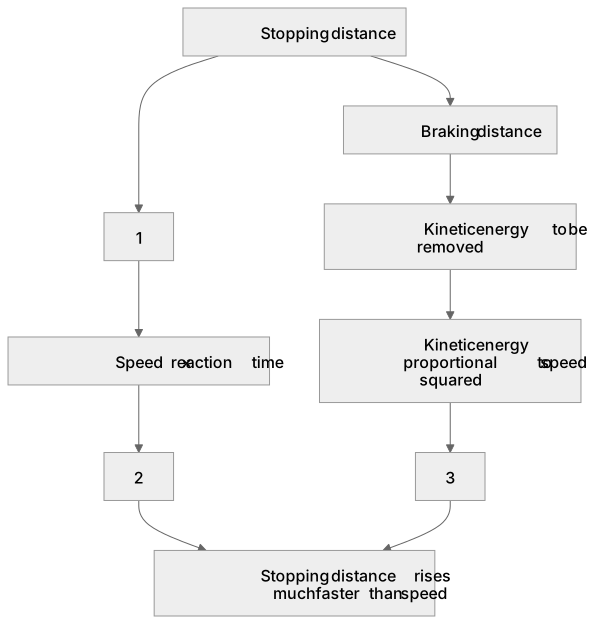
1Box 1
2Box 2
3Box 3
There is more to this lesson
The full lesson goes on to check your understanding and help you earn the marks. Create a free account to carry on, with your progress saved.
A week of Premium from your first lesson · Then the free plan continues · No card, no charge
Test your understanding of Factors affecting braking distance 1: estimate how the distance required for road vehicles to stop in an emergency varies over a range of typical speeds.
Active recall beats re-reading. Take an instant quiz now to test what you’ve learned and lock it into long-term memory.
A week of Premium from your first lesson · Then the free plan continues · No card, no charge