AQA · GCSE · Combined Science
Course version: 8464 · Version from Sept 2018
The greater the speed of a vehicle the greater the braking force needed to…
Full specification wording
Factors affecting braking distance 2: The greater the speed of a vehicle the greater the braking force needed to stop the vehicle in a certain distance.
A moving vehicle has kinetic energy that depends on its mass and on the square of its speed.
Checked against the AQA 8464 specification (opens in a new tab) on .
- Point 2 of 5
Study notes
From the checked teaching notes for this specification point.
The idea
A moving vehicle has kinetic energy that depends on its mass and on the square of its speed. To stop in a fixed distance, the brakes must remove that kinetic energy by doing work: braking force × braking distance = kinetic energy transferred. Because kinetic energy is proportional to speed², doubling the speed roughly quadruples the energy that must be removed. If the stopping distance is kept the same, the required braking force must also roughly quadruple. For example, a car at 30 m/s has far more kinetic energy than at 15 m/s, so its brakes must exert a much larger force over the same distance. This explains why speed limits and safe separation distances matter: higher speed demands greater braking force, which may exceed what the brakes can safely provide.
What earns the marks
- Kinetic energy increases with the square of speed, so a vehicle travelling faster stores much more energy to be removed.
- Work done by the brakes equals braking force × braking distance, linking force, distance and energy transfer.
- For a fixed braking distance, a greater speed requires a proportionally greater braking force.
- Doubling speed while keeping braking distance constant requires roughly four times the braking force.
- The relationship can be used to compare two speeds or two braking forces in a calculation or explanation.
Common mistakes and how to put them right
Assuming braking force is directly proportional to speed rather than to speed².
Put it right by using the kinetic energy relationship and squaring the speed ratio.
Confusing braking distance with overall stopping distance.
Put it right: Braking distance is only the distance travelled while the brakes act, after the thinking distance.
Ignoring mass: a more massive vehicle at the same speed has more kinetic energy and needs a greater braking force for the same braking distance.
Exam tips
- State clearly that kinetic energy depends on speed², then link it to work done by the brakes.
- When comparing speeds, calculate the ratio of speeds, square it, and use that to compare braking forces.
- Use the equation braking force × braking distance = kinetic energy transferred, and show substitution with units.
Try the lesson
The start of the Factors affecting braking distance 2: The greater the speed of a vehicle the greater the braking force needed to stop the vehicle in a certain distance. lesson, made from checked teaching notes for this specification point.
Have a go first
A car is travelling at 10 m/s and the driver brakes to stop it in a certain distance. The same car later travels at 20 m/s and the driver brakes to stop it in the same distance. How does the braking force needed at 20 m/s compare with the braking force needed at 10 m/s?
Listen
A moving vehicle has kinetic energy that depends on its mass and on the square of its speed. To stop in a fixed distance, the brakes must remove that kinetic energy by doing work: braking force × braking distance = kinetic energy transferred. Because kinetic energy is proportional to speed², doubling the speed roughly quadruples the energy that must be removed. If the stopping distance is kept the same, the required braking force must also roughly quadruple. For example, a car at 30 m/s has far more kinetic energy than at 15 m/s, so its brakes must exert a much larger force over the same distance. This explains why speed limits and safe separation distances matter: higher speed demands greater braking force, which may exceed what the brakes can safely provide. A strong answer earns marks for these points. Kinetic energy increases with the square of speed, so a vehicle travelling faster stores much more energy to be removed. Work done by the brakes equals braking force × braking distance, linking force, distance and energy transfer. For a fixed braking distance, a greater speed requires a proportionally greater braking force. Doubling speed while keeping braking distance constant requires roughly four times the braking force. A common slip: Assuming braking force is directly proportional to speed rather than to speed². Instead, using the kinetic energy relationship and squaring the speed ratio. Exam tip: State clearly that kinetic energy depends on speed², then link it to work done by the brakes.
See it
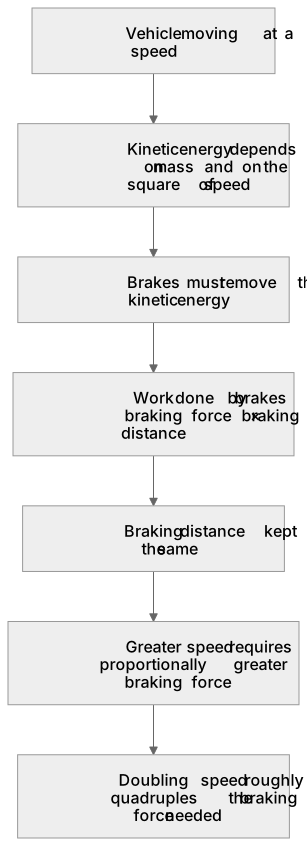
Put it in order
Put these steps in the order they happen.
- 1. Doubling speed roughly quadruples the braking force needed
- 2. Greater speed requires a proportionally greater braking force
- 3. Brakes must remove the kinetic energy
- 4. Braking distance kept the same
- 5. Vehicle moving at a speed
- 6. Kinetic energy depends on mass and on the square of speed
- 7. Work done by brakes = braking force × braking distance
Label the diagram
Some boxes have lost their names. Pick the right name for each number.
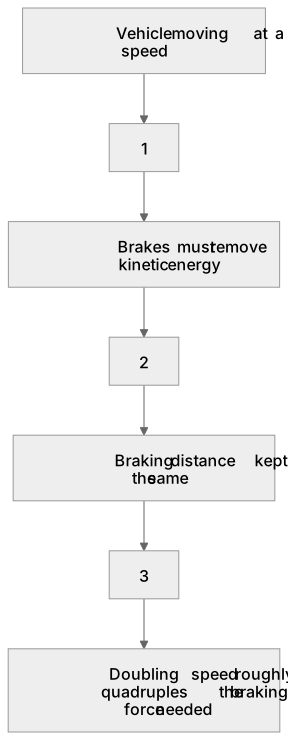
1Box 1
2Box 2
3Box 3
There is more to this lesson
The full lesson goes on to check your understanding and help you earn the marks. Create a free account to carry on, with your progress saved.
A week of Premium from your first lesson · Then the free plan continues · No card, no charge
Test your understanding of Factors affecting braking distance 2: The greater the speed of a vehicle the greater the braking force needed to stop the vehicle in a certain distance.
Active recall beats re-reading. Take an instant quiz now to test what you’ve learned and lock it into long-term memory.
A week of Premium from your first lesson · Then the free plan continues · No card, no charge