AQA · GCSE · Combined Science
Course version: 8464 · Version from Sept 2018
Fleming's left-hand rule (HT only): magnetic flux density, B, in tesla, T
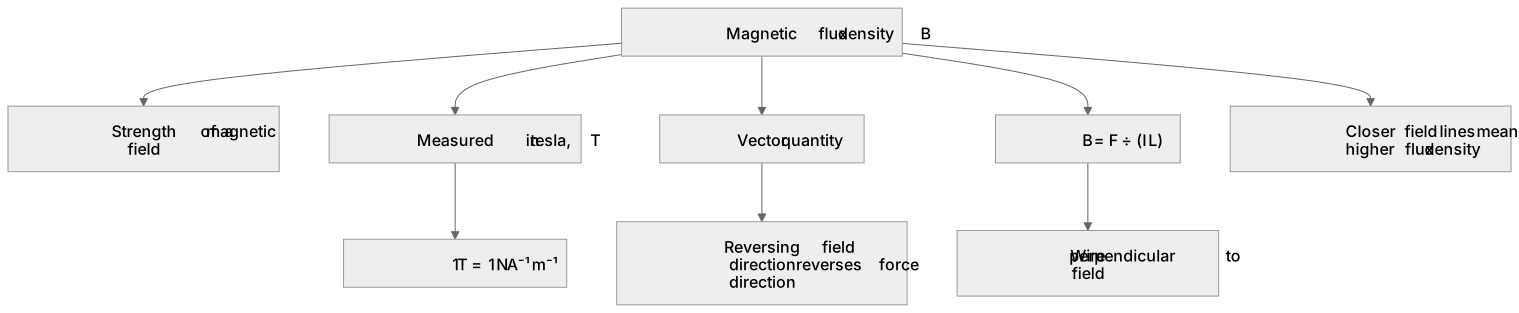
Magnetic flux density, B, measures the strength of a magnetic field.
Checked against the AQA 8464 specification (opens in a new tab) on .
- Point 8 of 10
- 4 key terms
Study notes
From the checked teaching notes for this specification point.
The idea
Magnetic flux density, B, measures the strength of a magnetic field. It is a vector quantity, meaning direction matters as well as magnitude. The unit is the tesla, T, where 1 T equals 1 newton per ampere per metre (1 N A⁻¹ m⁻¹). In the motor effect, a wire of length L carrying current I at right angles to a uniform magnetic field experiences a force F = B I L, so B = F ÷ (I L).
For example: If a 0.20 m wire carrying 3.0 A feels a force of 0.60 N perpendicular to a magnetic field, then B = 0.60 N ÷ (3.0 A × 0.20 m) = 1.0 T. The magnetic flux density indicates how close the magnetic field lines are; closer lines mean a higher flux density and a stronger magnetic field.
What earns the marks
- State that magnetic flux density B is measured in tesla, T, and describe it as the strength of a magnetic field.
- Use the motor-effect relationship F = B I L to calculate B when force, current and length perpendicular to the field are known.
- Recognise that 1 T is equivalent to 1 N A⁻¹ m⁻¹, linking the unit to the defining equation.
- Explain that B is a vector quantity, so reversing the magnetic field direction reverses the force direction.
- Interpret typical field strengths, for example the Earth's field is around 5 × 10⁻⁵ T while an MRI scanner field can exceed 1 T.
Common mistakes and how to put them right
Confusing the quantity symbol with the unit.
Put it right: The quantity symbol is italic B, while the unit is the tesla, T.
Using B = F ÷ (I L) when the wire is parallel to the field.
Put it right: The equation applies when the wire is perpendicular to the magnetic field, and force is zero when parallel.
Writing the unit as 'teslas' with an incorrect symbol or omitting the capital T.
Put it right: The unit symbol is T.
Exam tips
- Always write the unit T after a calculated flux density and check that the rearranged equation gives the correct subject before substituting numbers.
- When a question gives force, current and length, identify them clearly and show the rearrangement B = F ÷ (I L) before calculating.
- Use Fleming's left-hand rule to confirm the direction of force, current or field, and state that the three directions are mutually perpendicular.
Try the lesson
The start of the Fleming's left-hand rule (HT only): magnetic flux density, B, in tesla, T lesson, made from checked teaching notes for this specification point.
Have a go first
Which unit is used to measure magnetic flux density, B?
Listen
Magnetic flux density, B, measures the strength of a magnetic field. It is a vector quantity, meaning direction matters as well as magnitude. The unit is the tesla, T, where 1 T equals 1 newton per ampere per metre (1 N A⁻¹ m⁻¹). In the motor effect, a wire of length L carrying current I at right angles to a uniform magnetic field experiences a force F = B I L, so B = F ÷ (I L). For example, if a 0.20 m wire carrying 3.0 A feels a force of 0.60 N perpendicular to a magnetic field, then B = 0.60 N ÷ (3.0 A × 0.20 m) = 1.0 T. The magnetic flux density indicates how close the magnetic field lines are; closer lines mean a higher flux density and a stronger magnetic field. A strong answer earns marks for these points. State that magnetic flux density B is measured in tesla, T, and describe it as the strength of a magnetic field. Use the motor-effect relationship F = B I L to calculate B when force, current and length perpendicular to the field are known. Recognise that 1 T is equivalent to 1 N A⁻¹ m⁻¹, linking the unit to the defining equation. Explain that B is a vector quantity, so reversing the magnetic field direction reverses the force direction. A common slip: Confusing the quantity symbol with the unit. Instead, the quantity symbol is italic B, while the unit is the tesla, T. Exam tip: Always write the unit T after a calculated flux density and check that the rearranged equation gives the correct subject before substituting numbers.
See it
Key words
Say what each word means before you turn the card.
magnetic flux density
Try answering aloud or in your head before turning the card.
tesla
Try answering aloud or in your head before turning the card.
vector quantity
Try answering aloud or in your head before turning the card.
motor effect
Try answering aloud or in your head before turning the card.
See every definition
- magnetic flux density
- Measures the strength of a magnetic field, is a vector quantity, and is measured in tesla, T.
- tesla
- The unit of magnetic flux density, where 1 T equals 1 newton per ampere per metre.
- vector quantity
- A quantity for which direction matters as well as magnitude.
- motor effect
- A wire of length L carrying current I at right angles to a uniform magnetic field experiences a force F = B I L.
Label the diagram
Some boxes have lost their names. Pick the right name for each number.
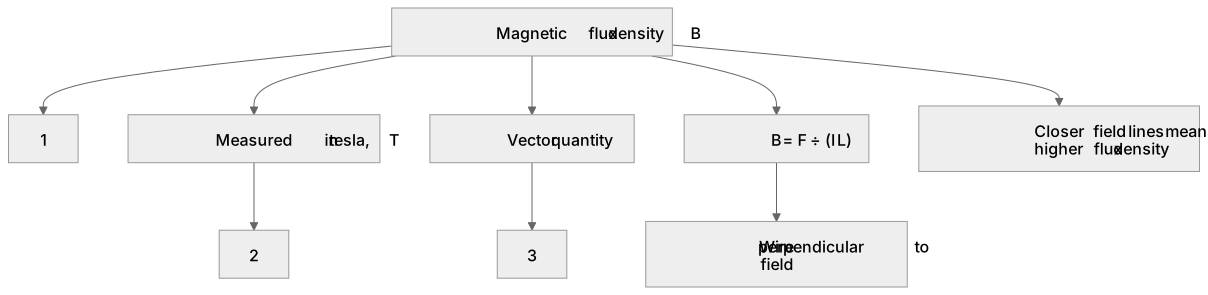
1Box 1
2Box 2
3Box 3
There is more to this lesson
The full lesson goes on to check your understanding and help you earn the marks. Create a free account to carry on, with your progress saved.
A week of Premium from your first lesson · Then the free plan continues · No card, no charge
Test your understanding of Fleming's left-hand rule (HT only): magnetic flux density, B, in tesla, T
Active recall beats re-reading. Take an instant quiz now to test what you’ve learned and lock it into long-term memory.
A week of Premium from your first lesson · Then the free plan continues · No card, no charge