AQA · GCSE · Combined Science
Course version: 8464 · Version from Sept 2018
Students should be able to recall the factors that affect the size of the…
Full specification wording
Fleming's left-hand rule (HT only): Students should be able to recall the factors that affect the size of the force on the conductor.
The force on a current-carrying conductor in an external magnetic field depends on several factors.
Checked against the AQA 8464 specification (opens in a new tab) on .
- Point 3 of 10
- 3 key terms
Study notes
From the checked teaching notes for this specification point.
The idea
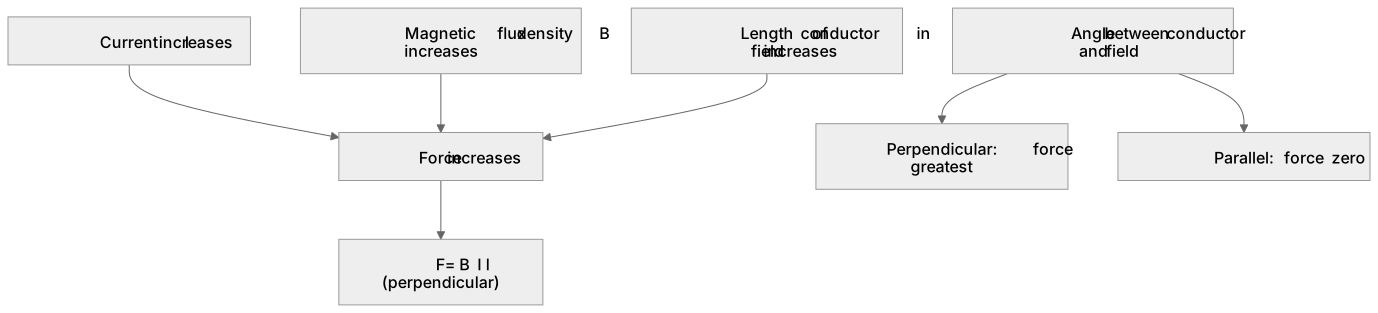
The force on a current-carrying conductor in an external magnetic field depends on several factors. Increasing the current increases the force. Increasing the magnetic flux density of the external field increases the force. Increasing the length of conductor within the field increases the force. The angle between the conductor and the field also matters: the force is greatest when the conductor is perpendicular to the field and zero when parallel. For a conductor at right angles to the field, these combine as F = B I l, where F is in newtons, B in tesla, I in amperes and l in metres. For example, doubling the current while keeping B and l fixed doubles the force. The force acts perpendicular to both the field and the conductor.
What earns the marks
- Recalls that increasing the current in the conductor increases the force.
- Recalls that increasing the magnetic flux density of the external field increases the force.
- Recalls that increasing the length of conductor within the magnetic field increases the force.
- Explains that the angle between the conductor and the field affects the force, with maximum force when perpendicular and zero force when parallel.
- Uses the relationship F = B I l for a conductor perpendicular to the field to calculate or compare forces.
- Applies proportional reasoning, for example stating that doubling one factor while others remain constant doubles the force.
Common mistakes and how to put them right
Thinking that a longer conductor always increases the force regardless of position.
Put it right: Is to consider the effective length perpendicular to the field.
Believing that the force is largest when the conductor is parallel to the field.
Put it right: Is that the force is zero when parallel and maximum when perpendicular.
Confusing magnetic flux density B with force F or with current I.
Put it right: Is to associate B with tesla, I with ampere and F with newton.
Exam tips
- Write the relationship as F = B I l and check that each quantity is in its standard unit before substituting.
- For comparison questions, change one factor at a time and state the proportional effect on the force.
- If the conductor is not perpendicular to the field, explain that the component of length perpendicular to the field determines the force.
Try the lesson
The start of the Fleming's left-hand rule (HT only): Students should be able to recall the factors that affect the size of the force on the conductor. lesson, made from checked teaching notes for this specification point.
Have a go first
Which change increases the size of the force on a current-carrying conductor in a magnetic field?
Listen
The force on a current-carrying conductor in an external magnetic field depends on several factors. Increasing the current increases the force. Increasing the magnetic flux density of the external field increases the force. Increasing the length of conductor within the field increases the force. The angle between the conductor and the field also matters: the force is greatest when the conductor is perpendicular to the field and zero when parallel. For a conductor at right angles to the field, these combine as F = B I l, where F is in newtons, B in tesla, I in amperes and l in metres. For example, doubling the current while keeping B and l fixed doubles the force. The force acts perpendicular to both the field and the conductor. A strong answer earns marks for these points. Recalls that increasing the current in the conductor increases the force. Recalls that increasing the magnetic flux density of the external field increases the force. Recalls that increasing the length of conductor within the magnetic field increases the force. Explains that the angle between the conductor and the field affects the force, with maximum force when perpendicular and zero force when parallel. A common slip: Thinking that a longer conductor always increases the force regardless of position: the error ignores that only the length within the field and the angle matter. Instead, is to consider the effective length perpendicular to the field. Exam tip: Write the relationship as F = B I l and check that each quantity is in its standard unit before substituting.
See it
Key words
Say what each word means before you turn the card.
Magnetic flux density
Try answering aloud or in your head before turning the card.
Proportional reasoning
Try answering aloud or in your head before turning the card.
Force, current and length relationships
Try answering aloud or in your head before turning the card.
See every definition
- Magnetic flux density
- Increasing this property of the external field increases the force on a current-carrying conductor within it.
- Proportional reasoning
- Doubling one factor while others remain constant doubles the force, as when doubling the current with B and l fixed.
- Force, current and length relationships
- For a conductor at right angles to the field, these combine as F = B I l, with F in newtons, I in amperes and l in metres.
Label the diagram
Some boxes have lost their names. Pick the right name for each number.
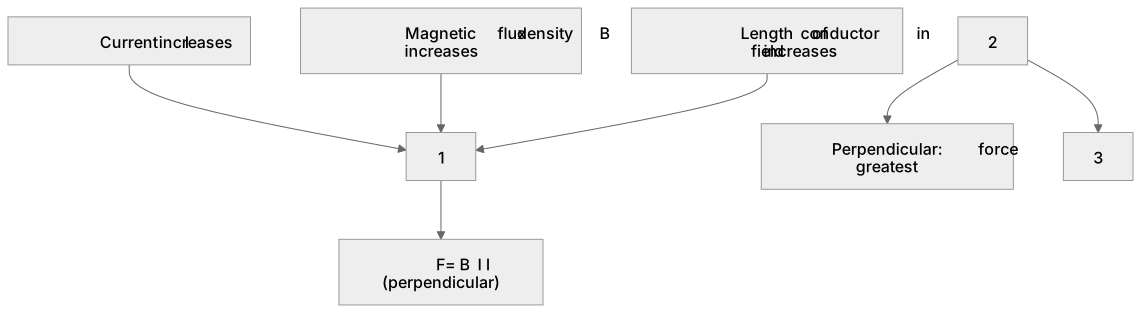
1Box 1
2Box 2
3Box 3
There is more to this lesson
The full lesson goes on to check your understanding and help you earn the marks. Create a free account to carry on, with your progress saved.
A week of Premium from your first lesson · Then the free plan continues · No card, no charge
Test your understanding of Fleming's left-hand rule (HT only): Students should be able to recall the factors that affect the size of the force on the conductor.
Active recall beats re-reading. Take an instant quiz now to test what you’ve learned and lock it into long-term memory.
A week of Premium from your first lesson · Then the free plan continues · No card, no charge