AQA · GCSE · Combined Science
Course version: 8464 · Version from Sept 2018
Describe the difference between elastic deformation and inelastic…
Full specification wording
Forces and elasticity: describe the difference between elastic deformation and inelastic deformation caused by stretching forces.
When a stretching force acts on an object, the object may change shape.
Checked against the AQA 8464 specification (opens in a new tab) on .
- Point 3 of 19
- 3 key terms
Study notes
From the checked teaching notes for this specification point.
The idea
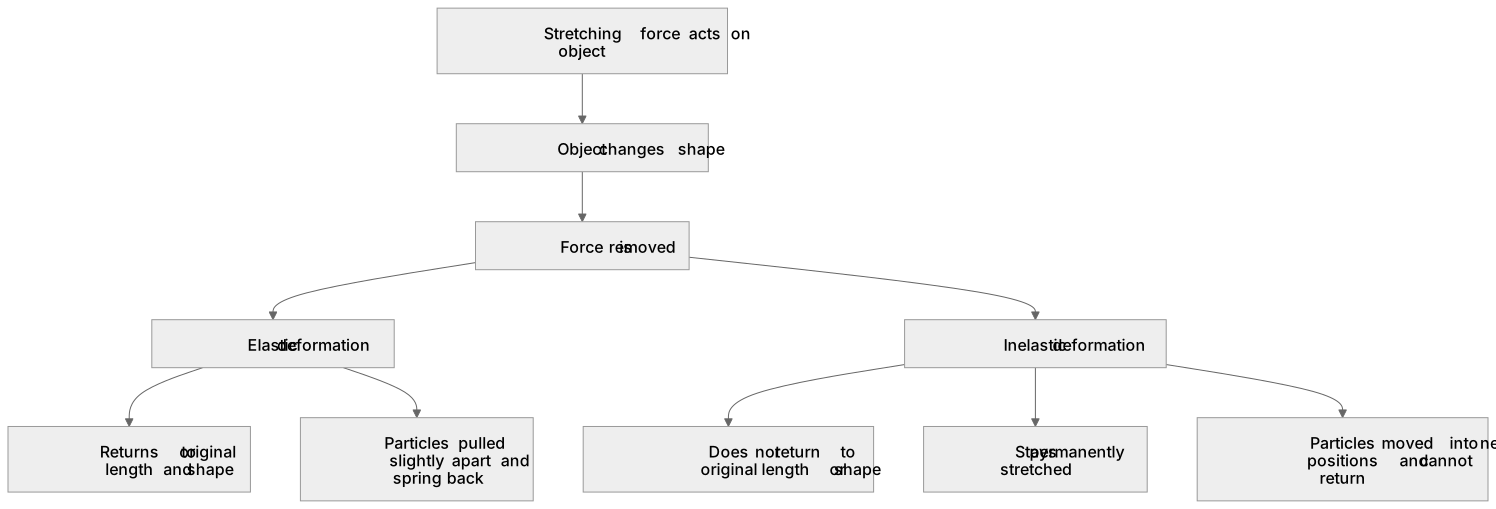
When a stretching force acts on an object, the object may change shape. In elastic deformation, the object returns to its original length and shape once the force is removed, because the particles are pulled slightly apart but spring back to their original arrangement. A rubber band or a spring stretched gently behaves elastically. In inelastic deformation, the object does not return to its original length or shape when the force is removed; it stays permanently stretched. This happens when the force is large enough to move particles into new positions so they cannot return. Stretching a plastic bag until it tears or over-stretching a spring produces inelastic deformation. The key difference is therefore whether the original shape is recovered after the stretching force is removed.
What earns the marks
- Elastic deformation: the object returns to its original length and shape when the stretching force is removed.
- Inelastic deformation: the object does not return to its original length and shape when the stretching force is removed, so it remains permanently stretched.
- In elastic deformation the particles are displaced only slightly and return to their original positions; in inelastic deformation the particles are displaced enough that they cannot return.
- A concrete example: a gently stretched spring or rubber band shows elastic deformation, while an over-stretched spring or a stretched plastic bag shows inelastic deformation.
- The comparison must refer to what happens after the force is removed, not just to how far the object stretches while the force is acting.
Common mistakes and how to put them right
Saying that elastic deformation means the object stretches and inelastic means it does not stretch.
Put it right: Both involve stretching; the difference is whether the original shape returns after the force is removed.
Confusing elastic deformation with the material elastic band.
Put it right: Elastic describes recoverable shape change, not a particular material.
Claiming that an object showing inelastic deformation cannot stretch at all.
Put it right: It stretches, but the change is permanent.
Exam tips
- Use the phrase 'when the force is removed' in your answer, because that is the condition that separates the two types of deformation.
- Give one example of each type, such as a spring returning to length (elastic) and a plastic bag staying stretched (inelastic).
- Link the behaviour to particles: slight displacement and return for elastic, permanent displacement for inelastic.
Try the lesson
The start of the Forces and elasticity: describe the difference between elastic deformation and inelastic deformation caused by stretching forces. lesson, made from checked teaching notes for this specification point.
Have a go first
A rubber band is stretched and then released. It returns to its original length. What name is given to this type of deformation?
Listen
When a stretching force acts on an object, the object may change shape. In elastic deformation, the object returns to its original length and shape once the force is removed, because the particles are pulled slightly apart but spring back to their original arrangement. A rubber band or a spring stretched gently behaves elastically. In inelastic deformation, the object does not return to its original length or shape when the force is removed; it stays permanently stretched. This happens when the force is large enough to move particles into new positions so they cannot return. Stretching a plastic bag until it tears or over-stretching a spring produces inelastic deformation. The key difference is therefore whether the original shape is recovered after the stretching force is removed. A strong answer earns marks for these points. Elastic deformation: the object returns to its original length and shape when the stretching force is removed. Inelastic deformation: the object does not return to its original length and shape when the stretching force is removed, so it remains permanently stretched. In elastic deformation the particles are displaced only slightly and return to their original positions; in inelastic deformation the particles are displaced enough that they cannot return. A concrete example: a gently stretched spring or rubber band shows elastic deformation, while an over-stretched spring or a stretched plastic bag shows inelastic deformation. A common slip: Saying that elastic deformation means the object stretches and inelastic means it does not stretch. Instead, both involve stretching; the difference is whether the original shape returns after the force is removed. Exam tip: Use the phrase 'when the force is removed' in your answer, because that is the condition that separates the two types of deformation.
See it
Key words
Say what each word means before you turn the card.
Elastic deformation
Try answering aloud or in your head before turning the card.
Inelastic deformation
Try answering aloud or in your head before turning the card.
Particle explanation of deformation
Try answering aloud or in your head before turning the card.
See every definition
- Elastic deformation
- The object returns to its original length and shape when the stretching force is removed, because the particles spring back to their original arrangement.
- Inelastic deformation
- The object does not return to its original length and shape when the force is removed, so it remains permanently stretched.
- Particle explanation of deformation
- In elastic deformation the particles are displaced only slightly and return to their original positions; in inelastic deformation they are displaced enough that they cannot return.
Label the diagram
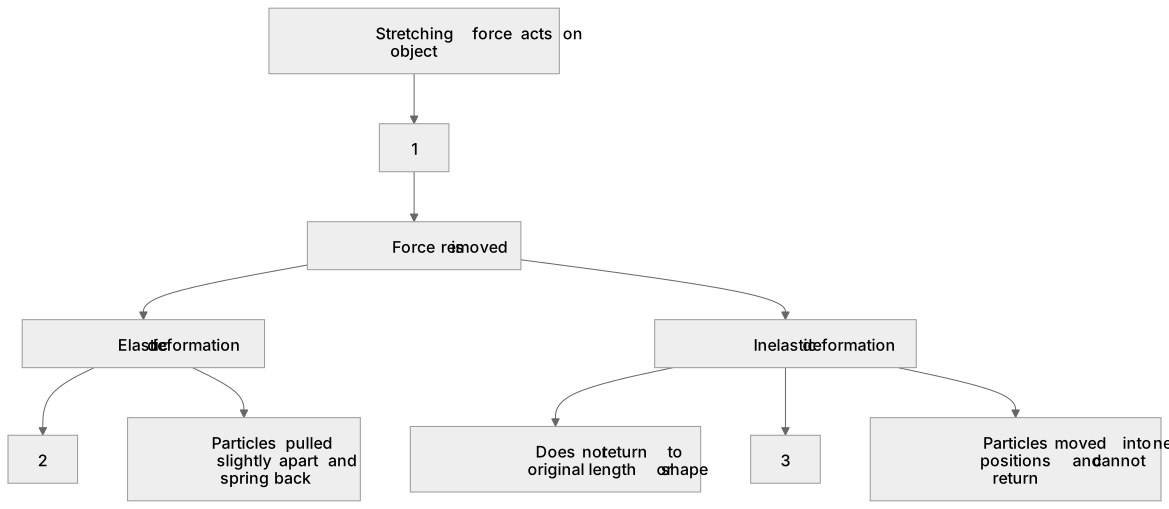
Some boxes have lost their names. Pick the right name for each number.
1Box 1
2Box 2
3Box 3
There is more to this lesson
The full lesson goes on to check your understanding and help you earn the marks. Create a free account to carry on, with your progress saved.
A week of Premium from your first lesson · Then the free plan continues · No card, no charge
Test your understanding of Forces and elasticity: describe the difference between elastic deformation and inelastic deformation caused by stretching forces.
Active recall beats re-reading. Take an instant quiz now to test what you’ve learned and lock it into long-term memory.
A week of Premium from your first lesson · Then the free plan continues · No card, no charge