AQA · GCSE · Combined Science
Course version: 8464 · Version from Sept 2018
Elastic potential energy = 0.5 × spring constant × extension ²
Full specification wording
Forces and elasticity: elastic potential energy = 0.5 × spring constant × extension ²
This equation gives the energy stored in a stretched or compressed spring when it obeys Hooke's law.
Checked against the AQA 8464 specification (opens in a new tab) on .
- Point 16 of 19
- 3 key terms
Study notes
From the checked teaching notes for this specification point.
The idea
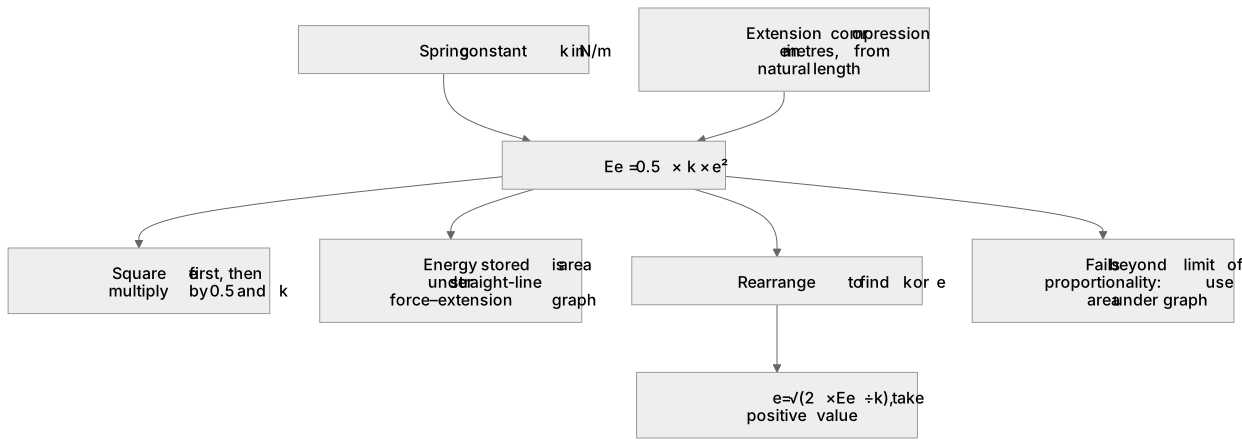
This equation gives the energy stored in a stretched or compressed spring when it obeys Hooke's law. The spring constant k measures stiffness in newtons per metre, and the extension e is the change in length in metres, not the total length. Because the force needed grows in proportion to the extension, the energy stored is the area under the force–extension graph, a triangle of base e and height k × e, so Ee = 0.5 × k × e². For example, a spring of spring constant 150 N/m extended by 0.20 m stores 0.5 × 150 × 0.20² = 3.0 J. The equation works for compression too, using the compression as e. It fails beyond the limit of proportionality, where the graph curves and the stored energy must be found from the area under the graph instead.
What earns the marks
- Identify k as the spring constant in N/m and e as the extension or compression in metres, measured from the natural length.
- Substitute values into Ee = 0.5 × k × e² and evaluate the square before multiplying by 0.5 and k.
- Recognise that the equation represents the area under the straight-line force–extension graph up to the limit of proportionality.
- Use the same equation for compression, treating the reduction in length as e.
- Rearrange the equation to find k or e when the energy is known, for example e = √(2 × Ee ÷ k).
- State the energy in joules and check that the value is reasonable for the stiffness and extension involved.
Common mistakes and how to put them right
Squaring the extension after multiplying by k, or squaring the whole expression 0.5 × k × e.
Put it right by squaring only e.
Using the total length of the spring instead of the extension.
Put it right by subtracting the natural length from the stretched length.
Mixing units, such as using centimetres for e while k is in N/m.
Put it right by converting all lengths to metres before substitution.
Exam tips
- Show the substitution line clearly, including the squared extension, so the examiner can follow the calculation.
- When rearranging for e, take the square root last and keep the positive value, since a length cannot be negative.
- Link the calculation to the force–extension graph by noting that the stored energy is the triangular area beneath the straight line.
Try the lesson
The start of the Forces and elasticity: elastic potential energy = 0.5 × spring constant × extension ² lesson, made from checked teaching notes for this specification point.
Have a go first
A spring with a spring constant of 40 N/m is stretched by an extension of 0.5 m. Using elastic potential energy = 0.5 × spring constant × extension², what is the elastic potential energy stored in the spring?
Listen
This equation gives the energy stored in a stretched or compressed spring when it obeys Hooke's law. The spring constant k measures stiffness in newtons per metre, and the extension e is the change in length in metres, not the total length. Because the force needed grows in proportion to the extension, the energy stored is the area under the force–extension graph, a triangle of base e and height k × e, so Ee = 0.5 × k × e². For example, a spring of spring constant 150 N/m extended by 0.20 m stores 0.5 × 150 × 0.20² = 3.0 J. The equation works for compression too, using the compression as e. It fails beyond the limit of proportionality, where the graph curves and the stored energy must be found from the area under the graph instead. A strong answer earns marks for these points. Identify k as the spring constant in N/m and e as the extension or compression in metres, measured from the natural length. Substitute values into Ee = 0.5 × k × e² and evaluate the square before multiplying by 0.5 and k. Recognise that the equation represents the area under the straight-line force–extension graph up to the limit of proportionality. Use the same equation for compression, treating the reduction in length as e. A common slip: Squaring the extension after multiplying by k, or squaring the whole expression 0.5 × k × e. Instead, squaring only e. Exam tip: Show the substitution line clearly, including the squared extension, so the examiner can follow the calculation.
See it
Key words
Say what each word means before you turn the card.
Elastic potential energy
Try answering aloud or in your head before turning the card.
Spring constant and stiffness
Try answering aloud or in your head before turning the card.
Hooke's law
Try answering aloud or in your head before turning the card.
See every definition
- Elastic potential energy
- The energy stored in a stretched or compressed spring when it obeys Hooke's law, given by 0.5 × spring constant × extension².
- Spring constant and stiffness
- The spring constant k measures stiffness in newtons per metre.
- Hooke's law
- The force needed grows in proportion to the extension, giving a straight-line force–extension graph up to the limit of proportionality.
Label the diagram
Some boxes have lost their names. Pick the right name for each number.
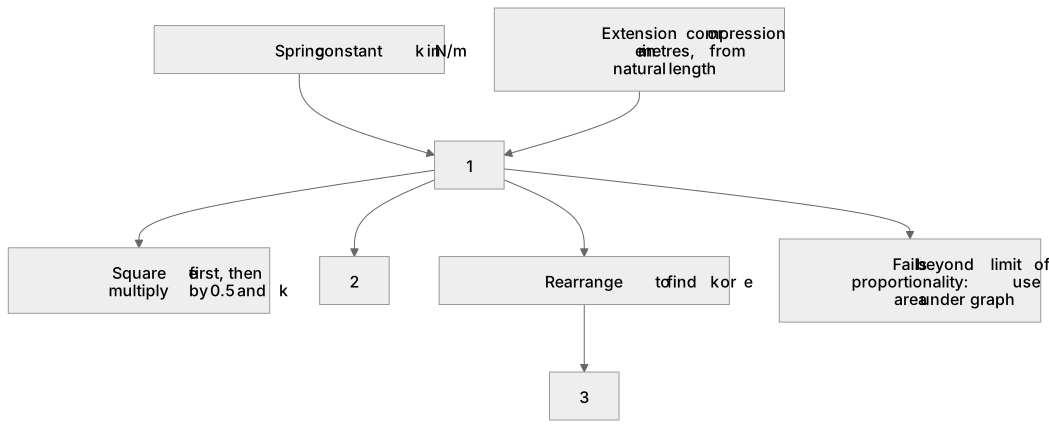
1Box 1
2Box 2
3Box 3
There is more to this lesson
The full lesson goes on to check your understanding and help you earn the marks. Create a free account to carry on, with your progress saved.
A week of Premium from your first lesson · Then the free plan continues · No card, no charge
Test your understanding of Forces and elasticity: elastic potential energy = 0.5 × spring constant × extension ²
Active recall beats re-reading. Take an instant quiz now to test what you’ve learned and lock it into long-term memory.
A week of Premium from your first lesson · Then the free plan continues · No card, no charge