AQA · GCSE · Combined Science
Course version: 8464 · Version from Sept 2018
Students should be able to calculate relevant values of stored energy and…
Full specification wording
Forces and elasticity: Students should be able to calculate relevant values of stored energy and energy transfers.
You may be asked to find the energy stored when a spring is stretched, the spring constant when energy and extension are known, or the extension when energy and k are known.
Checked against the AQA 8464 specification (opens in a new tab) on .
- Point 18 of 19
Study notes
From the checked teaching notes for this specification point.
The idea
You may be asked to find the energy stored when a spring is stretched, the spring constant when energy and extension are known, or the extension when energy and k are known. Rearranging is often needed: k = 2Eₑ ÷ e² and e = √(2Eₑ ÷ k). For example, if 0.50 J is stored in a spring with k = 100 N/m, then e = √(2 × 0.50 ÷ 100) = 0.10 m. When the spring is released, the elastic potential energy store decreases and equal energy is transferred to kinetic, gravitational potential or thermal energy stores, depending on the situation.
What earns the marks
- Select the equation Eₑ = ½ke² and rearrange it correctly for the quantity required.
- Calculate stored elastic potential energy from a given spring constant and extension.
- Calculate the spring constant from a given stored energy and extension.
- Calculate the extension from a given stored energy and spring constant, taking the positive square root.
- Describe energy transfers between elastic potential, kinetic, gravitational potential and thermal stores when a spring is stretched or released.
- Check that the spring remains within its limit of proportionality when applying the equation.
Common mistakes and how to put them right
Rearranging incorrectly, for example writing k = Eₑ ÷ e² instead of k = 2Eₑ ÷ e².
Put it right: Multiply both sides by 2 before dividing by e².
Forgetting the square root when finding extension.
Put it right: Take the square root of 2Eₑ ÷ k.
Assuming all stored energy becomes useful kinetic energy.
Put it right: State that some energy may be transferred to the thermal store of the surroundings.
Exam tips
- Show each rearrangement step so that method marks can be awarded even if the final value is wrong.
- Give the final answer with the correct unit and a sensible number of significant figures.
- When describing transfers, name the store that decreases and the store that increases, and mention any thermal transfer to the surroundings.
Try the lesson
The start of the Forces and elasticity: Students should be able to calculate relevant values of stored energy and energy transfers. lesson, made from checked teaching notes for this specification point.
Have a go first
A spring has a spring constant of 200 N/m. It is stretched so that its extension is 0.15 m. Calculate the elastic potential energy stored in the spring.
Listen
You may be asked to find the energy stored when a spring is stretched, the spring constant when energy and extension are known, or the extension when energy and k are known. Rearranging is often needed: k = 2Eₑ ÷ e² and e = √(2Eₑ ÷ k). For example, if 0.50 J is stored in a spring with k = 100 N/m, then e = √(2 × 0.50 ÷ 100) = 0.10 m. When the spring is released, the elastic potential energy store decreases and equal energy is transferred to kinetic, gravitational potential or thermal energy stores, depending on the situation. A strong answer earns marks for these points. Select the equation Eₑ = ½ke² and rearrange it correctly for the quantity required. Calculate stored elastic potential energy from a given spring constant and extension. Calculate the spring constant from a given stored energy and extension. Calculate the extension from a given stored energy and spring constant, taking the positive square root. A common slip: Rearranging incorrectly, for example writing k = Eₑ ÷ e² instead of k = 2Eₑ ÷ e². Instead, multiply both sides by 2 before dividing by e². Exam tip: Show each rearrangement step so that method marks can be awarded even if the final value is wrong.
See it
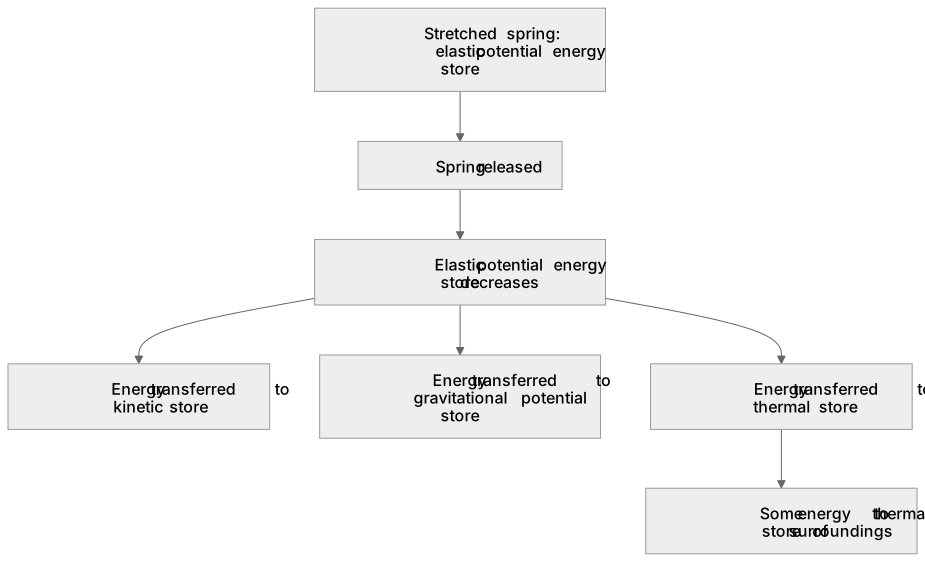
Label the diagram
Some boxes have lost their names. Pick the right name for each number.
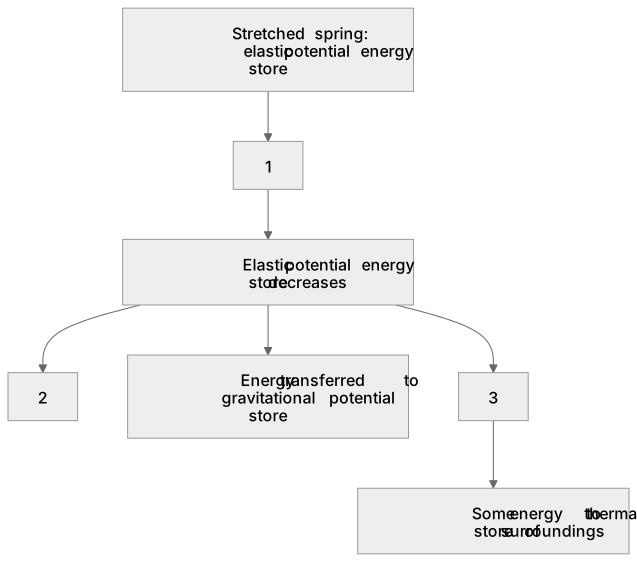
1Box 1
2Box 2
3Box 3
There is more to this lesson
The full lesson goes on to check your understanding and help you earn the marks. Create a free account to carry on, with your progress saved.
A week of Premium from your first lesson · Then the free plan continues · No card, no charge
Test your understanding of Forces and elasticity: Students should be able to calculate relevant values of stored energy and energy transfers.
Active recall beats re-reading. Take an instant quiz now to test what you’ve learned and lock it into long-term memory.
A week of Premium from your first lesson · Then the free plan continues · No card, no charge