AQA · GCSE · Combined Science
Course version: 8464 · Version from Sept 2018
This relationship also applies to the compression of an elastic object,…
Full specification wording
Forces and elasticity: This relationship also applies to the compression of an elastic object, where ‘e’ would be the compression of the object.
The force–extension relationship, force = spring constant × extension, also describes compression of an elastic object.
Checked against the AQA 8464 specification (opens in a new tab) on .
- Point 10 of 19
Study notes
From the checked teaching notes for this specification point.
The idea
The force–extension relationship, force = spring constant × extension, also describes compression of an elastic object. In compression, the object shortens, and e represents the compression, the decrease in length. Compression is calculated as original length minus compressed length: e = L₀ − L. For example, a spring of original length 0.15 m compressed to 0.11 m has e = 0.15 m − 0.11 m = 0.04 m. The spring constant has the same meaning, and the force is the compressive force. Compression is still measured in metres, and the same equation applies as long as the elastic limit is not exceeded.
What earns the marks
- States that the force–extension relationship also applies when an elastic object is compressed.
- Defines compression as the decrease in length of an elastic object under a compressive force.
- Calculates compression using e = original length − compressed length.
- Uses the same equation, force = spring constant × compression, with e representing compression.
- Recognises that compression is measured in metres and that the spring constant is unchanged in meaning.
- Applies the relationship only while the elastic limit is not exceeded.
Common mistakes and how to put them right
Subtracting the original length from the compressed length, giving a negative value.
Put it right by using e = original length − compressed length.
Treating compression as a different equation from extension.
Put it right by recognising that the same relationship applies, with e representing compression.
Forgetting to convert centimetres to metres before calculating compression.
Put it right by converting all lengths to metres first.
Exam tips
- Label which length is original and which is compressed before subtracting, so the direction of the change is clear.
- State that e represents compression when the object is squashed, and keep the unit as metres.
- Use the same equation as for extension, but substitute the compression value for e.
Try the lesson
The start of the Forces and elasticity: This relationship also applies to the compression of an elastic object, where ‘e’ would be the compression of the object. lesson, made from checked teaching notes for this specification point.
Have a go first
A spring has an original length of 15 cm. A force is applied to squash the spring until its length is 11 cm. What is the compression, e, of the spring?
Listen
The force–extension relationship, force = spring constant × extension, also describes compression of an elastic object. In compression, the object shortens, and e represents the compression, the decrease in length. Compression is calculated as original length minus compressed length: e = L₀ − L. For example, a spring of original length 0.15 m compressed to 0.11 m has e = 0.15 m − 0.11 m = 0.04 m. The spring constant has the same meaning, and the force is the compressive force. Compression is still measured in metres, and the same equation applies as long as the elastic limit is not exceeded. A strong answer earns marks for these points. States that the force–extension relationship also applies when an elastic object is compressed. Defines compression as the decrease in length of an elastic object under a compressive force. Calculates compression using e = original length − compressed length. Uses the same equation, force = spring constant × compression, with e representing compression. A common slip: Subtracting the original length from the compressed length, giving a negative value. Instead, using e = original length − compressed length. Exam tip: Label which length is original and which is compressed before subtracting, so the direction of the change is clear.
See it
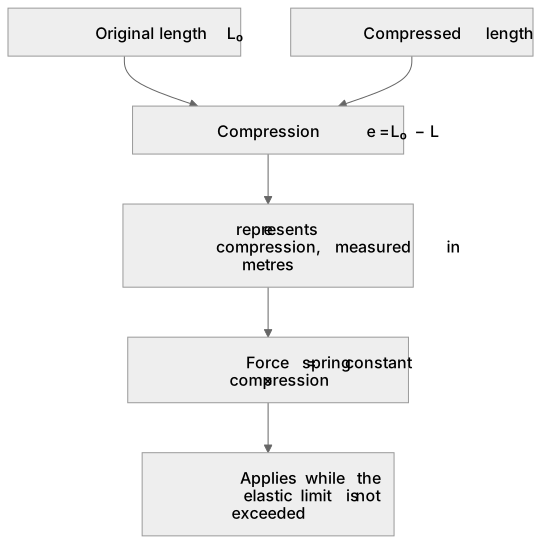
Label the diagram
Some boxes have lost their names. Pick the right name for each number.
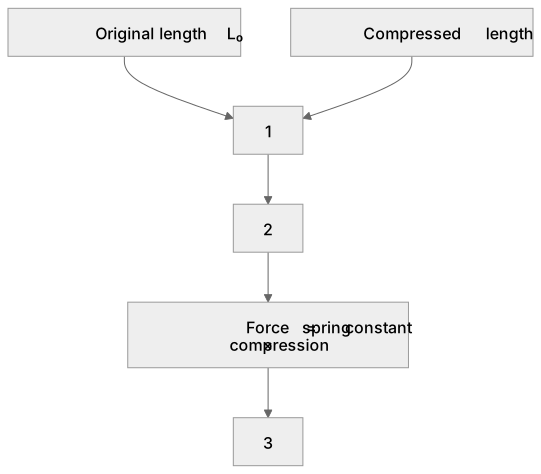
1Box 1
2Box 2
3Box 3
There is more to this lesson
The full lesson goes on to check your understanding and help you earn the marks. Create a free account to carry on, with your progress saved.
A week of Premium from your first lesson · Then the free plan continues · No card, no charge
Test your understanding of Forces and elasticity: This relationship also applies to the compression of an elastic object, where ‘e’ would be the compression of the object.
Active recall beats re-reading. Take an instant quiz now to test what you’ve learned and lock it into long-term memory.
A week of Premium from your first lesson · Then the free plan continues · No card, no charge