AQA · GCSE · Combined Science
Course version: 8464 · Version from Sept 2018
Fossils are the ‘remains’ of organisms from millions of years ago, which…
Full specification wording
Fossils: Fossils are the ‘remains’ of organisms from millions of years ago, which are found in rocks.
A fossil is any preserved trace of an organism that lived millions of years ago, and fossils are found within rocks.
Checked against the AQA 8464 specification (opens in a new tab) on .
- Point 1 of 8
- 4 key terms
Study notes
From the checked teaching notes for this specification point.
The idea
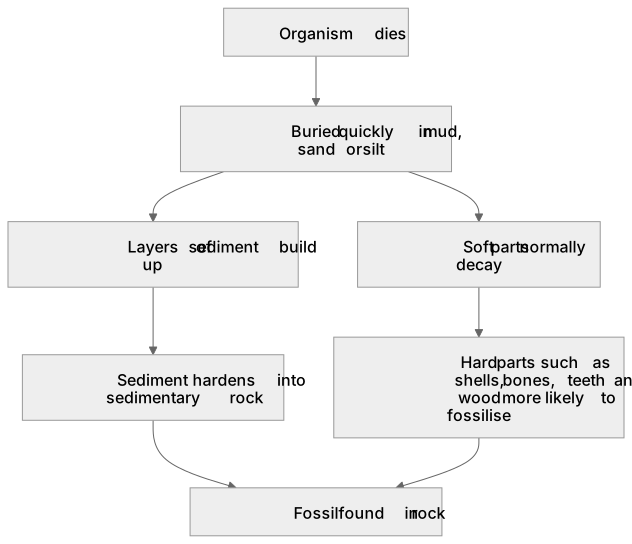
A fossil is any preserved trace of an organism that lived millions of years ago, and fossils are found within rocks. The word ‘remains’ is in quotation marks because a fossil is not always body material: it can be the shape, impression or chemical trace left behind. Most fossils occur in sedimentary rock, where layers of mud, sand or silt bury dead organisms and harden over long periods. The organism must usually be buried quickly, and soft parts normally decay before preservation, so hard parts such as shells, bones, teeth and wood are most commonly fossilised. For example, a dinosaur skeleton in sandstone or an ammonite in limestone shows how rock preserves evidence of past life. Because the rock layers form in order, fossils give a record of organisms that existed long before humans, supporting ideas about evolution.
What earns the marks
- States that a fossil is evidence of an organism that lived millions of years ago.
- Explains that fossils are found in rocks, most commonly sedimentary rock formed from layers of sediment.
- Recognises that ‘remains’ can include body parts, impressions, moulds, casts or chemical traces rather than only whole organisms.
- Links preservation to rapid burial and to the decay or loss of soft parts, leaving hard parts more likely to fossilise.
- Uses a named example, such as an ammonite in limestone or a dinosaur bone in sandstone, to illustrate the idea.
Common mistakes and how to put them right
Thinking every fossil is the actual body of the organism.
Put it right by explaining that many fossils are impressions, moulds, casts or mineral replacements.
Believing fossils are found in any rock type.
Put it right by linking most fossils to sedimentary rock, where layers bury and preserve remains.
Assuming all organisms fossilise.
Put it right by noting that decay, scavengers and geological processes destroy most remains, so fossils are rare.
Exam tips
- Define the term fossil in one sentence, then add where fossils are found and why that rock type preserves them.
- Use the phrase ‘millions of years ago’ when giving the timescale, rather than vague words such as ‘a long time ago’.
- Include one named example of a fossil and the rock it is found in to make the answer concrete.
Try the lesson
The start of the Fossils: Fossils are the ‘remains’ of organisms from millions of years ago, which are found in rocks. lesson, made from checked teaching notes for this specification point.
Have a go first
Which statement describes what a fossil is?
Listen
A fossil is any preserved trace of an organism that lived millions of years ago, and fossils are found within rocks. The word ‘remains’ is in quotation marks because a fossil is not always body material: it can be the shape, impression or chemical trace left behind. Most fossils occur in sedimentary rock, where layers of mud, sand or silt bury dead organisms and harden over long periods. The organism must usually be buried quickly, and soft parts normally decay before preservation, so hard parts such as shells, bones, teeth and wood are most commonly fossilised. For example, a dinosaur skeleton in sandstone or an ammonite in limestone shows how rock preserves evidence of past life. Because the rock layers form in order, fossils give a record of organisms that existed long before humans, supporting ideas about evolution. A strong answer earns marks for these points. States that a fossil is evidence of an organism that lived millions of years ago. Explains that fossils are found in rocks, most commonly sedimentary rock formed from layers of sediment. Recognises that ‘remains’ can include body parts, impressions, moulds, casts or chemical traces rather than only whole organisms. Links preservation to rapid burial and to the decay or loss of soft parts, leaving hard parts more likely to fossilise. A common slip: Thinking every fossil is the actual body of the organism. Instead, explaining that many fossils are impressions, moulds, casts or mineral replacements. Exam tip: Define the term fossil in one sentence, then add where fossils are found and why that rock type preserves them.
See it
Key words
Say what each word means before you turn the card.
Fossils
Try answering aloud or in your head before turning the card.
Sedimentary rock formation
Try answering aloud or in your head before turning the card.
Preservation and decay
Try answering aloud or in your head before turning the card.
Timescale of millions of years
Try answering aloud or in your head before turning the card.
See every definition
- Fossils
- The 'remains' of organisms from millions of years ago, which are found in rocks.
- Sedimentary rock formation
- Layers of mud, sand or silt bury dead organisms and harden over long periods.
- Preservation and decay
- The organism must usually be buried quickly, and soft parts normally decay before preservation, so hard parts are most commonly fossilised.
- Timescale of millions of years
- Fossils are the remains of organisms from millions of years ago, existing long before humans.
Label the diagram
Some boxes have lost their names. Pick the right name for each number.
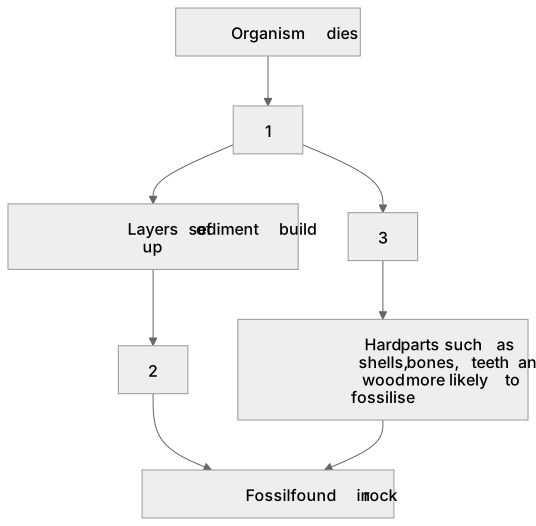
1Box 1
2Box 2
3Box 3
There is more to this lesson
The full lesson goes on to check your understanding and help you earn the marks. Create a free account to carry on, with your progress saved.
A week of Premium from your first lesson · Then the free plan continues · No card, no charge
Test your understanding of Fossils: Fossils are the ‘remains’ of organisms from millions of years ago, which are found in rocks.
Active recall beats re-reading. Take an instant quiz now to test what you’ve learned and lock it into long-term memory.
A week of Premium from your first lesson · Then the free plan continues · No card, no charge