AQA · GCSE · Combined Science
Course version: 8464 · Version from Sept 2018
(HT only) Students should be able to describe the main steps in the…
Full specification wording
Genetic engineering: (HT only) Students should be able to describe the main steps in the process of genetic engineering.
This content is for Higher Tier students.
Checked against the AQA 8464 specification (opens in a new tab) on .
- Point 9 of 12
- 3 key terms
Study notes
From the checked teaching notes for this specification point.
The idea
This content is for Higher Tier students. Genetic engineering involves several main steps to transfer a gene from one organism to another. First, enzymes are used to isolate and 'cut out' the required gene from the donor organism's DNA. This gene is then inserted into a vector. The vector is usually a bacterial plasmid (a small ring of DNA) or a virus. The vector is then used to insert the gene into the required cells of the recipient organism. This transfer is typically done at an early stage in the organism's development, such as an embryo, so that the organism develops with the desired characteristics.
For example: Inserting the human insulin gene into a bacterial plasmid allows the bacteria to produce insulin.
What earns the marks
- Enzymes are used to isolate and cut out the required gene from the donor organism.
- The isolated gene is inserted into a vector, which is usually a bacterial plasmid or a virus.
- The vector is used to insert the gene into the required cells of the recipient organism.
- Genes are transferred at an early stage of development so the organism develops with the desired characteristics.
Common mistakes and how to put them right
Naming specific enzymes like restriction enzymes or ligase.
Put it right: Simply using the term 'enzymes' as required by the specification.
Forgetting to mention the vector.
Put it right by explaining that a vector, such as a plasmid or virus, is essential to carry the gene into the new cell.
Thinking the transfer happens in adult organisms.
Put it right by stating the transfer occurs at an early stage of development so all cells develop the characteristic.
Exam tips
- Learn the sequence of steps logically: isolate with enzymes, insert into a vector, transfer to recipient cells.
- Give examples of vectors, specifically mentioning bacterial plasmids or viruses.
Try the lesson
The start of the Genetic engineering: (HT only) Students should be able to describe the main steps in the process of genetic engineering. lesson, made from checked teaching notes for this specification point.
Have a go first
In the process of genetic engineering, which type of substance is used to isolate the required gene from a chromosome?
Listen
This content is for Higher Tier students. Genetic engineering involves several main steps to transfer a gene from one organism to another. First, enzymes are used to isolate and 'cut out' the required gene from the donor organism's DNA. This gene is then inserted into a vector. The vector is usually a bacterial plasmid (a small ring of DNA) or a virus. The vector is then used to insert the gene into the required cells of the recipient organism. This transfer is typically done at an early stage in the organism's development, such as an embryo, so that the organism develops with the desired characteristics. For example, inserting the human insulin gene into a bacterial plasmid allows the bacteria to produce insulin. A strong answer earns marks for these points. Enzymes are used to isolate and cut out the required gene from the donor organism. The isolated gene is inserted into a vector, which is usually a bacterial plasmid or a virus. The vector is used to insert the gene into the required cells of the recipient organism. Genes are transferred at an early stage of development so the organism develops with the desired characteristics. A common slip: Naming specific enzymes like restriction enzymes or ligase. Instead, simply using the term 'enzymes' as required by the specification. Exam tip: Learn the sequence of steps logically: isolate with enzymes, insert into a vector, transfer to recipient cells.
See it
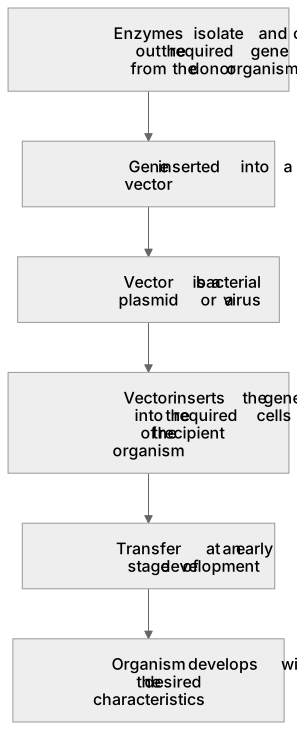
Put it in order
Put these steps in the order they happen.
- 1. Vector is a bacterial plasmid or a virus
- 2. Gene inserted into a vector
- 3. Enzymes isolate and cut out the required gene from the donor organism
- 4. Organism develops with the desired characteristics
- 5. Transfer at an early stage of development
- 6. Vector inserts the gene into the required cells of the recipient organism
Key words
Say what each word means before you turn the card.
Genetic engineering steps
Try answering aloud or in your head before turning the card.
Vectors in genetics
Try answering aloud or in your head before turning the card.
Early stage development
Try answering aloud or in your head before turning the card.
See every definition
- Genetic engineering steps
- Enzymes are used to isolate and cut out the required gene from the donor organism, and the gene is inserted into a vector.
- Vectors in genetics
- A vector, usually a bacterial plasmid or a virus, is used to insert the gene into the required cells of the recipient organism.
- Early stage development
- Genes are transferred at an early stage of development so the organism develops with the desired characteristics.
Label the diagram
Some boxes have lost their names. Pick the right name for each number.
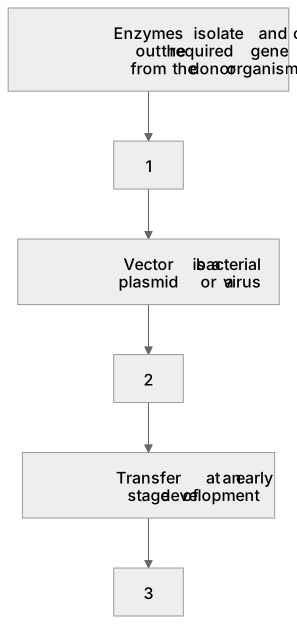
1Box 1
2Box 2
3Box 3
There is more to this lesson
The full lesson goes on to check your understanding and help you earn the marks. Create a free account to carry on, with your progress saved.
A week of Premium from your first lesson · Then the free plan continues · No card, no charge
Test your understanding of Genetic engineering: (HT only) Students should be able to describe the main steps in the process of genetic engineering.
Active recall beats re-reading. Take an instant quiz now to test what you’ve learned and lock it into long-term memory.
A week of Premium from your first lesson · Then the free plan continues · No card, no charge