AQA · GCSE · Combined Science
Course version: 8464 · Version from Sept 2018
Genetic inheritance: chromosome
A chromosome is a thread-like structure of DNA found in the nucleus of eukaryotic cells.
Checked against the AQA 8464 specification (opens in a new tab) on .
- Point 3 of 20
- 4 key terms
Study notes
From the checked teaching notes for this specification point.
The idea
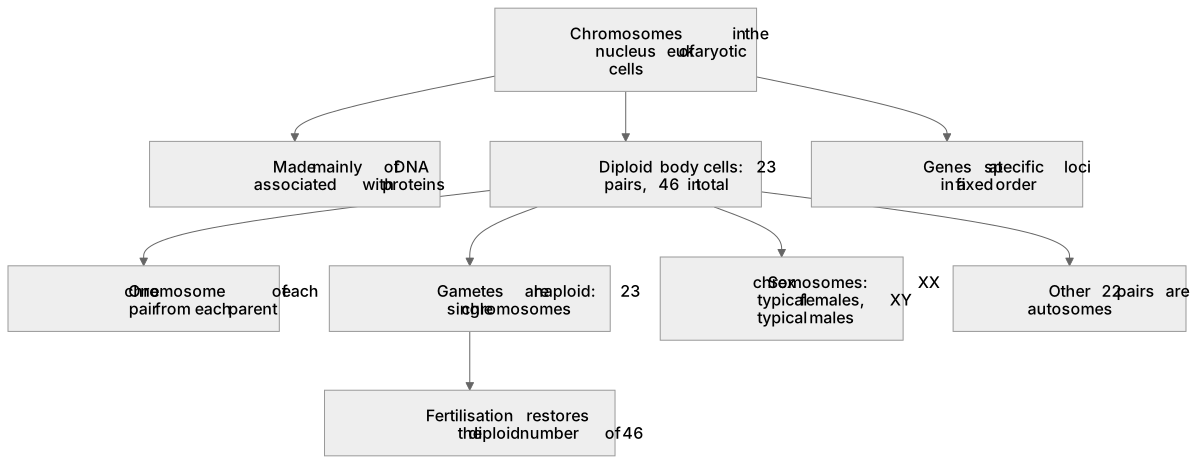
A chromosome is a thread-like structure of DNA found in the nucleus of eukaryotic cells. Most human body cells are diploid, containing 23 pairs of chromosomes, so 46 in total. One chromosome of each pair is inherited from each parent. Chromosomes carry genes in a fixed linear order, so each gene has a specific locus. In cells preparing to divide, chromosomes condense and become visible under a light microscope; they can be stained and photographed to produce a karyotype. Sex is determined by the sex chromosomes: XX in typical females and XY in typical males. Gametes are haploid, carrying 23 single chromosomes, so fertilisation restores the diploid number. Errors in chromosome number, such as trisomy 21, show why accurate separation in meiosis matters.
What earns the marks
- Chromosomes are located in the nucleus of eukaryotic cells and are made mainly of DNA associated with proteins.
- Human body cells are diploid, containing 23 pairs of chromosomes, that is 46 chromosomes in total.
- Each chromosome pair contains one chromosome from each parent, so offspring inherit genetic information from both.
- Genes are arranged along a chromosome at specific loci, and the order of genes on a chromosome is fixed.
- Gametes are haploid with 23 chromosomes, and fertilisation restores the diploid number of 46.
- The sex chromosomes are XX in typical females and XY in typical males, while the other 22 pairs are autosomes.
Common mistakes and how to put them right
Saying that a chromosome is a gene.
Put it right: A chromosome is a structure made of DNA that carries many genes, whereas a gene is a short section of DNA coding for a protein.
Writing that human gametes contain 46 chromosomes.
Put it right: Gametes are haploid and contain 23 chromosomes, and the diploid number 46 is restored at fertilisation.
Confusing chromosome number with chromatid number.
Put it right: After DNA replication a chromosome consists of two sister chromatids, but the chromosome count remains unchanged.
Exam tips
- Use the terms haploid and diploid precisely, and state the numbers 23 and 46 with their meaning.
- When describing inheritance, refer to one chromosome of each pair coming from each parent rather than saying chromosomes are 'mixed'.
- If asked to explain a karyotype or chromosome disorder, link the observed chromosome number to errors in meiosis or fertilisation.
Try the lesson
The start of the Genetic inheritance: chromosome lesson, made from checked teaching notes for this specification point.
Have a go first
In which part of a human body cell are the chromosomes found?
Listen
A chromosome is a thread-like structure of DNA found in the nucleus of eukaryotic cells. Most human body cells are diploid, containing 23 pairs of chromosomes, so 46 in total. One chromosome of each pair is inherited from each parent. Chromosomes carry genes in a fixed linear order, so each gene has a specific locus. In cells preparing to divide, chromosomes condense and become visible under a light microscope; they can be stained and photographed to produce a karyotype. Sex is determined by the sex chromosomes: XX in typical females and XY in typical males. Gametes are haploid, carrying 23 single chromosomes, so fertilisation restores the diploid number. Errors in chromosome number, such as trisomy 21, show why accurate separation in meiosis matters. A strong answer earns marks for these points. Chromosomes are located in the nucleus of eukaryotic cells and are made mainly of DNA associated with proteins. Human body cells are diploid, containing 23 pairs of chromosomes, that is 46 chromosomes in total. Each chromosome pair contains one chromosome from each parent, so offspring inherit genetic information from both. Genes are arranged along a chromosome at specific loci, and the order of genes on a chromosome is fixed. Exam tip: Use the terms haploid and diploid precisely, and state the numbers 23 and 46 with their meaning.
See it
Key words
Say what each word means before you turn the card.
chromosome
Try answering aloud or in your head before turning the card.
diploid
Try answering aloud or in your head before turning the card.
haploid
Try answering aloud or in your head before turning the card.
sex chromosomes
Try answering aloud or in your head before turning the card.
See every definition
- chromosome
- A thread-like structure of DNA found in the nucleus of eukaryotic cells, carrying genes in a fixed linear order.
- diploid
- Describes a cell containing 23 pairs of chromosomes, so 46 in total, as in most human body cells.
- haploid
- Describes a gamete carrying 23 single chromosomes, so that fertilisation restores the diploid number.
- sex chromosomes
- The chromosomes that determine sex, being XX in typical females and XY in typical males.
Label the diagram
Some boxes have lost their names. Pick the right name for each number.
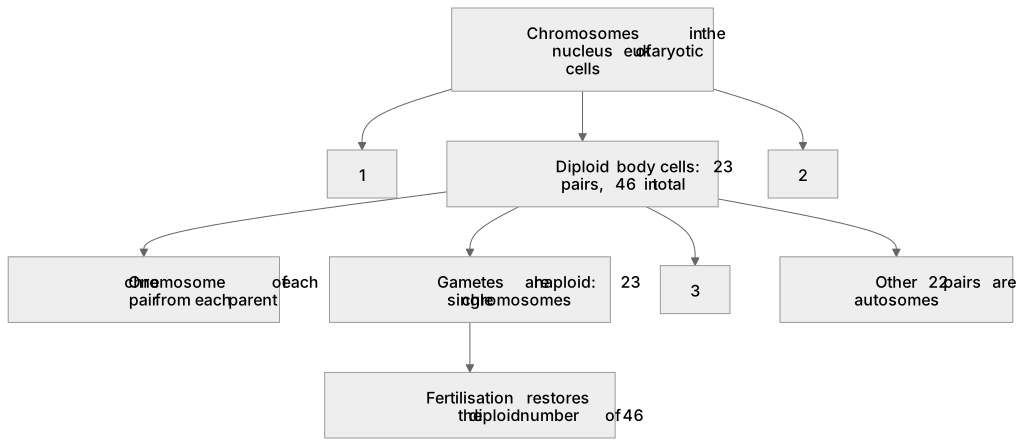
1Box 1
2Box 2
3Box 3
There is more to this lesson
The full lesson goes on to check your understanding and help you earn the marks. Create a free account to carry on, with your progress saved.
A week of Premium from your first lesson · Then the free plan continues · No card, no charge
Test your understanding of Genetic inheritance: chromosome
Active recall beats re-reading. Take an instant quiz now to test what you’ve learned and lock it into long-term memory.
A week of Premium from your first lesson · Then the free plan continues · No card, no charge