AQA · GCSE · Combined Science
Course version: 8464 · Version from Sept 2018
Most characteristics are a result of multiple genes interacting, rather…
Full specification wording
Genetic inheritance: Most characteristics are a result of multiple genes interacting, rather than a single gene.
Although simple monohybrid examples such as pea colour or earlobe shape are useful for learning inheritance, most characteristics are polygenic, meaning they are controlled by several genes acting…
Checked against the AQA 8464 specification (opens in a new tab) on .
- Point 16 of 20
- 2 key terms
Study notes
From the checked teaching notes for this specification point.
The idea
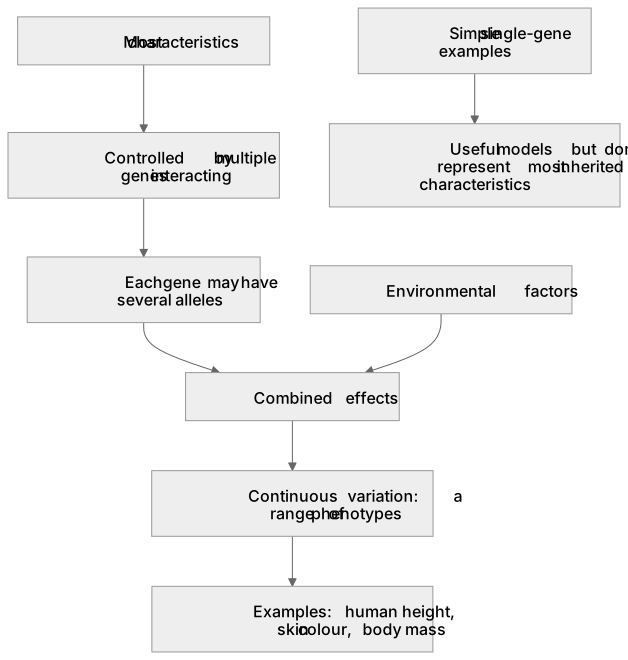
Although simple monohybrid examples such as pea colour or earlobe shape are useful for learning inheritance, most characteristics are polygenic, meaning they are controlled by several genes acting together. Each gene may have multiple alleles, and the combined effects produce a continuous range of phenotypes rather than a few distinct categories. Human height, skin colour, body mass and many crop yields are examples. Environmental factors also influence these characteristics, so the final phenotype depends on both genotype and environment. Because several genes contribute, inheritance patterns are more complex than a single dominant or recessive pair, and outcomes are often shown as a normal distribution. Understanding polygenic inheritance explains why most people do not fall neatly into two groups and why predictions for individuals are less certain than in simple monohybrid crosses.
What earns the marks
- Most characteristics are controlled by multiple genes rather than one gene, which is called polygenic inheritance.
- Each gene involved may have several alleles, and their effects combine to influence the characteristic.
- Polygenic inheritance usually produces continuous variation, giving a range of phenotypes rather than distinct categories.
- Environmental factors interact with multiple genes, so the phenotype is not determined by genotype alone.
- Examples include human height, skin colour and body mass, which show a spread of values in a population.
- Simple single-gene examples are useful models but do not represent most inherited characteristics.
Common mistakes and how to put them right
Assuming every characteristic follows a simple dominant or recessive pattern.
Put it right: Most characteristics are polygenic and show continuous variation.
Believing continuous variation means the characteristic is not inherited.
Put it right: Many genes still contribute, alongside environmental effects.
Confusing multiple alleles with multiple genes.
Put it right: Polygenic inheritance involves several different genes interacting.
Exam tips
- Use the phrase continuous variation when describing the outcome of polygenic inheritance, and give a named example such as human height.
- If a question asks why a characteristic shows a range of values, refer to multiple genes and environmental influence together.
- Avoid claiming that a single gene fully determines a polygenic characteristic; instead describe the combined effect of many genes.
Try the lesson
The start of the Genetic inheritance: Most characteristics are a result of multiple genes interacting, rather than a single gene. lesson, made from checked teaching notes for this specification point.
Have a go first
Which statement best describes how most characteristics are controlled?
Listen
Although simple monohybrid examples such as pea colour or earlobe shape are useful for learning inheritance, most characteristics are polygenic, meaning they are controlled by several genes acting together. Each gene may have multiple alleles, and the combined effects produce a continuous range of phenotypes rather than a few distinct categories. Human height, skin colour, body mass and many crop yields are examples. Environmental factors also influence these characteristics, so the final phenotype depends on both genotype and environment. Because several genes contribute, inheritance patterns are more complex than a single dominant or recessive pair, and outcomes are often shown as a normal distribution. Understanding polygenic inheritance explains why most people do not fall neatly into two groups and why predictions for individuals are less certain than in simple monohybrid crosses. A strong answer earns marks for these points. Most characteristics are controlled by multiple genes rather than one gene, which is called polygenic inheritance. Each gene involved may have several alleles, and their effects combine to influence the characteristic. Polygenic inheritance usually produces continuous variation, giving a range of phenotypes rather than distinct categories. Environmental factors interact with multiple genes, so the phenotype is not determined by genotype alone. A common slip: Assuming every characteristic follows a simple dominant or recessive pattern: the error is applying a single-gene model to height or skin colour. Instead, most characteristics are polygenic and show continuous variation. Exam tip: Use the phrase continuous variation when describing the outcome of polygenic inheritance, and give a named example such as human height.
See it
Key words
Say what each word means before you turn the card.
Polygenic inheritance
Try answering aloud or in your head before turning the card.
Continuous variation
Try answering aloud or in your head before turning the card.
See every definition
- Polygenic inheritance
- Most characteristics are controlled by multiple genes rather than one gene, which is called polygenic inheritance.
- Continuous variation
- Polygenic inheritance usually produces continuous variation, giving a range of phenotypes rather than distinct categories.
Label the diagram
Some boxes have lost their names. Pick the right name for each number.
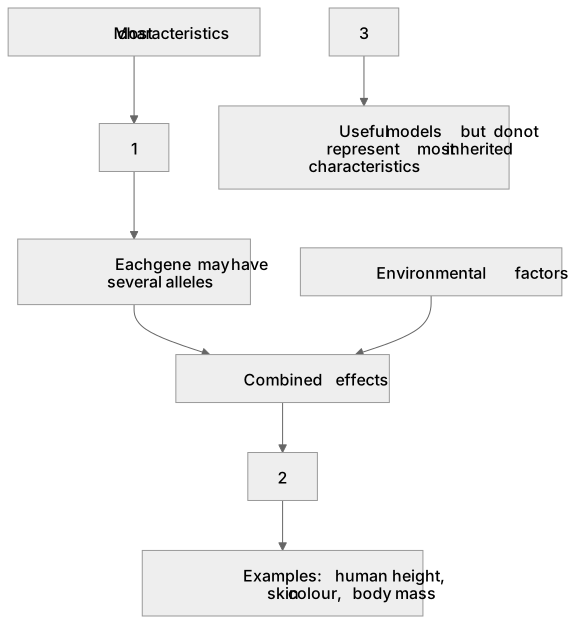
1Box 1
2Box 2
3Box 3
There is more to this lesson
The full lesson goes on to check your understanding and help you earn the marks. Create a free account to carry on, with your progress saved.
A week of Premium from your first lesson · Then the free plan continues · No card, no charge
Test your understanding of Genetic inheritance: Most characteristics are a result of multiple genes interacting, rather than a single gene.
Active recall beats re-reading. Take an instant quiz now to test what you’ve learned and lock it into long-term memory.
A week of Premium from your first lesson · Then the free plan continues · No card, no charge