AQA · GCSE · Combined Science
Course version: 8464 · Version from Sept 2018
Some characteristics are controlled by a single gene, such as: fur colour…
Full specification wording
Genetic inheritance: Some characteristics are controlled by a single gene, such as: fur colour in mice; and red-green colour blindness in humans. Each gene may have different forms called alleles.
A gene is a short section of DNA that codes for a characteristic.
Checked against the AQA 8464 specification (opens in a new tab) on .
- Point 12 of 20
- 3 key terms
Study notes
From the checked teaching notes for this specification point.
The idea
A gene is a short section of DNA that codes for a characteristic. Some characteristics, such as fur colour in mice or red-green colour blindness in humans, are controlled by a single gene, so inheritance follows simple dominant and recessive patterns. Each gene can exist in different forms called alleles; for example, a mouse fur-colour gene may have a black allele and a brown allele. You represent alleles with letters: dominant as a capital, recessive as a lower case. A homozygous organism has two identical alleles, heterozygous has two different alleles. Red-green colour blindness is caused by a recessive allele on the X chromosome, so it is more common in males.
What earns the marks
- A gene is a section of DNA that codes for a protein and therefore controls a characteristic.
- Some characteristics are controlled by a single gene, giving simple inheritance patterns.
- Named examples include fur colour in mice and red-green colour blindness in humans.
- Alleles are different forms of the same gene, such as a black-fur allele and a brown-fur allele.
- Dominant alleles are represented by capital letters and recessive alleles by lower case letters.
- Homozygous means two identical alleles; heterozygous means two different alleles for that gene.
- Red-green colour blindness is a recessive X-linked condition, so males are more likely to be affected.
Common mistakes and how to put them right
Saying alleles are different genes.
Put it right: Alleles are different forms of the same gene at the same locus.
Writing dominant alleles in lower case.
Put it right: Use a capital letter for the dominant allele and the same lower case letter for the recessive allele.
Claiming all characteristics are controlled by a single gene.
Put it right: Many characteristics are polygenic or affected by the environment, and only some follow simple single-gene inheritance.
Exam tips
- Choose one letter per gene and keep capital and lower case versions consistent throughout a genetic cross.
- For colour blindness, remember it is carried on the X chromosome, so use X and Y notation when explaining why males are affected more often.
- Link each allele to its effect, for example B gives black fur and b gives brown fur, so phenotype predictions are clear.
Try the lesson
The start of the Genetic inheritance: Some characteristics are controlled by a single gene, such as: fur colour in mice; and red-green colour blindness in humans. Each gene may have different forms called alleles. lesson, made from checked teaching notes for this specification point.
Have a go first
What name is given to the different forms of a gene?
Listen
A gene is a short section of DNA that codes for a characteristic. Some characteristics, such as fur colour in mice or red-green colour blindness in humans, are controlled by a single gene, so inheritance follows simple dominant and recessive patterns. Each gene can exist in different forms called alleles; for example, a mouse fur-colour gene may have a black allele and a brown allele. You represent alleles with letters: dominant as a capital, recessive as a lower case. A homozygous organism has two identical alleles, heterozygous has two different alleles. Red-green colour blindness is caused by a recessive allele on the X chromosome, so it is more common in males. A strong answer earns marks for these points. A gene is a section of DNA that codes for a protein and therefore controls a characteristic. Some characteristics are controlled by a single gene, giving simple inheritance patterns. Named examples include fur colour in mice and red-green colour blindness in humans. Alleles are different forms of the same gene, such as a black-fur allele and a brown-fur allele. A common slip: Saying alleles are different genes. Instead, alleles are different forms of the same gene at the same locus. Exam tip: Choose one letter per gene and keep capital and lower case versions consistent throughout a genetic cross.
See it
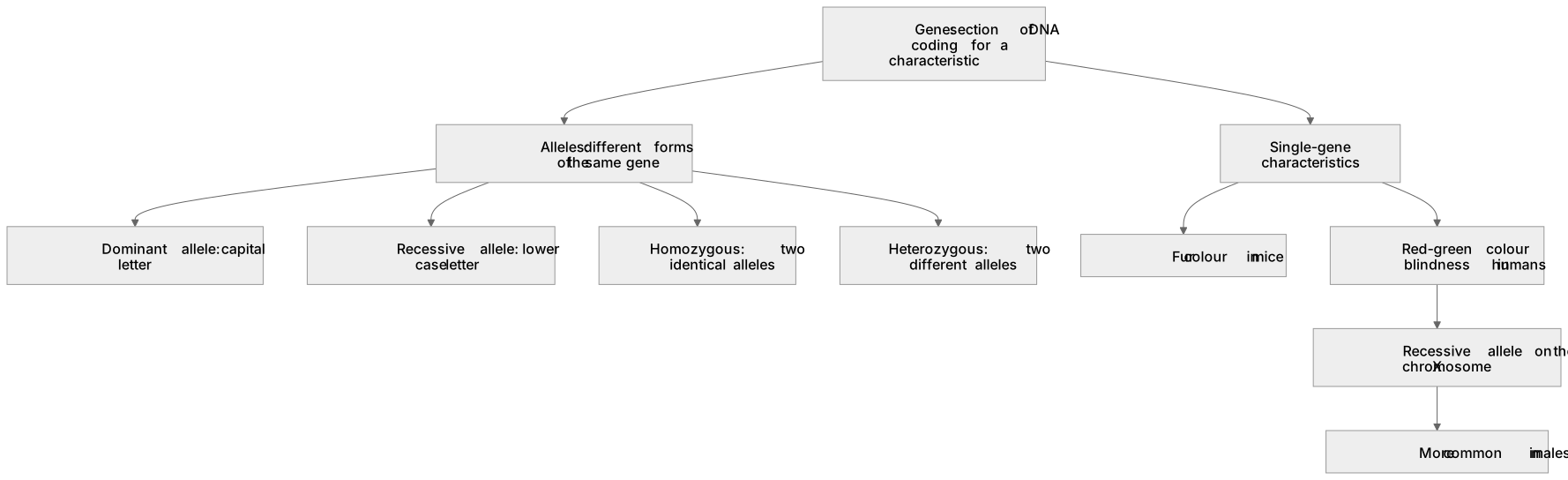
Key words
Say what each word means before you turn the card.
Gene
Try answering aloud or in your head before turning the card.
Alleles
Try answering aloud or in your head before turning the card.
Heterozygous
Try answering aloud or in your head before turning the card.
See every definition
- Gene
- A short section of DNA that codes for a characteristic.
- Alleles
- Different forms of the same gene, such as a black-fur allele and a brown-fur allele.
- Heterozygous
- Having two different alleles for that gene.
Label the diagram
Some boxes have lost their names. Pick the right name for each number.
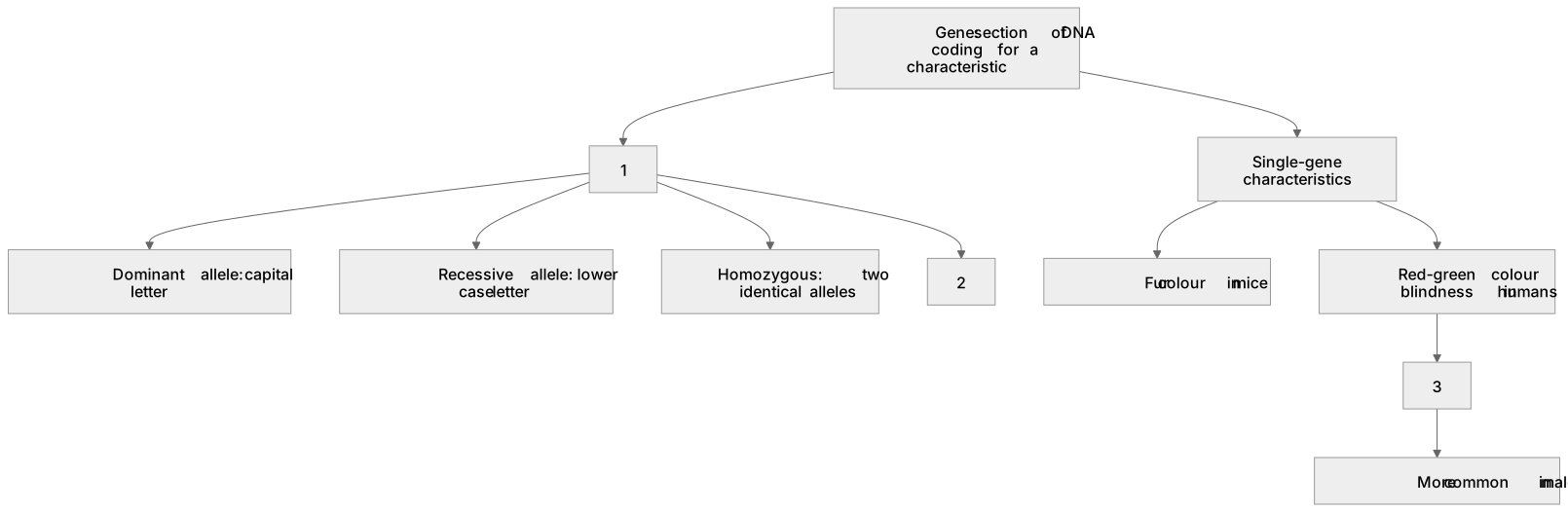
1Box 1
2Box 2
3Box 3
There is more to this lesson
The full lesson goes on to check your understanding and help you earn the marks. Create a free account to carry on, with your progress saved.
A week of Premium from your first lesson · Then the free plan continues · No card, no charge
Test your understanding of Genetic inheritance: Some characteristics are controlled by a single gene, such as: fur colour in mice; and red-green colour blindness in humans. Each gene may have different forms called alleles.
Active recall beats re-reading. Take an instant quiz now to test what you’ve learned and lock it into long-term memory.
A week of Premium from your first lesson · Then the free plan continues · No card, no charge