AQA · GCSE · Combined Science
Course version: 8464 · Version from Sept 2018
Students should be able to describe some of the biological consequences of…
Full specification wording
Global warming: Students should be able to describe some of the biological consequences of global warming.
Global warming raises average temperatures and shifts weather patterns, so organisms face changed conditions.
Checked against the AQA 8464 specification (opens in a new tab) on .
- Point 1 of 2
Study notes
From the checked teaching notes for this specification point.
The idea
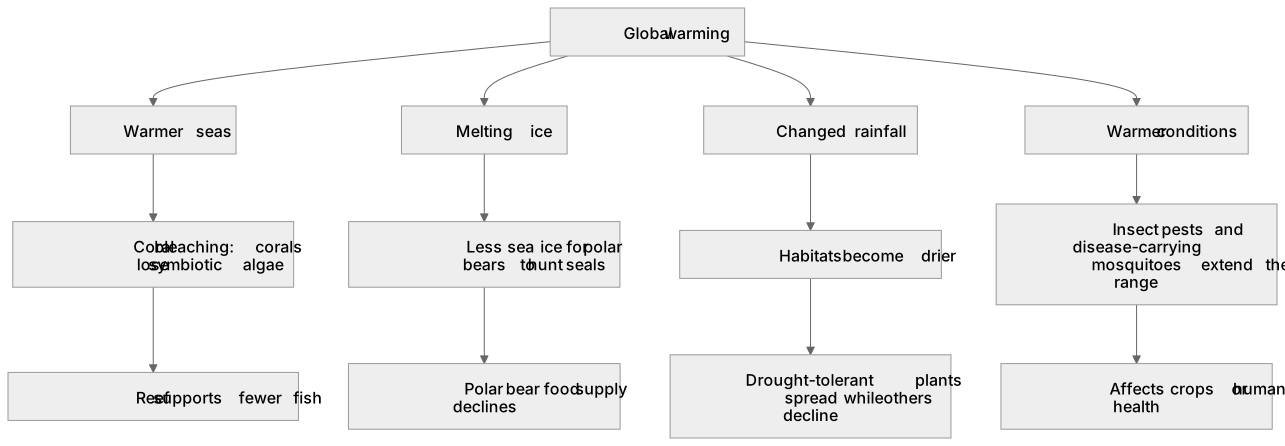
Global warming raises average temperatures and shifts weather patterns, so organisms face changed conditions. Describe consequences by linking a physical change to an effect on organisms. For example, warmer seas can bleach coral reefs: corals lose their symbiotic algae, so the reef supports fewer fish. Rising temperatures can melt ice, reducing polar bear hunting habitat. Changed rainfall can make some habitats drier, so drought-tolerant plants spread while others decline. Warmer conditions can let some insect pests or disease-carrying mosquitoes extend their range, affecting crops or human health. Some species may migrate towards the poles or to higher land, while those that cannot move or adapt may become endangered or extinct. Describe means give clear points with a cause and effect, not just name a change. Use named examples where possible and explain the biological link.
What earns the marks
- Rising sea temperatures can cause coral bleaching because corals lose their symbiotic algae, reducing the reef's biodiversity.
- Melting polar ice reduces the area of sea ice used by polar bears for hunting seals, so their food supply declines.
- Changes in rainfall patterns can cause some habitats to become drier, so drought-resistant plant species may replace those less able to survive.
- Warmer conditions can allow some insect pests or disease-carrying mosquitoes to spread into new areas, affecting crop yields or human health.
- Some species may shift their geographic range towards the poles or to higher altitudes, while species unable to move or adapt may become endangered or extinct.
- Changing temperatures can alter the timing of life-cycle events such as breeding, flowering or migration, which can disrupt food chains and ecological interactions.
Common mistakes and how to put them right
Confusing global warming with ozone depletion.
Put it right: Global warming is mainly driven by greenhouse gases trapping heat, while ozone depletion is a separate issue caused by CFCs.
Giving only physical effects such as 'ice melts' without a biological consequence.
Put it right: Link the physical change to an effect on a named organism or ecosystem, for example melting sea ice reduces polar bear hunting habitat.
Assuming all species will simply move or adapt successfully.
Put it right: Some species cannot move fast enough or have no suitable habitat, so they may become endangered or extinct.
Exam tips
- Use command word 'describe' to give a sequence of clear points: state the environmental change, then the biological effect on a named organism.
- Include at least one named example, such as coral bleaching or polar bear habitat loss, to make your answer specific.
- Link each consequence back to global warming rather than writing generally about pollution or habitat loss.
Try the lesson
The start of the Global warming: Students should be able to describe some of the biological consequences of global warming. lesson, made from checked teaching notes for this specification point.
Have a go first
Which of the following is a likely biological consequence of global warming?
Listen
Global warming raises average temperatures and shifts weather patterns, so organisms face changed conditions. Describe consequences by linking a physical change to an effect on organisms. For example, warmer seas can bleach coral reefs: corals lose their symbiotic algae, so the reef supports fewer fish. Rising temperatures can melt ice, reducing polar bear hunting habitat. Changed rainfall can make some habitats drier, so drought-tolerant plants spread while others decline. Warmer conditions can let some insect pests or disease-carrying mosquitoes extend their range, affecting crops or human health. Some species may migrate towards the poles or to higher land, while those that cannot move or adapt may become endangered or extinct. Describe means give clear points with a cause and effect, not just name a change. Use named examples where possible and explain the biological link. A strong answer earns marks for these points. Rising sea temperatures can cause coral bleaching because corals lose their symbiotic algae, reducing the reef's biodiversity. Melting polar ice reduces the area of sea ice used by polar bears for hunting seals, so their food supply declines. Changes in rainfall patterns can cause some habitats to become drier, so drought-resistant plant species may replace those less able to survive. Warmer conditions can allow some insect pests or disease-carrying mosquitoes to spread into new areas, affecting crop yields or human health. A common slip: Confusing global warming with ozone depletion: students may say the ozone hole causes warming. Instead, global warming is mainly driven by greenhouse gases trapping heat, while ozone depletion is a separate issue caused by CFCs. Exam tip: Use command word 'describe' to give a sequence of clear points: state the environmental change, then the biological effect on a named organism.
See it
Label the diagram
Some boxes have lost their names. Pick the right name for each number.
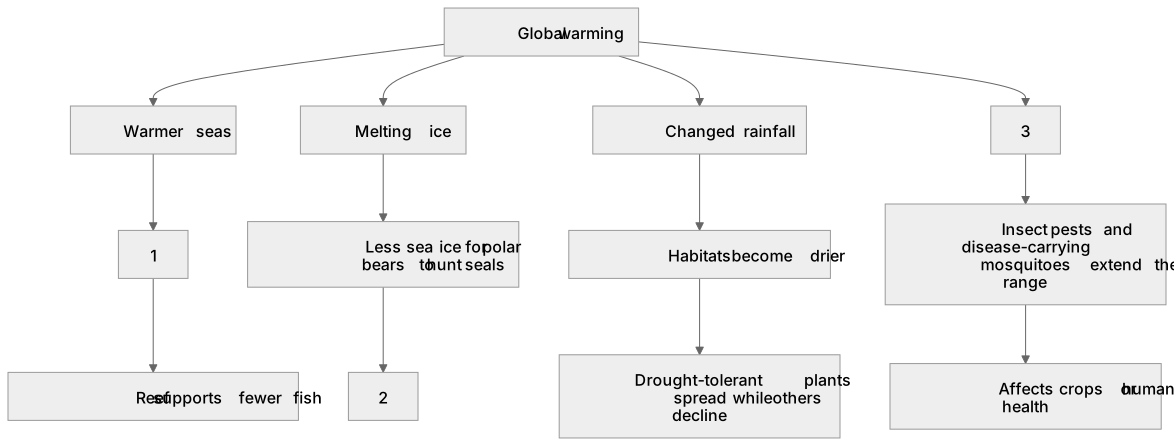
1Box 1
2Box 2
3Box 3
There is more to this lesson
The full lesson goes on to check your understanding and help you earn the marks. Create a free account to carry on, with your progress saved.
A week of Premium from your first lesson · Then the free plan continues · No card, no charge
Test your understanding of Global warming: Students should be able to describe some of the biological consequences of global warming.
Active recall beats re-reading. Take an instant quiz now to test what you’ve learned and lock it into long-term memory.
A week of Premium from your first lesson · Then the free plan continues · No card, no charge