AQA · GCSE · Combined Science
Course version: 8464 · Version from Sept 2018
Graphene is a single layer of graphite and has properties that make it…
Full specification wording
Graphene and fullerenes: Graphene is a single layer of graphite and has properties that make it useful in electronics and composites.
Graphene is a single layer of graphite, one atom thick, in which carbon atoms are arranged in a hexagonal lattice.
Checked against the AQA 8464 specification (opens in a new tab) on .
- Point 1 of 6
Study notes
From the checked teaching notes for this specification point.
The idea
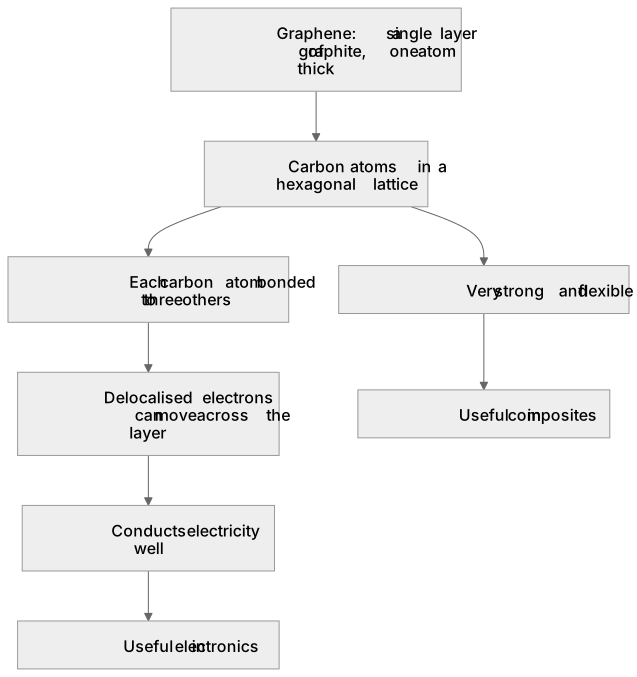
Graphene is a single layer of graphite, one atom thick, in which carbon atoms are arranged in a hexagonal lattice. Each carbon atom forms three covalent bonds, leaving delocalised electrons that can move across the layer. This makes graphene an excellent conductor of electricity and thermal energy, and it is also very strong and flexible. These properties make it useful in electronics, for example in fast transistors, touchscreens and conductive films, and in composites, where it is added to materials such as plastics to increase strength and conductivity without adding much mass. A useful method is to link each property to an application: high electrical conductivity leads to electronics, and high strength with low mass leads to composite materials.
What earns the marks
- Graphene is a single layer of graphite, one atom thick.
- Delocalised electrons are present and can move across the layer, so graphene conducts electricity well.
- Graphene is very strong and flexible, which makes it useful in composites.
- Its high electrical conductivity and nanoscale thickness make it useful in electronics.
- Graphene has a very large surface area per unit mass, which can be useful in composite materials and sensors.
Common mistakes and how to put them right
Describing graphene as many layers of graphite.
Put it right by stating that graphene is a single layer, one atom thick.
Saying graphene is an electrical insulator because it is covalent.
Put it right by explaining that delocalised electrons make it a good conductor.
Confusing graphene with a fullerene such as buckminsterfullerene.
Put it right by noting that graphene is a flat single layer, while fullerenes are hollow molecular cages.
Exam tips
- Always state that graphene is one layer of graphite before describing its properties.
- Link each property to a named use, for example high conductivity to electronics and high strength to composites.
- Use comparative language such as very strong, flexible and conductive to make the link between structure and application clear.
Try the lesson
The start of the Graphene and fullerenes: Graphene is a single layer of graphite and has properties that make it useful in electronics and composites. lesson, made from checked teaching notes for this specification point.
Have a go first
Which statement describes the structure of graphene?
Listen
Graphene is a single layer of graphite, one atom thick, in which carbon atoms are arranged in a hexagonal lattice. Each carbon atom forms three covalent bonds, leaving delocalised electrons that can move across the layer. This makes graphene an excellent conductor of electricity and thermal energy, and it is also very strong and flexible. These properties make it useful in electronics, for example in fast transistors, touchscreens and conductive films, and in composites, where it is added to materials such as plastics to increase strength and conductivity without adding much mass. A useful method is to link each property to an application: high electrical conductivity leads to electronics, and high strength with low mass leads to composite materials. A strong answer earns marks for these points. Graphene is a single layer of graphite, one atom thick. Delocalised electrons are present and can move across the layer, so graphene conducts electricity well. Graphene is very strong and flexible, which makes it useful in composites. Its high electrical conductivity and nanoscale thickness make it useful in electronics. A common slip: Describing graphene as many layers of graphite. Instead, stating that graphene is a single layer, one atom thick. Exam tip: Always state that graphene is one layer of graphite before describing its properties.
See it
Label the diagram
Some boxes have lost their names. Pick the right name for each number.
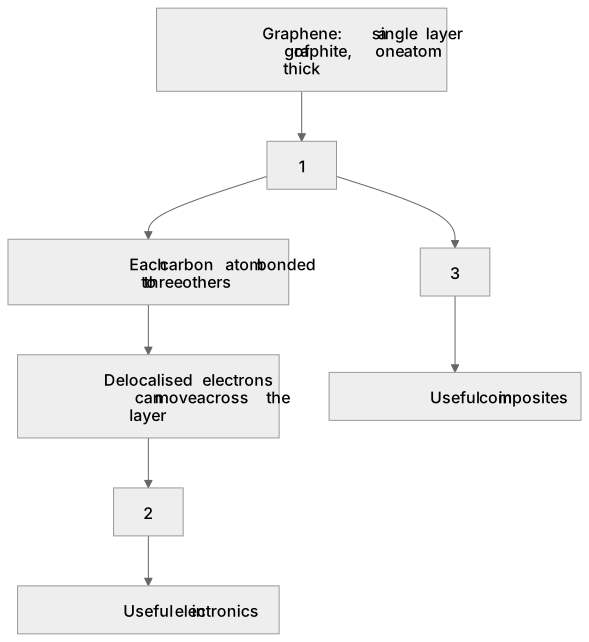
1Box 1
2Box 2
3Box 3
There is more to this lesson
The full lesson goes on to check your understanding and help you earn the marks. Create a free account to carry on, with your progress saved.
A week of Premium from your first lesson · Then the free plan continues · No card, no charge
Test your understanding of Graphene and fullerenes: Graphene is a single layer of graphite and has properties that make it useful in electronics and composites.
Active recall beats re-reading. Take an instant quiz now to test what you’ve learned and lock it into long-term memory.
A week of Premium from your first lesson · Then the free plan continues · No card, no charge