AQA · GCSE · Combined Science
Course version: 8464 · Version from Sept 2018
Students should know that graphite is similar to metals in that it has…
Full specification wording
Graphite: Students should know that graphite is similar to metals in that it has delocalised electrons.
Graphite is a giant covalent structure of carbon atoms arranged in hexagonal layers.
Checked against the AQA 8464 specification (opens in a new tab) on .
- Point 4 of 4
- 4 key terms
Study notes
From the checked teaching notes for this specification point.
The idea
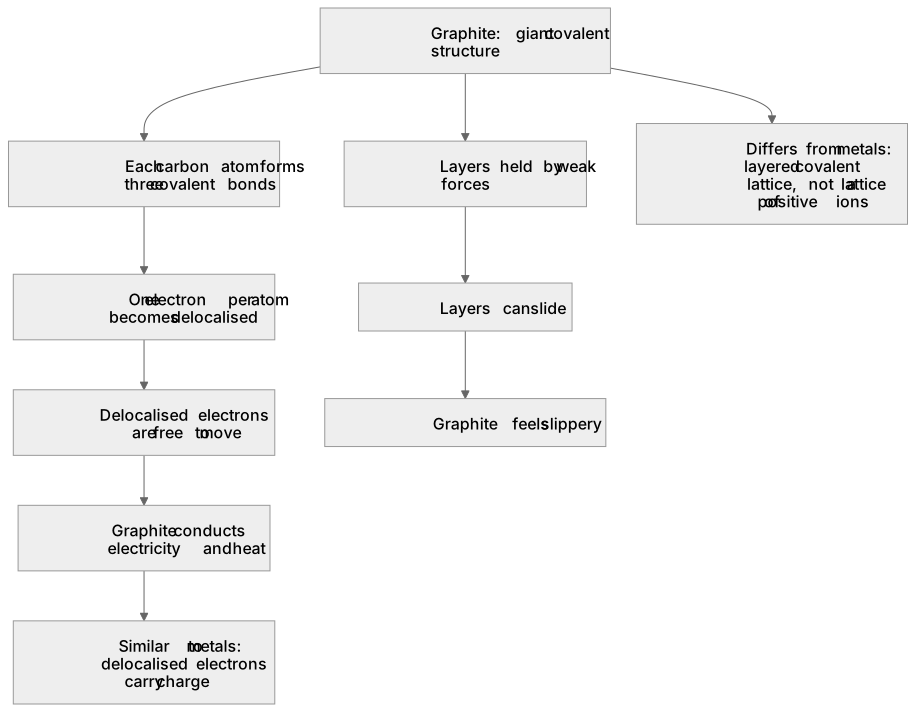
Graphite is a giant covalent structure of carbon atoms arranged in hexagonal layers. Each carbon atom forms three covalent bonds, leaving one electron per atom delocalised within the layers. These delocalised electrons are free to move through the structure, so graphite conducts electricity and heat like a metal. Unlike metals, graphite is not malleable in the same way, because its layers are held by weak forces and can slide, and it has no sea of positive ions. A useful method is to compare graphite with a metal such as copper: both conduct because charged particles can move, but in copper the moving charges are electrons in a metallic lattice, while in graphite they are delocalised electrons within covalent layers. This explains why graphite is used for electrodes and feels slippery.
What earns the marks
- Graphite is a giant covalent structure in which each carbon atom is covalently bonded to three other carbon atoms.
- Each carbon atom contributes one electron that becomes delocalised, so delocalised electrons are present within the layers.
- The delocalised electrons are free to move, allowing graphite to conduct electricity and thermal energy.
- Graphite differs from metals because it has a layered covalent lattice rather than a lattice of positive ions.
- The weak forces between layers allow them to slide, which explains why graphite is slippery and useful as a lubricant.
Common mistakes and how to put them right
Thinking graphite conducts because its ions move.
Put it right by stating that the moving charges are delocalised electrons, not ions.
Believing each carbon atom in graphite forms four covalent bonds.
Put it right by noting that only three bonds form, leaving one delocalised electron per carbon atom.
Confusing graphite with diamond and saying it does not conduct.
Put it right by explaining that diamond has no delocalised electrons, whereas graphite does.
Exam tips
- Link the structure of graphite directly to its property of conduction in one sentence, for example: three bonds per carbon atom leave delocalised electrons that can move.
- When comparing graphite with metals, name the similarity (delocalised electrons) and one difference (layered covalent structure versus positive ion lattice).
- Use the phrase delocalised electrons rather than free electrons if the question asks for the reason graphite conducts, and avoid saying electrons are shared between layers.
Try the lesson
The start of the Graphite: Students should know that graphite is similar to metals in that it has delocalised electrons. lesson, made from checked teaching notes for this specification point.
Have a go first
Which feature of graphite makes it similar to metals?
Listen
Graphite is a giant covalent structure of carbon atoms arranged in hexagonal layers. Each carbon atom forms three covalent bonds, leaving one electron per atom delocalised within the layers. These delocalised electrons are free to move through the structure, so graphite conducts electricity and heat like a metal. Unlike metals, graphite is not malleable in the same way, because its layers are held by weak forces and can slide, and it has no sea of positive ions. A useful method is to compare graphite with a metal such as copper: both conduct because charged particles can move, but in copper the moving charges are electrons in a metallic lattice, while in graphite they are delocalised electrons within covalent layers. This explains why graphite is used for electrodes and feels slippery. A strong answer earns marks for these points. Graphite is a giant covalent structure in which each carbon atom is covalently bonded to three other carbon atoms. Each carbon atom contributes one electron that becomes delocalised, so delocalised electrons are present within the layers. The delocalised electrons are free to move, allowing graphite to conduct electricity and thermal energy. Graphite differs from metals because it has a layered covalent lattice rather than a lattice of positive ions. A common slip: Thinking graphite conducts because its ions move. Instead, stating that the moving charges are delocalised electrons, not ions. Exam tip: Link the structure of graphite directly to its property of conduction in one sentence, for example: three bonds per carbon atom leave delocalised electrons that can move.
See it
Key words
Say what each word means before you turn the card.
Delocalised electrons
Try answering aloud or in your head before turning the card.
Electrical conductivity
Try answering aloud or in your head before turning the card.
Comparison of graphite and metals
Try answering aloud or in your head before turning the card.
Structure and bonding
Try answering aloud or in your head before turning the card.
See every definition
- Delocalised electrons
- Electrons that are free to move through the structure, allowing graphite to conduct electricity and thermal energy.
- Electrical conductivity
- Conduction that occurs because charged particles can move, as in graphite where delocalised electrons carry charge through the structure.
- Comparison of graphite and metals
- Both conduct because charged particles can move, but graphite has a layered covalent lattice rather than a lattice of positive ions.
- Structure and bonding
- A giant covalent structure in which each carbon atom is covalently bonded to three other carbon atoms, leaving one electron per atom delocalised within the layers.
Label the diagram
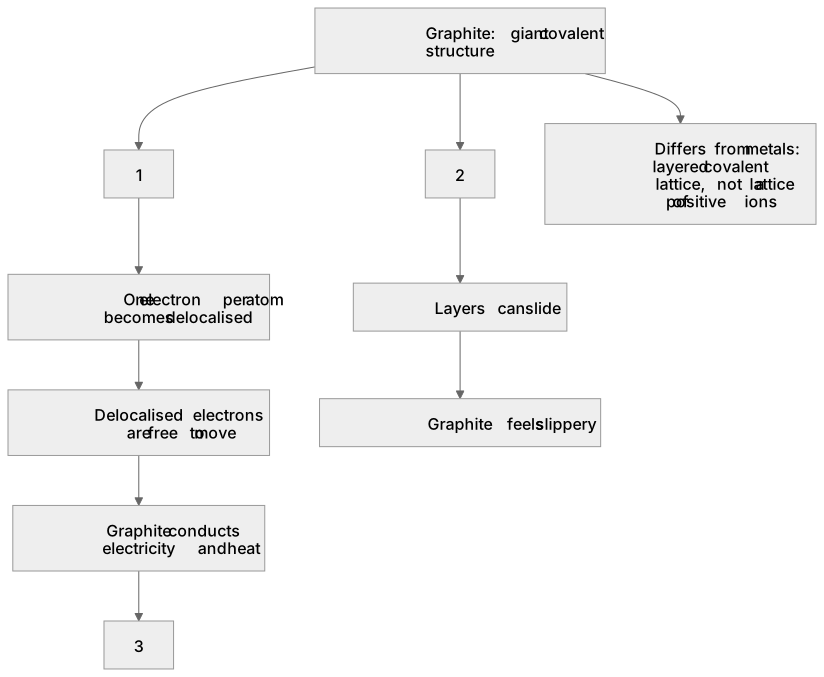
Some boxes have lost their names. Pick the right name for each number.
1Box 1
2Box 2
3Box 3
There is more to this lesson
The full lesson goes on to check your understanding and help you earn the marks. Create a free account to carry on, with your progress saved.
A week of Premium from your first lesson · Then the free plan continues · No card, no charge
Test your understanding of Graphite: Students should know that graphite is similar to metals in that it has delocalised electrons.
Active recall beats re-reading. Take an instant quiz now to test what you’ve learned and lock it into long-term memory.
A week of Premium from your first lesson · Then the free plan continues · No card, no charge