AQA · GCSE · Combined Science
Course version: 8464 · Version from Sept 2018
Weight is measured using a calibrated spring-balance (a newtonmeter).
Full specification wording
Gravity: Weight is measured using a calibrated spring-balance (a newtonmeter).
Weight is the gravitational force acting on an object, measured in newtons (N).
Checked against the AQA 8464 specification (opens in a new tab) on .
- Point 11 of 11
- 4 key terms
Study notes
From the checked teaching notes for this specification point.
The idea
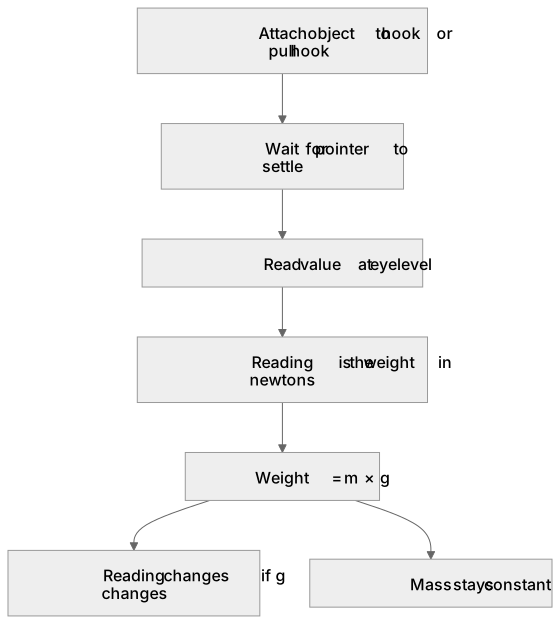
Weight is the gravitational force acting on an object, measured in newtons (N). A spring-balance, also called a newtonmeter, measures this force directly. Inside, a spring stretches when a force pulls it; the extension is proportional to the force, so a scale can be calibrated in newtons. To use one, hang the object from the hook or pull the hook with the object, wait for it to settle, and read the value at eye level. The reading is the weight, not the mass. Mass is measured with a balance in kilograms (kg) and does not change with location, but weight changes with gravitational field strength g, because W = m × g. For example, a 2 kg mass has a weight of about 20 N on Earth (g ≈ 10 N/kg), but only 3.2 N on the Moon (g ≈ 1.6 N/kg). A calibrated spring-balance therefore gives different readings on different planets, while a mass balance gives the same mass everywhere.
What earns the marks
- Weight is a force measured in newtons (N), whereas mass is measured in kilograms (kg).
- A spring-balance (newtonmeter) measures weight directly by the extension of a calibrated spring.
- The scale of a spring-balance is calibrated in newtons, often using known weights or a known gravitational field strength.
- To measure weight, the object is attached to the hook or the hook is pulled, and the reading is taken when the pointer is steady.
- The reading should be taken at eye level to avoid parallax error.
- Weight is calculated using W = m × g, where g is the gravitational field strength in N/kg.
- A spring-balance reading changes if g changes, but mass remains constant.
Common mistakes and how to put them right
Confusing weight with mass.
Put it right: State the unit and remember W = m × g.
Reading the spring-balance while it is still moving.
Put it right: Wait for the reading to settle.
Assuming a spring-balance measures mass.
Put it right: Use a mass balance for mass and a spring-balance for weight.
Reading the scale at an angle, causing parallax error.
Put it right: Position your eye level with the pointer.
Exam tips
- When asked how to measure weight, name the spring-balance (newtonmeter) and state that it is calibrated in newtons.
- If a question gives mass and asks for weight, use W = m × g and include the correct unit (N).
- To compare weight on Earth and the Moon, calculate both using the appropriate g values and comment on the difference.
- Describe the method clearly: attach the object, wait for it to settle, read at eye level.
Try the lesson
The start of the Gravity: Weight is measured using a calibrated spring-balance (a newtonmeter). lesson, made from checked teaching notes for this specification point.
Have a go first
Which instrument is used in a school laboratory to directly measure the weight of an object?
Listen
Weight is the gravitational force acting on an object, measured in newtons (N). A spring-balance, also called a newtonmeter, measures this force directly. Inside, a spring stretches when a force pulls it; the extension is proportional to the force, so a scale can be calibrated in newtons. To use one, hang the object from the hook or pull the hook with the object, wait for it to settle, and read the value at eye level. The reading is the weight, not the mass. Mass is measured with a balance in kilograms (kg) and does not change with location, but weight changes with gravitational field strength g, because W = m × g. For example, a 2 kg mass has a weight of about 20 N on Earth (g ≈ 10 N/kg), but only 3.2 N on the Moon (g ≈ 1.6 N/kg). A calibrated spring-balance therefore gives different readings on different planets, while a mass balance gives the same mass everywhere. A strong answer earns marks for these points. Weight is a force measured in newtons (N), whereas mass is measured in kilograms (kg). A spring-balance (newtonmeter) measures weight directly by the extension of a calibrated spring. The scale of a spring-balance is calibrated in newtons, often using known weights or a known gravitational field strength. To measure weight, the object is attached to the hook or the hook is pulled, and the reading is taken when the pointer is steady. A common slip: Confusing weight with mass: weight is a force in newtons, mass is in kilograms. Instead, state the unit and remember W = m × g. Exam tip: When asked how to measure weight, name the spring-balance (newtonmeter) and state that it is calibrated in newtons.
See it
Key words
Say what each word means before you turn the card.
Weight
Try answering aloud or in your head before turning the card.
Spring-balance
Try answering aloud or in your head before turning the card.
Calibration
Try answering aloud or in your head before turning the card.
Gravitational field strength
Try answering aloud or in your head before turning the card.
See every definition
- Weight
- A force measured in newtons (N), whereas mass is measured in kilograms (kg).
- Spring-balance
- Also called a newtonmeter, it measures weight directly by the extension of a calibrated spring.
- Calibration
- The scale of a spring-balance is calibrated in newtons, often using known weights or a known gravitational field strength.
- Gravitational field strength
- Given the symbol g and measured in N/kg, it is used in W = m × g to calculate weight.
Label the diagram
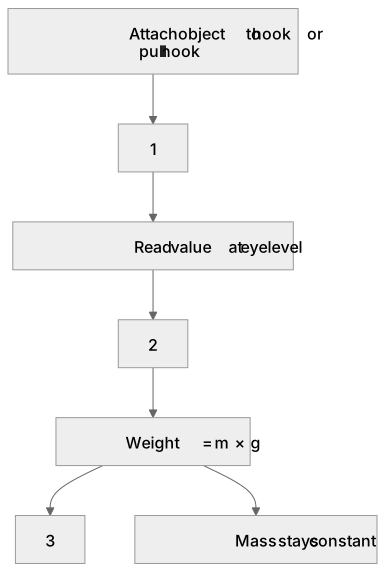
Some boxes have lost their names. Pick the right name for each number.
1Box 1
2Box 2
3Box 3
There is more to this lesson
The full lesson goes on to check your understanding and help you earn the marks. Create a free account to carry on, with your progress saved.
A week of Premium from your first lesson · Then the free plan continues · No card, no charge
Test your understanding of Gravity: Weight is measured using a calibrated spring-balance (a newtonmeter).
Active recall beats re-reading. Take an instant quiz now to test what you’ve learned and lock it into long-term memory.
A week of Premium from your first lesson · Then the free plan continues · No card, no charge