AQA · GCSE · Combined Science
Course version: 8464 · Version from Sept 2018
Group 0: predict properties from given trends down the group.
Down Group 0, the noble gases show clear trends.
Checked against the AQA 8464 specification (opens in a new tab) on .
- Point 4 of 4
Study notes
From the checked teaching notes for this specification point.
The idea
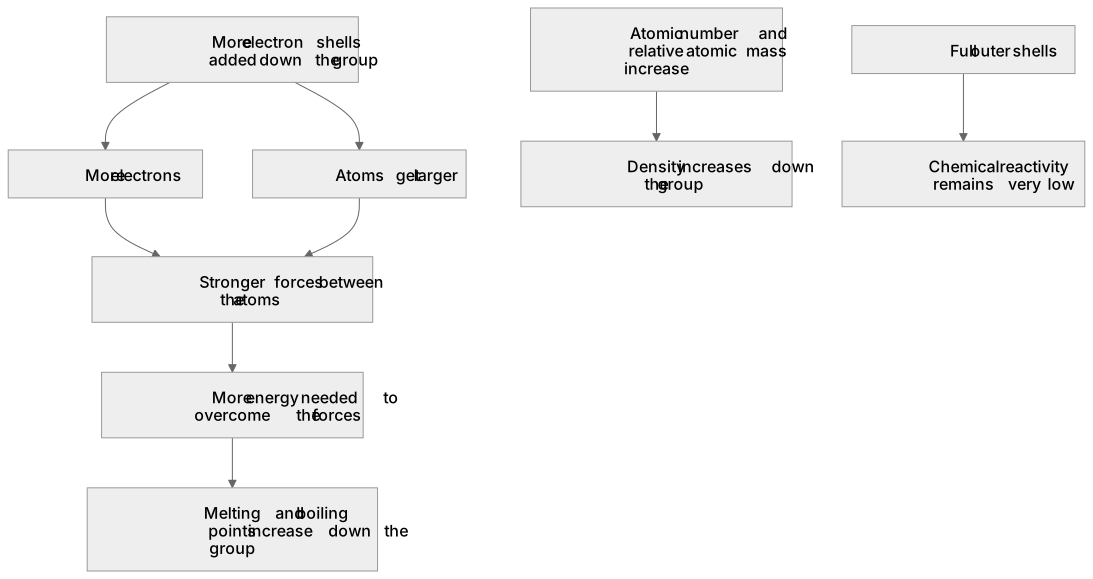
Down Group 0, the noble gases show clear trends. Atomic number and relative atomic mass increase, and atoms get larger because more electron shells are added. The forces between the atoms become stronger as the number of electrons increases, so more energy is needed to overcome them. As a result, melting and boiling points increase down the group: helium boils at about −269 °C, neon at about −246 °C, argon at about −186 °C, krypton at about −153 °C and xenon at about −108 °C. Density also increases down the group. Chemical reactivity remains very low because all these atoms still have full outer shells. To predict a property, identify the trend from the data given, then apply it to the element in question, stating whether the value will be higher or lower than a neighbouring element.
What earns the marks
- Identify the trend from the data provided, such as boiling point increasing down Group 0.
- Use atomic structure to explain the trend: more shells and more electrons down the group lead to larger atoms and stronger intermolecular forces.
- Predict a property for a named noble gas by comparing it with elements above or below it in the group.
- State that chemical reactivity remains very low down the group because the outer shell stays full.
- Recognise that density increases down the group as atomic mass increases while atomic size increases less proportionally.
- Apply the trend to unfamiliar data, such as estimating the boiling point of radon from the values for xenon and krypton.
Common mistakes and how to put them right
Saying reactivity increases down Group 0.
Put it right: Reactivity stays very low because the outer shell remains full; the trend is in physical properties such as boiling point.
Predicting that boiling point decreases down the group.
Put it right: Boiling point increases because intermolecular forces become stronger as atoms get larger.
Confusing the trend in Group 0 with Group 1 or Group 7.
Put it right: Group 0 trends are physical, while Groups 1 and 7 show trends in chemical reactivity.
Giving a prediction without referring to the trend or data.
Put it right: Quote the trend and compare with a neighbouring element to justify the prediction.
Exam tips
- Quote the trend explicitly, for example 'boiling point increases down the group', before giving your prediction.
- Use data from the question to support your answer, such as comparing the boiling points of argon and krypton.
- If asked to predict a value, give a sensible estimate that fits between or beyond the given values and explain your reasoning.
- Remember that all Group 0 elements are still unreactive, so do not predict chemical reactions unless the question specifically asks about extreme conditions.
Try the lesson
The start of the Group 0: predict properties from given trends down the group. lesson, made from checked teaching notes for this specification point.
Have a go first
The boiling points of the noble gases increase as you go down Group 0. Argon has a boiling point of -186 °C. Krypton is below argon in the periodic table. Which of the following is a reasonable prediction for the boiling point of krypton?
Listen
Down Group 0, the noble gases show clear trends. Atomic number and relative atomic mass increase, and atoms get larger because more electron shells are added. The forces between the atoms become stronger as the number of electrons increases, so more energy is needed to overcome them. As a result, melting and boiling points increase down the group: helium boils at about −269 °C, neon at about −246 °C, argon at about −186 °C, krypton at about −153 °C and xenon at about −108 °C. Density also increases down the group. Chemical reactivity remains very low because all these atoms still have full outer shells. To predict a property, identify the trend from the data given, then apply it to the element in question, stating whether the value will be higher or lower than a neighbouring element. A strong answer earns marks for these points. Identify the trend from the data provided, such as boiling point increasing down Group 0. Use atomic structure to explain the trend: more shells and more electrons down the group lead to larger atoms and stronger intermolecular forces. Predict a property for a named noble gas by comparing it with elements above or below it in the group. State that chemical reactivity remains very low down the group because the outer shell stays full. A common slip: saying reactivity increases down Group 0. Instead, reactivity stays very low because the outer shell remains full; the trend is in physical properties such as boiling point. Exam tip: Quote the trend explicitly, for example 'boiling point increases down the group', before giving your prediction.
See it
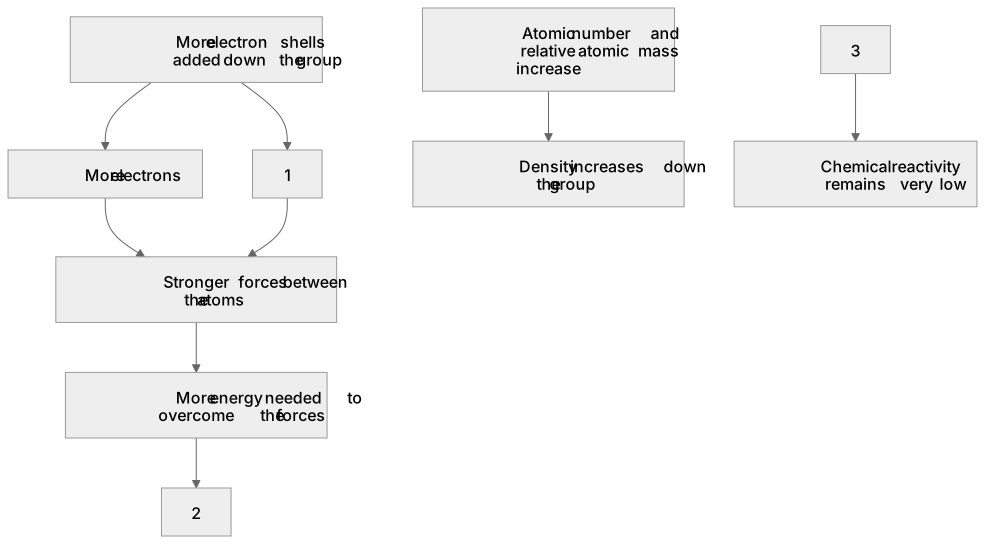
Label the diagram
Some boxes have lost their names. Pick the right name for each number.
1Box 1
2Box 2
3Box 3
There is more to this lesson
The full lesson goes on to check your understanding and help you earn the marks. Create a free account to carry on, with your progress saved.
A week of Premium from your first lesson · Then the free plan continues · No card, no charge
Test your understanding of Group 0: predict properties from given trends down the group.
Active recall beats re-reading. Take an instant quiz now to test what you’ve learned and lock it into long-term memory.
A week of Premium from your first lesson · Then the free plan continues · No card, no charge