AQA · GCSE · Combined Science
Course version: 8464 · Version from Sept 2018
In Group 7, the reactivity of the elements decreases going down the group.
Full specification wording
Group 7: In Group 7, the reactivity of the elements decreases going down the group.
Group 7 halogens react by gaining one electron to form a 1⁻ ion.
Checked against the AQA 8464 specification (opens in a new tab) on .
- Point 4 of 7
Study notes
From the checked teaching notes for this specification point.
The idea
Group 7 halogens react by gaining one electron to form a 1⁻ ion. Going down the group, the outer shell becomes further from the nucleus and there are more inner shells shielding the outer electrons. Although nuclear charge increases, the increased distance and shielding mean the attraction for an incoming electron is weaker, so reactivity decreases. This is shown by displacement reactions: a more reactive halogen higher in the group displaces a less reactive halide lower down. For example, chlorine displaces bromine from potassium bromide solution, but bromine cannot displace chlorine from potassium chloride solution. The trend is assessed by explaining electron gain and by predicting displacement reactions.
What earns the marks
- Halogens react by gaining one electron to form a 1⁻ ion, so reactivity depends on how easily the outer shell attracts an electron.
- Down the group, the outer shell is further from the nucleus and there are more inner shells, increasing shielding.
- The increased distance and shielding outweigh the increased nuclear charge, so the attraction for an incoming electron is weaker.
- A more reactive halogen higher in the group displaces a less reactive halide lower in the group from its compound.
- Displacement observations, such as a colour change in solution, provide evidence for the reactivity trend.
Common mistakes and how to put them right
Saying reactivity increases down the group because atoms get larger.
Put it right by explaining that larger atoms have weaker attraction for an incoming electron, so reactivity decreases.
Ignoring shielding and only referring to distance.
Put it right by stating that more inner shells shield the outer shell and reduce the effective nuclear attraction.
Predicting that a lower halogen can displace a higher halide.
Put it right by applying the rule that the more reactive halogen higher in the group does the displacing.
Exam tips
- Link reactivity to electron gain and the formation of a 1⁻ ion, then explain the effect of distance and shielding.
- For displacement questions, name the halogen and the halide, state which is more reactive, and describe the expected observation.
- Use comparative language such as more reactive than and less reactive than to make the trend clear.
Try the lesson
The start of the Group 7: In Group 7, the reactivity of the elements decreases going down the group. lesson, made from checked teaching notes for this specification point.
Have a go first
Which statement describes the trend in reactivity of the Group 7 elements as you go down the group?
Listen
Group 7 halogens react by gaining one electron to form a 1⁻ ion. Going down the group, the outer shell becomes further from the nucleus and there are more inner shells shielding the outer electrons. Although nuclear charge increases, the increased distance and shielding mean the attraction for an incoming electron is weaker, so reactivity decreases. This is shown by displacement reactions: a more reactive halogen higher in the group displaces a less reactive halide lower down. For example, chlorine displaces bromine from potassium bromide solution, but bromine cannot displace chlorine from potassium chloride solution. The trend is assessed by explaining electron gain and by predicting displacement reactions. A strong answer earns marks for these points. Halogens react by gaining one electron to form a 1⁻ ion, so reactivity depends on how easily the outer shell attracts an electron. Down the group, the outer shell is further from the nucleus and there are more inner shells, increasing shielding. The increased distance and shielding outweigh the increased nuclear charge, so the attraction for an incoming electron is weaker. A more reactive halogen higher in the group displaces a less reactive halide lower in the group from its compound. A common slip: Saying reactivity increases down the group because atoms get larger. Instead, explaining that larger atoms have weaker attraction for an incoming electron, so reactivity decreases. Exam tip: Link reactivity to electron gain and the formation of a 1⁻ ion, then explain the effect of distance and shielding.
See it
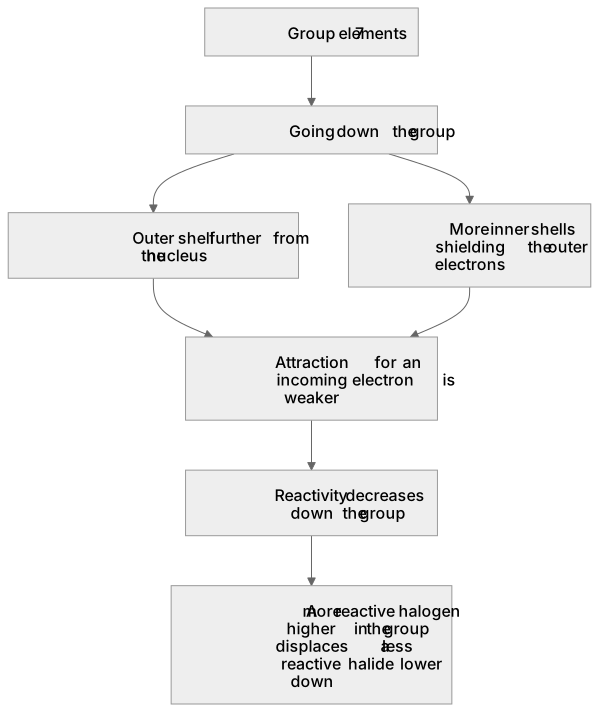
Label the diagram
Some boxes have lost their names. Pick the right name for each number.
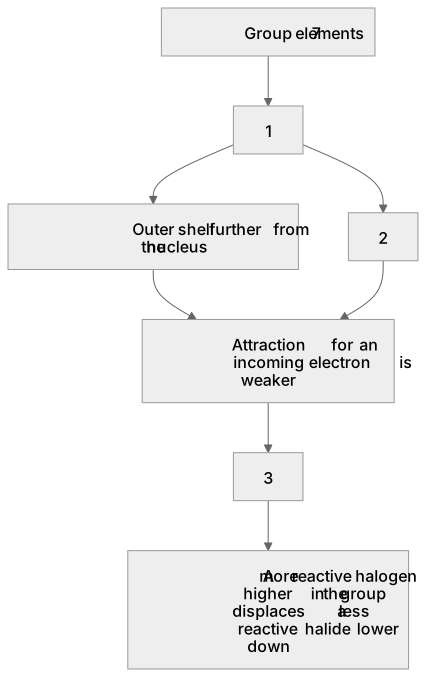
1Box 1
2Box 2
3Box 3
There is more to this lesson
The full lesson goes on to check your understanding and help you earn the marks. Create a free account to carry on, with your progress saved.
A week of Premium from your first lesson · Then the free plan continues · No card, no charge
Test your understanding of Group 7: In Group 7, the reactivity of the elements decreases going down the group.
Active recall beats re-reading. Take an instant quiz now to test what you’ve learned and lock it into long-term memory.
A week of Premium from your first lesson · Then the free plan continues · No card, no charge