AQA · GCSE · Combined Science
Course version: 8464 · Version from Sept 2018
Group 7: predict properties from given trends down the group.
Down Group 7, the halogens show clear trends in physical and chemical properties.
Checked against the AQA 8464 specification (opens in a new tab) on .
- Point 7 of 7
- 4 key terms
Study notes
From the checked teaching notes for this specification point.
The idea
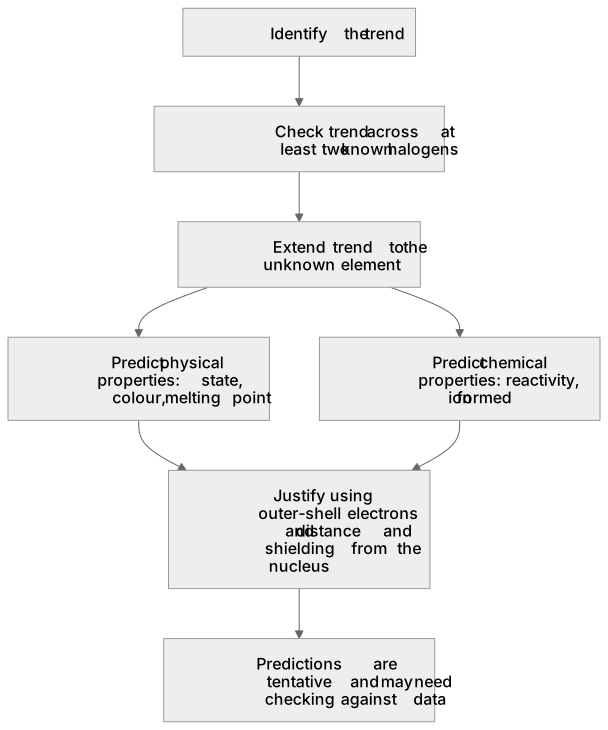
Down Group 7, the halogens show clear trends in physical and chemical properties. Fluorine and chlorine are gases, bromine is a liquid and iodine is a solid, so melting and boiling points increase down the group. The colour deepens from pale yellow through green, red-brown and grey-black. Reactivity decreases down the group because the outer shell is further from the nucleus and shielded by more inner shells, so the attraction for an incoming electron is weaker. These trends allow predictions about less familiar halogens such as astatine. Astatine should be a dark solid with a high melting point and low reactivity, and it should form a 1⁻ ion and diatomic molecules. Predictions are made by identifying the trend, checking it across at least two known elements and extending it to the unknown element.
What earns the marks
- Identify the trend being used, such as increasing melting point or decreasing reactivity down Group 7.
- Check the trend against at least two known halogens before extending it to the unknown element.
- Predict a physical property, for example that astatine is a solid with a higher melting point than iodine.
- Predict a chemical property, for example that astatine is less reactive than iodine and forms a 1⁻ ion.
- Justify the prediction using the outer-shell electron configuration and increasing distance and shielding from the nucleus.
- State that predictions from trends are tentative and may need checking against data.
Common mistakes and how to put them right
Assuming all halogens are gases.
Put it right by recalling that bromine is a liquid and iodine is a solid at room temperature.
Predicting that reactivity increases down the group.
Put it right by linking decreasing reactivity to weaker attraction for an incoming electron as the outer shell becomes further from the nucleus.
Extending a trend from only one known element.
Put it right by checking the trend across at least two known halogens before predicting.
Exam tips
- Name the trend you are using and quote data for at least two known halogens to support your prediction.
- Separate physical predictions, such as state and colour, from chemical predictions, such as reactivity and ion formed.
- Use correct notation for ions and molecules, for example I⁻ and I₂, and avoid vague words such as better or worse without explanation.
Try the lesson
The start of the Group 7: predict properties from given trends down the group. lesson, made from checked teaching notes for this specification point.
Have a go first
A student knows that chlorine is a gas and bromine is a liquid at room temperature. Using the trend down Group 7, what is the state of iodine at room temperature?
Listen
Down Group 7, the halogens show clear trends in physical and chemical properties. Fluorine and chlorine are gases, bromine is a liquid and iodine is a solid, so melting and boiling points increase down the group. The colour deepens from pale yellow through green, red-brown and grey-black. Reactivity decreases down the group because the outer shell is further from the nucleus and shielded by more inner shells, so the attraction for an incoming electron is weaker. These trends allow predictions about less familiar halogens such as astatine. Astatine should be a dark solid with a high melting point and low reactivity, and it should form a 1⁻ ion and diatomic molecules. Predictions are made by identifying the trend, checking it across at least two known elements and extending it to the unknown element. A strong answer earns marks for these points. Identify the trend being used, such as increasing melting point or decreasing reactivity down Group 7. Check the trend against at least two known halogens before extending it to the unknown element. Predict a physical property, for example that astatine is a solid with a higher melting point than iodine. Predict a chemical property, for example that astatine is less reactive than iodine and forms a 1⁻ ion. A common slip: Assuming all halogens are gases. Instead, recalling that bromine is a liquid and iodine is a solid at room temperature. Exam tip: Name the trend you are using and quote data for at least two known halogens to support your prediction.
See it
Key words
Say what each word means before you turn the card.
Patterns and trends in the periodic table
Try answering aloud or in your head before turning the card.
Physical properties of the halogens
Try answering aloud or in your head before turning the card.
Reactivity and electronic structure
Try answering aloud or in your head before turning the card.
Using data to make and justify predictions
Try answering aloud or in your head before turning the card.
See every definition
- Patterns and trends in the periodic table
- Clear trends in physical and chemical properties shown down Group 7, such as melting and boiling points increasing and colour deepening.
- Physical properties of the halogens
- Fluorine and chlorine are gases, bromine is a liquid and iodine is a solid, with melting and boiling points increasing down the group.
- Reactivity and electronic structure
- Reactivity decreases down the group because the outer shell is further from the nucleus and shielded by more inner shells, so attraction for an incoming electron is weaker.
- Using data to make and justify predictions
- Predictions are made by identifying the trend, checking it across at least two known elements and extending it to the unknown element.
Label the diagram
Some boxes have lost their names. Pick the right name for each number.
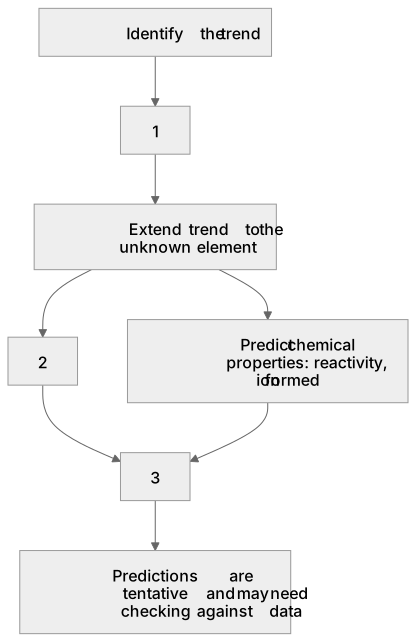
1Box 1
2Box 2
3Box 3
There is more to this lesson
The full lesson goes on to check your understanding and help you earn the marks. Create a free account to carry on, with your progress saved.
A week of Premium from your first lesson · Then the free plan continues · No card, no charge
Test your understanding of Group 7: predict properties from given trends down the group.
Active recall beats re-reading. Take an instant quiz now to test what you’ve learned and lock it into long-term memory.
A week of Premium from your first lesson · Then the free plan continues · No card, no charge