AQA · GCSE · Combined Science
Course version: 8464 · Version from Sept 2018
The elements in Group 7 of the periodic table are known as the halogens…
Full specification wording
Group 7: The elements in Group 7 of the periodic table are known as the halogens and have similar reactions because they all have seven electrons in their outer shell. The halogens are non-metals and consist of molecules made of pairs of atoms.
Group 7 elements, the halogens, sit in the second-from-right column of the periodic table.
Checked against the AQA 8464 specification (opens in a new tab) on .
- Point 1 of 7
Study notes
From the checked teaching notes for this specification point.
The idea
Group 7 elements, the halogens, sit in the second-from-right column of the periodic table. Each halogen atom has seven electrons in its outer shell, so all halogens react in similar ways: they gain one electron to complete a stable outer shell of eight. This shared outer-shell pattern explains why fluorine, chlorine, bromine, iodine and astatine behave as a family. Halogens are non-metals, so they are poor conductors and have low melting and boiling points compared with metals. Their atoms pair up covalently, forming diatomic molecules such as F₂, Cl₂, Br₂ and I₂. For example, chlorine exists as Cl₂, not as single Cl atoms, because the two atoms share a pair of electrons. The seven outer electrons and diatomic molecules together explain the similar reactions and the physical properties of the group.
What earns the marks
- Group 7 elements are called halogens and include fluorine, chlorine, bromine, iodine and astatine.
- Each halogen atom has seven electrons in its outer shell, giving the group its similar chemical reactions.
- Halogens are non-metals, so they are poor conductors of electricity and have relatively low melting and boiling points.
- Halogen atoms form diatomic molecules by sharing a pair of electrons, for example Cl₂, Br₂ and I₂.
- The tendency to gain one electron to complete an outer shell of eight explains the similar reactivity of the halogens.
Common mistakes and how to put them right
Writing halogen molecules as single atoms such as Cl or Br.
Put it right by writing the diatomic forms Cl₂, Br₂ and I₂.
Saying halogens have eight outer electrons.
Put it right by stating they have seven outer electrons and gain one electron to reach eight.
Describing halogens as metals because they react with metals.
Put it right by stating halogens are non-metals that form compounds with metals.
Exam tips
- Link the seven outer electrons directly to the similar reactions, rather than listing the two facts separately.
- Use the correct diatomic formula with a subscript, for example Cl₂, when describing a halogen molecule.
- Contrast halogen properties with metal properties, such as poor conduction and low melting points, to show understanding of non-metals.
Try the lesson
The start of the Group 7: The elements in Group 7 of the periodic table are known as the halogens and have similar reactions because they all have seven electrons in their outer shell. The halogens are non-metals and consist of molecules made of pairs of atoms. lesson, made from checked teaching notes for this specification point.
Have a go first
What name is given to the elements in Group 7 of the periodic table?
Listen
Group 7 elements, the halogens, sit in the second-from-right column of the periodic table. Each halogen atom has seven electrons in its outer shell, so all halogens react in similar ways: they gain one electron to complete a stable outer shell of eight. This shared outer-shell pattern explains why fluorine, chlorine, bromine, iodine and astatine behave as a family. Halogens are non-metals, so they are poor conductors and have low melting and boiling points compared with metals. Their atoms pair up covalently, forming diatomic molecules such as F₂, Cl₂, Br₂ and I₂. For example, chlorine exists as Cl₂, not as single Cl atoms, because the two atoms share a pair of electrons. The seven outer electrons and diatomic molecules together explain the similar reactions and the physical properties of the group. A strong answer earns marks for these points. Group 7 elements are called halogens and include fluorine, chlorine, bromine, iodine and astatine. Each halogen atom has seven electrons in its outer shell, giving the group its similar chemical reactions. Halogens are non-metals, so they are poor conductors of electricity and have relatively low melting and boiling points. Halogen atoms form diatomic molecules by sharing a pair of electrons, for example Cl₂, Br₂ and I₂. A common slip: Writing halogen molecules as single atoms such as Cl or Br. Instead, writing the diatomic forms Cl₂, Br₂ and I₂. Exam tip: Link the seven outer electrons directly to the similar reactions, rather than listing the two facts separately.
See it
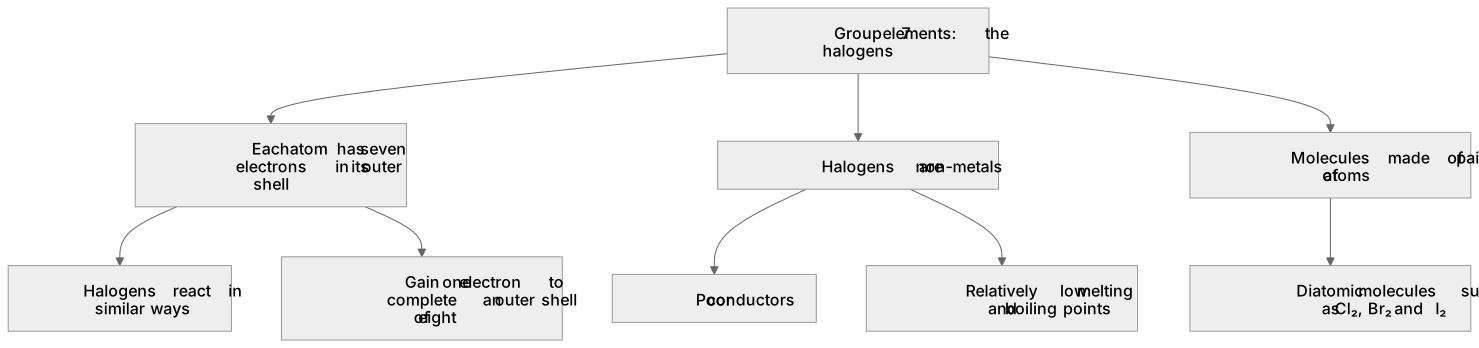
Label the diagram
Some boxes have lost their names. Pick the right name for each number.
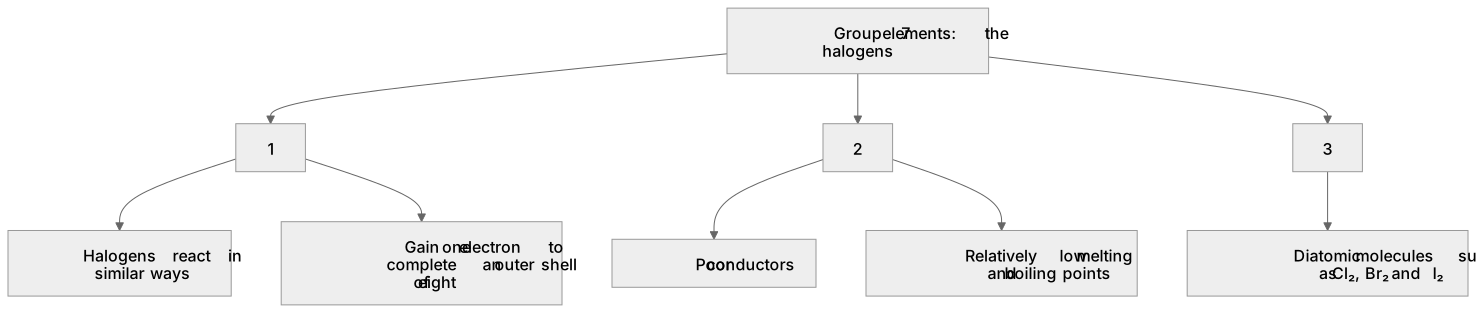
1Box 1
2Box 2
3Box 3
There is more to this lesson
The full lesson goes on to check your understanding and help you earn the marks. Create a free account to carry on, with your progress saved.
A week of Premium from your first lesson · Then the free plan continues · No card, no charge
Test your understanding of Group 7: The elements in Group 7 of the periodic table are known as the halogens and have similar reactions because they all have seven electrons in their outer shell. The halogens are non-metals and consist of molecules made of pairs of atoms.
Active recall beats re-reading. Take an instant quiz now to test what you’ve learned and lock it into long-term memory.
A week of Premium from your first lesson · Then the free plan continues · No card, no charge