AQA · GCSE · Combined Science
Course version: 8464 · Version from Sept 2018
(HT only) Students should be able to calculate the net decline, expressed…
Full specification wording
Half-lives and the random nature of radioactive decay: (HT only) Students should be able to calculate the net decline, expressed as a ratio, in a radioactive emission after a given number of half-lives.
After each half-life, the count rate or activity of a radioactive sample falls to half its previous value.
Checked against the AQA 8464 specification (opens in a new tab) on .
- Point 5 of 5
- 3 key terms
Study notes
From the checked teaching notes for this specification point.
The idea
After each half-life, the count rate or activity of a radioactive sample falls to half its previous value. After n half-lives, the remaining fraction is (1/2)ⁿ. The net decline is expressed as a ratio of the final emission to the original emission, which is 1:2ⁿ. For example, after 3 half-lives, the remaining fraction is (1/2)³ = 1/8. The ratio of final to original emission is therefore 1:8. If the starting count rate is 640 counts per minute, after 3 half-lives it is 640 ÷ 8 = 80 counts per minute. The ratio of 80 to 640 simplifies to 1:8.
What earns the marks
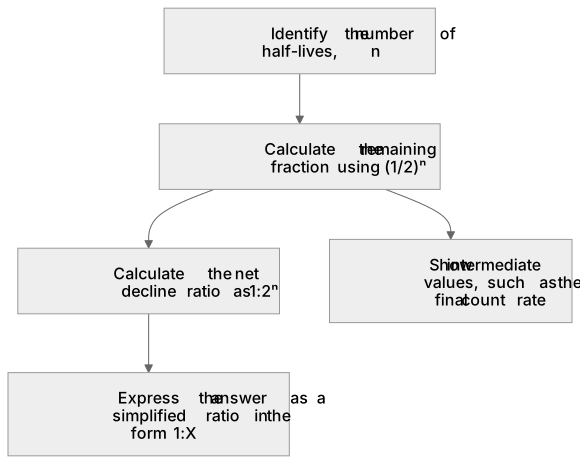
- Identify the number of half-lives, n, from the question or by dividing the total time by the half-life.
- Calculate the remaining fraction after n half-lives using (1/2)ⁿ.
- Calculate the net decline ratio as 1:2ⁿ, representing the final emission compared to the original emission.
- Express the answer as a simplified ratio in the form 1:X (e.g., 1:8 after 3 half-lives).
- Show intermediate values, such as the final count rate, to make the calculation method clear.
Common mistakes and how to put them right
Using n/2 instead of (1/2)ⁿ.
Put it right: The process is repeated halving, so use the power (1/2)ⁿ or multiply by 1/2 for each half-life.
Reversing the ratio to 2ⁿ:1 (e.g., 8:1).
Put it right: AQA mark schemes require the ratio of final to original emission, so it should be written as 1:2ⁿ (e.g., 1:8).
Forgetting to simplify the ratio.
Put it right: If calculating from raw count rates like 80:640, divide both sides by the highest common factor to give 1:8.
Exam tips
- Write down the number of half-lives first, then use powers of 2 to find the ratio quickly.
- Always present the net decline ratio in the format 1:2ⁿ unless specifically instructed otherwise.
Try the lesson
The start of the Half-lives and the random nature of radioactive decay: (HT only) Students should be able to calculate the net decline, expressed as a ratio, in a radioactive emission after a given number of half-lives. lesson, made from checked teaching notes for this specification point.
Have a go first
A radioactive source used in a laboratory has an initial count rate of 6400 counts per minute. After 4 half-lives, what is the net decline in the count rate, expressed as a ratio of the decline to the initial count rate?
Listen
After each half-life, the count rate or activity of a radioactive sample falls to half its previous value. After n half-lives, the remaining fraction is (1/2)ⁿ. The net decline is expressed as a ratio of the final emission to the original emission, which is 1:2ⁿ. For example, after 3 half-lives, the remaining fraction is (1/2)³ = 1/8. The ratio of final to original emission is therefore 1:8. If the starting count rate is 640 counts per minute, after 3 half-lives it is 640 ÷ 8 = 80 counts per minute. The ratio of 80 to 640 simplifies to 1:8. A strong answer earns marks for these points. Identify the number of half-lives, n, from the question or by dividing the total time by the half-life. Calculate the remaining fraction after n half-lives using (1/2)ⁿ. Calculate the net decline ratio as 1:2ⁿ, representing the final emission compared to the original emission. Express the answer as a simplified ratio in the form 1:X (e.g., 1:8 after 3 half-lives). A common slip: Using n/2 instead of (1/2)ⁿ. Instead, the process is repeated halving, so use the power (1/2)ⁿ or multiply by 1/2 for each half-life. Exam tip: Write down the number of half-lives first, then use powers of 2 to find the ratio quickly.
See it
Key words
Say what each word means before you turn the card.
net decline
Try answering aloud or in your head before turning the card.
half-life
Try answering aloud or in your head before turning the card.
remaining fraction
Try answering aloud or in your head before turning the card.
See every definition
- net decline
- The fall in a radioactive emission after a given number of half-lives, expressed as a ratio of the final emission to the original emission.
- half-life
- The time after which the count rate or activity of a radioactive sample falls to half its previous value.
- remaining fraction
- The amount left after n half-lives, found using (1/2)ⁿ because the process is repeated halving.
Label the diagram
Some boxes have lost their names. Pick the right name for each number.
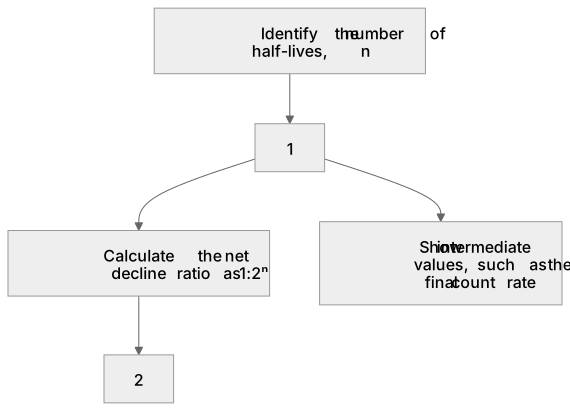
1Box 1
2Box 2
There is more to this lesson
The full lesson goes on to check your understanding and help you earn the marks. Create a free account to carry on, with your progress saved.
A week of Premium from your first lesson · Then the free plan continues · No card, no charge
Test your understanding of Half-lives and the random nature of radioactive decay: (HT only) Students should be able to calculate the net decline, expressed as a ratio, in a radioactive emission after a given number of half-lives.
Active recall beats re-reading. Take an instant quiz now to test what you’ve learned and lock it into long-term memory.
A week of Premium from your first lesson · Then the free plan continues · No card, no charge