AQA · GCSE · Combined Science
Course version: 8464 · Version from Sept 2018
Radioactive decay is random.
Full specification wording
Half-lives and the random nature of radioactive decay: Radioactive decay is random.
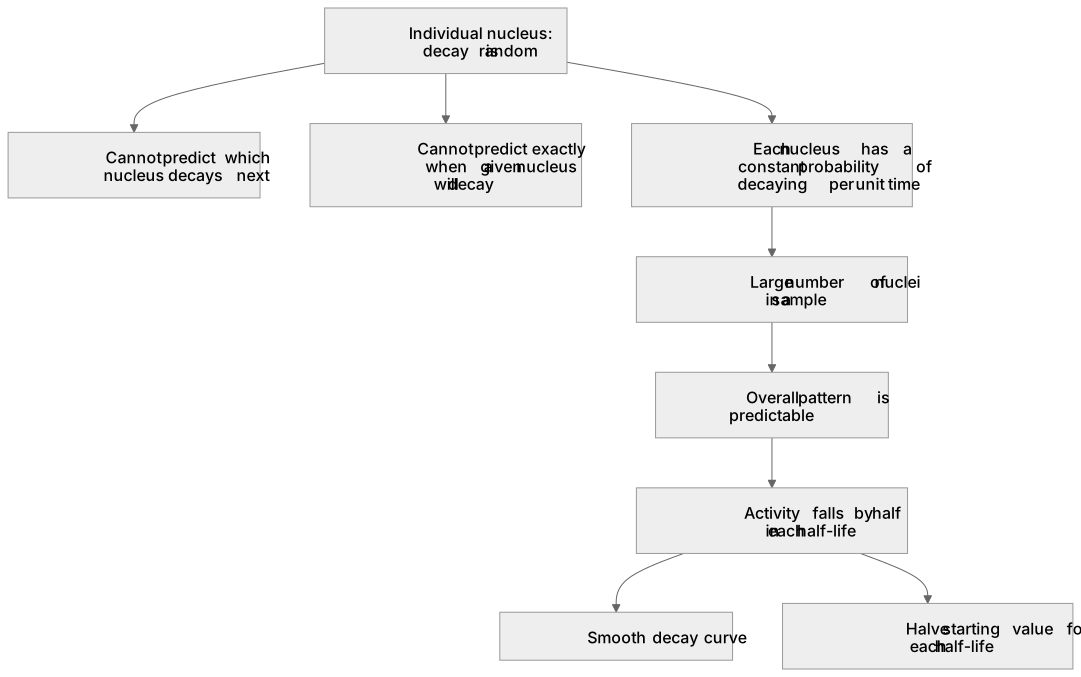
Random decay means you cannot predict when any particular unstable nucleus will decay, nor which nucleus in a sample will decay next.
Checked against the AQA 8464 specification (opens in a new tab) on .
- Point 1 of 5
- 4 key terms
Study notes
From the checked teaching notes for this specification point.
The idea
Random decay means you cannot predict when any particular unstable nucleus will decay, nor which nucleus in a sample will decay next. Each nucleus has a fixed probability of decaying in a given time, but the actual moment is a matter of chance. This is why a single count-rate reading is unreliable: the count over the next minute might be higher or lower than the last. However, because a sample contains enormous numbers of nuclei, the overall pattern is predictable. The activity falls by half in each half-life, giving a smooth decay curve.
For example: A source with a half-life of 5 days and an initial count rate of 800 counts per minute would be expected to give about 400 counts per minute after 5 days and about 200 counts per minute after 10 days, even though no one can say when an individual nucleus will decay.
What earns the marks
- Defines random decay as being unable to predict which nucleus decays next or exactly when a given nucleus will decay.
- Explains that each nucleus has a constant probability of decaying per unit time, but the timing of any individual decay is chance.
- Uses the large number of nuclei in a sample to explain why the overall activity follows a predictable half-life pattern.
- Applies half-life reasoning to calculate expected count rate or activity after one or more half-lives, for example halving 800 counts per minute to 400 then 200.
- Distinguishes random decay from a regular or clockwork process, noting that a single short count may not match the expected average.
Common mistakes and how to put them right
Saying that a nucleus 'gets old' and decays after a set time.
Put it right by stating that decay is not scheduled and the nucleus has the same chance of decaying at any moment.
Treating a single count-rate measurement as proof that half-life has changed.
Put it right by explaining that random variation makes individual readings unreliable and repeated readings or longer counts are needed.
Confusing half-life with the time for all nuclei to decay.
Put it right by stressing that half-life is the time for half the unstable nuclei to decay, or for the count rate to halve.
Exam tips
- Use the phrase 'cannot predict' when defining random decay, and add that the overall behaviour of a large sample is predictable.
- For half-life calculations, count how many half-lives have passed, then halve the starting value that many times, showing each step.
- When interpreting a graph, read the half-life from the curve by finding the time for the count rate to fall to half its initial value, not by joining points with a ruler.
Try the lesson
The start of the Half-lives and the random nature of radioactive decay: Radioactive decay is random. lesson, made from checked teaching notes for this specification point.
Have a go first
Which statement describes the random nature of radioactive decay?
Listen
Random decay means you cannot predict when any particular unstable nucleus will decay, nor which nucleus in a sample will decay next. Each nucleus has a fixed probability of decaying in a given time, but the actual moment is a matter of chance. This is why a single count-rate reading is unreliable: the count over the next minute might be higher or lower than the last. However, because a sample contains enormous numbers of nuclei, the overall pattern is predictable. The activity falls by half in each half-life, giving a smooth decay curve. For example, a source with a half-life of 5 days and an initial count rate of 800 counts per minute would be expected to give about 400 counts per minute after 5 days and about 200 counts per minute after 10 days, even though no one can say when an individual nucleus will decay. A strong answer earns marks for these points. Defines random decay as being unable to predict which nucleus decays next or exactly when a given nucleus will decay. Explains that each nucleus has a constant probability of decaying per unit time, but the timing of any individual decay is chance. Uses the large number of nuclei in a sample to explain why the overall activity follows a predictable half-life pattern. Applies half-life reasoning to calculate expected count rate or activity after one or more half-lives, for example halving 800 counts per minute to 400 then 200. A common slip: Saying that a nucleus 'gets old' and decays after a set time. Instead, stating that decay is not scheduled and the nucleus has the same chance of decaying at any moment. Exam tip: Use the phrase 'cannot predict' when defining random decay, and add that the overall behaviour of a large sample is predictable.
See it
Key words
Say what each word means before you turn the card.
Random nature of radioactive decay
Try answering aloud or in your head before turning the card.
Half-life and activity
Try answering aloud or in your head before turning the card.
Predicting count rate from half-life
Try answering aloud or in your head before turning the card.
Experimental variation and reliability of measurements
Try answering aloud or in your head before turning the card.
See every definition
- Random nature of radioactive decay
- You cannot predict when any particular unstable nucleus will decay, nor which nucleus in a sample will decay next.
- Half-life and activity
- The activity falls by half in each half-life, giving a smooth decay curve.
- Predicting count rate from half-life
- The expected count rate after one or more half-lives is found by halving the starting value that many times.
- Experimental variation and reliability of measurements
- A single count-rate reading is unreliable because the count over the next minute might be higher or lower than the last.
Label the diagram
Some boxes have lost their names. Pick the right name for each number.
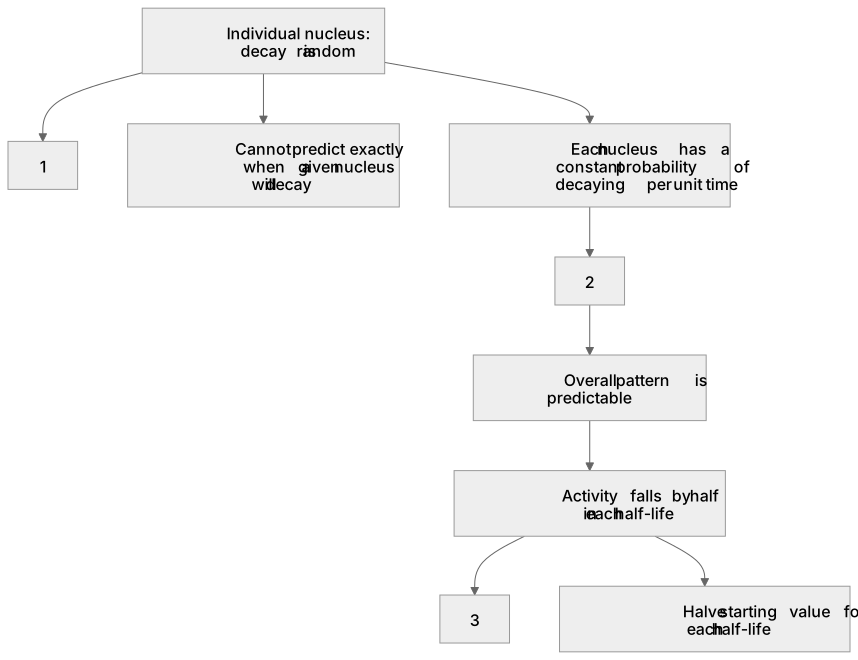
1Box 1
2Box 2
3Box 3
There is more to this lesson
The full lesson goes on to check your understanding and help you earn the marks. Create a free account to carry on, with your progress saved.
A week of Premium from your first lesson · Then the free plan continues · No card, no charge
Test your understanding of Half-lives and the random nature of radioactive decay: Radioactive decay is random.
Active recall beats re-reading. Take an instant quiz now to test what you’ve learned and lock it into long-term memory.
A week of Premium from your first lesson · Then the free plan continues · No card, no charge