AQA · GCSE · Combined Science
Course version: 8464 · Version from Sept 2018
Students should be able to explain the concept of half-life and how it is…
Full specification wording
Half-lives and the random nature of radioactive decay: Students should be able to explain the concept of half-life and how it is related to the random nature of radioactive decay.
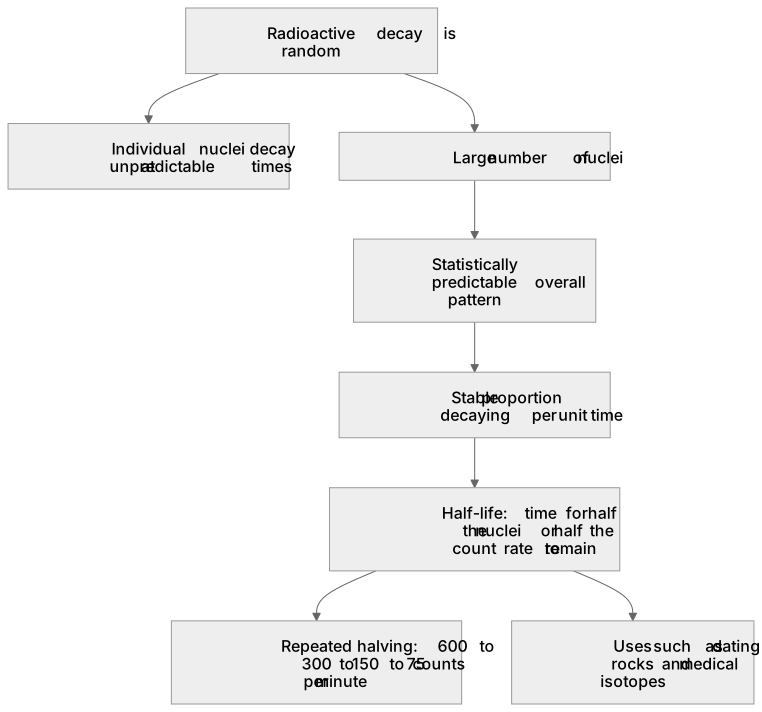
Radioactive decay is random: you cannot predict which nucleus decays next or exactly when.
Checked against the AQA 8464 specification (opens in a new tab) on .
- Point 3 of 5
- 4 key terms
Study notes
From the checked teaching notes for this specification point.
The idea
Radioactive decay is random: you cannot predict which nucleus decays next or exactly when. Yet a large sample shows a steady pattern because many nuclei are present, so the proportion decaying per unit time is stable. Half-life is the time for half the nuclei, or half the count rate, to remain. For example, a source of 600 counts per minute falls to about 300, then 150, then 75 over equal half-lives. Individual decays are chance events, but the overall halving is predictable. This lets scientists date rocks and trace medical isotopes.
What earns the marks
- Explain that radioactive decay is random, so individual nuclei decay at unpredictable times.
- Explain that a large number of nuclei gives a statistically predictable overall pattern.
- Link the predictable pattern to half-life as the time for half the nuclei or half the count rate to remain.
- Use a numerical example, such as 600 → 300 → 150 → 75 counts per minute, to show repeated halving.
- Distinguish between the random behaviour of one nucleus and the reliable average behaviour of a large sample.
- Apply the concept to a context such as carbon dating or medical tracers, choosing an isotope with a suitable half-life.
Common mistakes and how to put them right
Saying that half-life makes each nucleus decay at a fixed time.
Put it right by stating that individual decay times remain random.
Confusing half-life with the time for the count rate to reach zero.
Put it right by showing the halving sequence continues without reaching zero.
Believing that a small sample will halve exactly on schedule.
Put it right by explaining that statistical predictability needs a large number of nuclei.
Exam tips
- Use the phrase random decay and then explain how many nuclei produce a predictable average.
- Support your explanation with a short halving sequence and clear units.
- When asked to explain, link each statement to the next: random decay, large numbers, stable proportion, half-life.
Try the lesson
The start of the Half-lives and the random nature of radioactive decay: Students should be able to explain the concept of half-life and how it is related to the random nature of radioactive decay. lesson, made from checked teaching notes for this specification point.
Have a go first
A radioactive source has a half-life of 8 days. What is meant by the half-life of this source?
Listen
Radioactive decay is random: you cannot predict which nucleus decays next or exactly when. Yet a large sample shows a steady pattern because many nuclei are present, so the proportion decaying per unit time is stable. Half-life is the time for half the nuclei, or half the count rate, to remain. For example, a source of 600 counts per minute falls to about 300, then 150, then 75 over equal half-lives. Individual decays are chance events, but the overall halving is predictable. This lets scientists date rocks and trace medical isotopes. A strong answer earns marks for these points. Explain that radioactive decay is random, so individual nuclei decay at unpredictable times. Explain that a large number of nuclei gives a statistically predictable overall pattern. Link the predictable pattern to half-life as the time for half the nuclei or half the count rate to remain. Use a numerical example, such as 600 → 300 → 150 → 75 counts per minute, to show repeated halving. A common slip: Saying that half-life makes each nucleus decay at a fixed time. Instead, stating that individual decay times remain random. Exam tip: Use the phrase random decay and then explain how many nuclei produce a predictable average.
See it
Key words
Say what each word means before you turn the card.
Randomness of individual decay events
Try answering aloud or in your head before turning the card.
Statistical predictability of large samples
Try answering aloud or in your head before turning the card.
Half-life as a measurable constant
Try answering aloud or in your head before turning the card.
Practical applications of half-life
Try answering aloud or in your head before turning the card.
See every definition
- Randomness of individual decay events
- You cannot predict which nucleus decays next or exactly when, so individual decays are chance events.
- Statistical predictability of large samples
- A large sample shows a steady pattern because many nuclei are present, so the proportion decaying per unit time is stable.
- Half-life as a measurable constant
- The time for half the nuclei, or half the count rate, to remain.
- Practical applications of half-life
- This lets scientists date rocks and trace medical isotopes.
Label the diagram
Some boxes have lost their names. Pick the right name for each number.
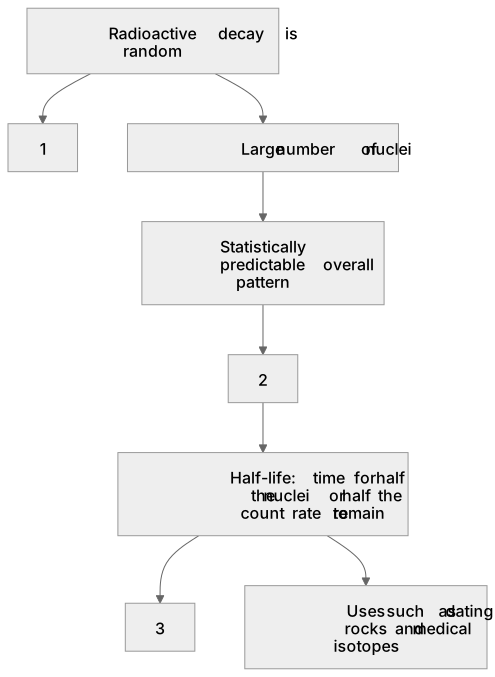
1Box 1
2Box 2
3Box 3
There is more to this lesson
The full lesson goes on to check your understanding and help you earn the marks. Create a free account to carry on, with your progress saved.
A week of Premium from your first lesson · Then the free plan continues · No card, no charge
Test your understanding of Half-lives and the random nature of radioactive decay: Students should be able to explain the concept of half-life and how it is related to the random nature of radioactive decay.
Active recall beats re-reading. Take an instant quiz now to test what you’ve learned and lock it into long-term memory.
A week of Premium from your first lesson · Then the free plan continues · No card, no charge